




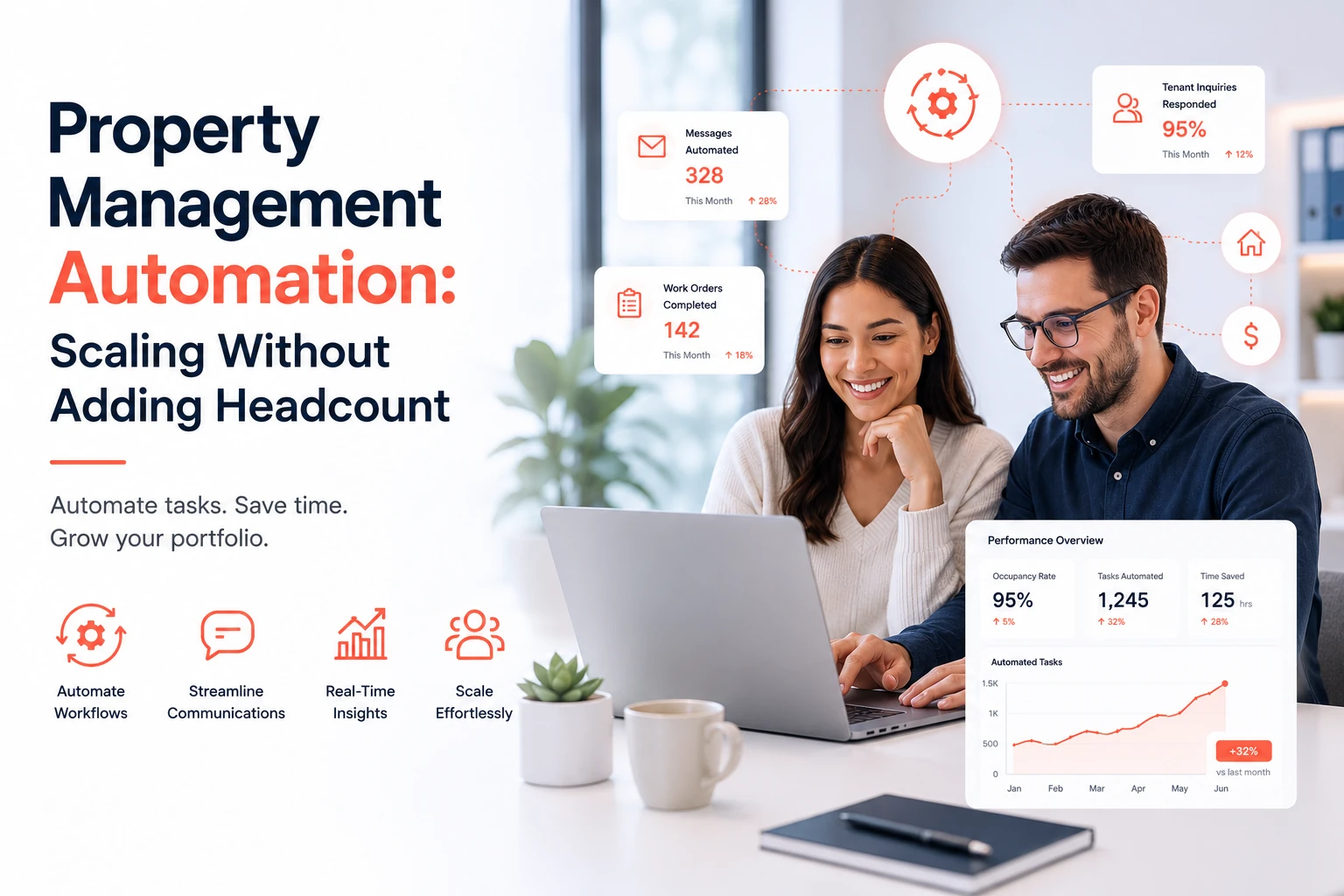
Property management automation uses software to handle recurring administrative work, such as rent collection, late fees, maintenance routing, and reporting, without adding headcount. For growing portfolios, it determines how many additional units an existing team can support before another hire becomes necessary, directly shaping labor costs and growth capacity.
Property management platforms are often evaluated on their specific features. Managers may think that an impressive list of features like online payments, maintenance management, accounting, resident communications, and reporting are what matter when choosing a platform... And they do matter, to an extent. But what makes them matter? It's not the tools themselves, but rather their impact, specifically the time and money they save. To executives approving the investment, the software's many features eventually have to translate into a meaningful number (KPIs).
Ask yourself: How many staff hours can be recovered? What does that labor cost today? How many additional units could the existing team support before another hire becomes necessary?
Those questions form the business case for property management automation. Of all the features available, automation is often one of the most important factors.
As portfolios grow, recurring administrative work grows with them. Measuring that workload in hours and dollars gives leadership a practical way to determine whether automation can lead to real growth.
Why Portfolio Growth Creates a Headcount Problem
A company managing 1,000 units has more transactions, maintenance requests, resident communications, financial records, and reporting requirements than a company managing 500 units. Many overhead costs can remain relatively stable as the business grows, while administrative workload increases with the portfolio.
Consider rent collection. Each month, charges have to be posted, payments processed, outstanding balances identified, residents contacted, late fees applied, and accounts reconciled.
The same pattern appears throughout property management operations. Maintenance requests need to be reviewed and routed. Vendors need information. Residents need updates. Association assessments and utility charges need to be billed. Owners and boards expect accurate reports. Financial transactions need to be reconciled. Vendors and owners need tax documents at year end.
Lease administration can create another layer of recurring work through preparation, renewals, and recordkeeping. For rental portfolios, lease automation software can reduce the staff time required for standardized lease workflows as unit counts increase.
As this workload grows, companies eventually need additional employees to handle the volume.
Every expansion plan therefore has an underlying labor requirement. A company may expect substantial revenue from adding 500 units, but leadership also needs to understand how many additional staff members will be required to manage them.
Property management workflow automation can change that calculation by reducing the amount of manual work associated with each additional unit.
Where Administrative Work Accumulates
An internal ROI analysis should begin with the recurring workflows that consume staff time across the portfolio.
Rent and Dues Collection
Rent and association dues create work throughout the payment cycle. Staff may issue charges, send reminders, process payments, follow up on overdue balances, update account records, and reconcile collections.
When payment processing, billing, and accounting are connected, many routine steps can occur automatically. Employees can direct their time toward delinquent accounts and other exceptions that require individual attention.
Across hundreds or thousands of units, reducing a few minutes of work per account can recover substantial staff capacity over the course of a year.
Late Fee Calculation and Application
Late fees are a relatively small task that becomes expensive through repetition.
Employees may need to identify overdue accounts, calculate charges according to established rules, apply fees, update balances, and notify residents.
Automating established late-fee rules reduces the number of accounts employees need to process manually each month and helps apply those rules consistently across the portfolio.
Recurring Billing
Recurring rent, association assessments, utility charges, and other predictable expenses create a regular administrative workload.
A large portfolio can generate hundreds or thousands of recurring charges every month. Creating and processing those charges manually uses staff capacity that grows along with the number of accounts being managed.
An automated rental management system can process recurring billing according to predefined schedules and rules, leaving employees to address changes, exceptions, and account-specific issues.
Maintenance Request Routing and Vendor Coordination
Maintenance requires considerable coordination before work begins.
A request needs to be received, categorized, assigned to the appropriate employee or vendor, tracked, and eventually closed. Residents may also need updates throughout the process.
Automation can handle portions of that workflow, including request intake, routing, notifications, and recordkeeping. This reduces the administrative time associated with each request and preserves staff capacity for maintenance issues that require direct intervention.
Owner, Board, and Resident Communications
Property management companies generate a large volume of routine communications.
Payment statements, invoices, meeting notices, election materials, compliance notices, welcome letters, maintenance updates, and general announcements all need to reach the appropriate recipients.
At scale, preparing, distributing, and tracking these communications individually can consume significant administrative time. Centralized communication workflows can reduce the repeated work required to manage these communications across a large portfolio.
Trust Accounting Reconciliation
Trust accounting carries operational and compliance risk in addition to its labor requirements. Transactions must be recorded accurately, and funds need to remain properly accounted for. As the number of properties, owners, associations, accounts, and transactions increases, reconciliation becomes more complex. For a deeper look at association accounting requirements, read our complete guide to HOA accounting and financial management.
Manual processes create more opportunities for errors and additional work when discrepancies need to be investigated. Accounting automation can reduce repetitive data entry and support consistent reconciliation processes.
For executives calculating ROI, trust accounting should be evaluated in terms of both staff capacity and the potential financial and compliance costs associated with errors.
Year-End 1099 Generation
Tax reporting can create a concentrated administrative workload at the end of the year.
When vendor, owner, and payment information is maintained consistently throughout the year, 1099 preparation becomes easier. Information spread across spreadsheets or disconnected systems can require staff to spend significant time gathering, verifying, and correcting records before filing.
Maintaining financial records within integrated workflows throughout the year can reduce the manual preparation required during reporting periods. Our complete rental property accounting guide covers the broader accounting structure behind income, expenses, recordkeeping, and tax reporting.
Turning Staff Hours Into an ROI Calculation
The financial model for automation can start with a simple calculation.
First, measure how many hours employees spend on a recurring workflow each month. Then calculate the fully loaded cost of those hours.
Suppose payment collection, billing, follow-up, and reconciliation require 120 staff hours each month. If the average fully loaded labor cost for the employees performing that work is $40 per hour, the annual labor cost is:
120 hours × $40 × 12 months = $57,600 per year
Next, estimate how many of those hours could reasonably be recovered through automation.
If automated workflows reduce the workload by 40 hours per month:
40 hours × $40 × 12 months = $19,200 in annual labor capacity recovered
For a growing company, that capacity can support additional properties before another employee needs to be added. If the existing team can manage another 200 units with those recovered hours, the financial value of automation extends into future staffing requirements.
The same calculation can be repeated across major workflows:
Monthly hours recovered × fully loaded hourly labor cost × 12 = annual labor capacity recovered
Leadership can then compare the annual value of recovered capacity with the annual cost of the property management automation software.
For companies planning significant portfolio growth, hires deferred can provide another useful measure of ROI. Consider a company managing 1,000 units that expects to reach 1,500 units over the next two years. Leadership can estimate how much additional work those 500 units will create and determine which positions would be required to support that workload under current processes.
The cost of a new employee extends beyond salary. Payroll taxes, benefits, recruiting, onboarding, equipment, training, and management time all contribute to the fully loaded cost of expanding the team.
If automated billing, payment processing, maintenance routing, communications, reconciliation, and reporting allow the existing team to support more units, the next hire can occur later in the growth cycle. The value of that additional capacity can then be included in the ROI calculation.
Technology Evaluation Centers reports 25% to 30% time savings and a 10% to 15% revenue lift within the first year for customers in its evaluation.
Actual results depend on portfolio size, staffing structure, current processes, and the workflows being automated. A calculation based on the company's own labor data provides the strongest basis for an investment decision.
Questions to Build the Internal Business Case
Before presenting an automation investment to ownership or a board, leadership should establish a baseline using current operating data. The following questions can help structure the analysis:
- How many staff hours per month go into rent and dues collection, billing, reconciliation, maintenance coordination, communications, and financial reporting?
- What does that time cost at fully loaded employee rates?
- How will planned portfolio growth affect workload over the next 12 to 24 months?
- How many additional hires would be required to support that growth under current processes?
- Which recurring workflows can be automated, and how many hours could realistically be recovered?
- What financial or compliance exposure exists around trust accounting errors, reconciliation issues, or late tax reporting?
- What would first-year ROI look like based on labor capacity recovered, hires deferred, and measurable revenue impact?
The resulting analysis gives leadership a financial baseline for evaluating different systems. Features can then be assessed according to the workflows they automate and the measurable operating costs they address.
Where ManageCasa Fits
ManageCasa brings the recurring workflows discussed above into a single rental management platform, including rent and dues collection, recurring billing, late fees, maintenance management, communications, accounting, reconciliation, reporting, and tax-related financial records.
For larger portfolios, pricing also makes the technology cost straightforward to include in an ROI model. At 500+ units with annual billing, ManageCasa lists Base at $0.50 per unit ($275 monthly minimum), Growth at $0.55 per unit ($325 monthly minimum), and Premium at $0.80 per unit ($400 monthly minimum). Flexible pricing is available for portfolios of 1,000 or more units.
Leadership can compare that cost with current labor requirements, expected portfolio growth, and the value of staff capacity that automation could recover.
Related Guides
Rental Property Management: The Complete Guide (2026)
Discover how to grow effectively. This guide covers the full rental management lifecycle, including leasing, rent collection, maintenance, financial management, and compliance.
Best Rental Property Accounting Software for 2026
Compare rental property accounting platforms and the financial workflows available for managing growing portfolios.
Rental Property Maintenance: Tips, Costs and Checklists for Landlords
Learn how to handle maintenance requests while scaling, from working with vendors to triaging maintenance requests.
Know the guideposts for growth as you scale in this guide.
Calculate the Capacity of Your Current Team
Measuring current staff hours, labor costs, and future hiring requirements can show where automation has the greatest financial impact. It also provides a clear benchmark for evaluating the cost of a new system.
See how much operating capacity your portfolio could recover with property management automation. Book a free ManageCasa demo.
Frequently Asked Questions
How much time can property management automation realistically save?
Time savings depend on portfolio size, existing processes, and the workflows being automated. Technology Evaluation Centers reports time savings of 25% to 30% for customers in its evaluation. Companies can develop a more relevant estimate by measuring the hours currently spent on recurring tasks and identifying which steps can be automated.
How quickly does property management automation typically pay for itself?
Payback depends on software costs, implementation requirements, labor costs, and the amount of staff capacity recovered. An organization can estimate its own payback period by comparing annual technology costs with recovered labor capacity, deferred hiring costs, and other measurable financial gains.
What tasks provide the biggest labor-cost reduction from automation?
High-volume recurring tasks usually provide the clearest opportunities. These include payment collection, recurring billing, late fee processing, reconciliation, maintenance routing, routine communications, accounting workflows, and year-end tax reporting. The largest savings depend on which processes currently consume the most staff time across the portfolio.
Does property management automation work for both rental and HOA portfolios?
Yes. The same recurring workflows, billing, collections, maintenance routing, communications, and reconciliation, exist in both rental and HOA operations. Association assessments and homeowner billing follow the same automation logic as rent collection, and the labor-recovery calculation applies the same way to both portfolio types.
Does automation replace property management staff?
No. Automation reduces the manual, repetitive share of the workload so existing staff can support more units without a proportional increase in headcount. Staff time shifts toward exceptions, resident relationships, and decisions that require judgment, while the recurring, rule-based work runs in the background.