




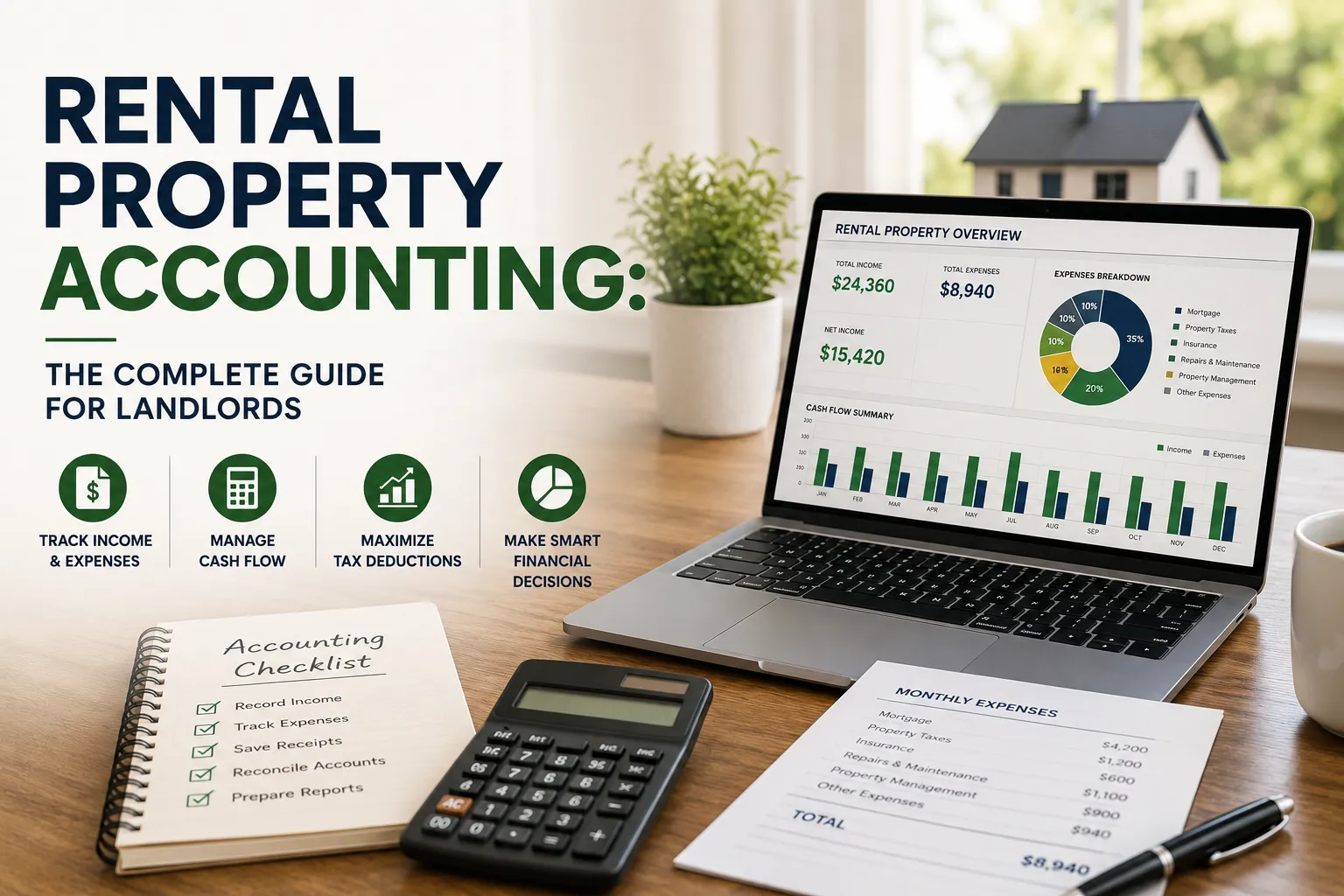
Rental property accounting is the process of tracking rental income, deductible expenses, and depreciation for tax and financial reporting. It includes choosing a cash or accrual method, maintaining a chart of accounts, and reporting results to the IRS on Schedule E using rules set out in IRS Publication 527.
Most landlords do not start out thinking of themselves as bookkeepers. Then the first tax season arrives, and suddenly you are staring at a shoebox of receipts trying to figure out what counts as a deductible expense and what has to be depreciated over the next 27 years. Good rental accounting is not complicated once you understand the handful of rules that actually matter, and it saves real money at tax time.
This guide covers what rental property accounting includes, how to choose between cash and accrual methods, what the IRS actually requires under Publication 527, and how to build a simple system that keeps you organized year round instead of scrambling every April. It is part of our broader rental property management guide, which covers screening, leasing, rent collection, and maintenance alongside the financial side covered here.
What Rental Property Accounting Includes
At its core, rental property accounting means tracking three things for each property you own: income, expenses, and depreciation. Everything else, whether it is a spreadsheet or dedicated software, exists to make those three things easier to track and report accurately.
• Income: rent payments, late fees, application fees, and any other payment connected to the property. Advance rent counts as income in the year you receive it, even if it covers a future month.
• Expenses: mortgage interest, property taxes, insurance, repairs, management fees, advertising, utilities you pay, and legal or professional fees.
• Depreciation: the annual, non-cash deduction that recovers the cost of the building itself (not the land) over its useful life.
A basic chart of accounts for a rental property groups these into income accounts and expense categories that match what Schedule E asks for, which makes tax season considerably less painful. Keeping separate records per property, rather than one combined pool, also makes it much easier to spot which units are actually profitable.
Cash vs. Accrual Accounting for Landlords
Most individual landlords use cash basis accounting, which means you record income when you actually receive it and expenses when you actually pay them. It is simpler, it matches how most people naturally think about money, and it is what the IRS expects on Schedule E for the vast majority of small residential landlords.
Accrual accounting records income when it is earned and expenses when they are incurred, regardless of when cash changes hands. This method is more common for larger operations or property management companies tracking multiple owners, since it gives a clearer picture of what is actually owed versus what has been collected. If you are a landlord with a handful of properties, cash basis is almost always the right starting point unless your accountant advises otherwise.
IRS Publication 527: Reporting Rental Income and Expenses

IRS Publication 527, Residential Rental Property, is the government's own guide to how rental income and expenses get reported, and it is worth reading directly rather than relying on secondhand summaries. It covers what counts as income, what you can deduct, how depreciation works, and the special rules for vacation homes and mixed-use properties.
Reporting on Schedule E
Rental income and expenses are reported on Schedule E (Form 1040), Supplemental Income and Loss. You list each property separately, report gross rents received, then subtract deductible expenses line by line: advertising, cleaning and maintenance, insurance, management fees, mortgage interest, repairs, taxes, utilities, and depreciation. The result is your net rental income or loss for that property.

Repairs vs. improvements
This distinction trips up more landlords than almost anything else in Publication 527. A repair keeps the property in its current condition, like fixing a leaky faucet or patching drywall, and is deductible immediately in the year you pay for it. An improvement adds value or extends the property's life, like a new roof or a full HVAC replacement, and has to be depreciated over time rather than deducted all at once.
Depreciation over 27.5 years
Residential rental buildings are depreciated using the straight-line method over a 27.5-year recovery period under the Modified Accelerated Cost Recovery System, using a mid-month convention. You cannot depreciate the land the building sits on, only the structure itself and qualifying improvements. To calculate your depreciable basis, you separate the purchase price between land and building, typically based on relative fair market value at purchase, then divide the building's basis by 27.5 to get your standard annual deduction.
The $25,000 Passive Loss Allowance
Rental real estate is generally treated as a passive activity by the IRS, which normally means losses can only offset other passive income, not your wages or salary. There is an important exception for smaller landlords: if you actively participate in managing the property and own at least 10 percent of it, you may be able to deduct up to $25,000 in rental losses against your non-passive income each year.
This allowance is income-sensitive. It is available in full if your modified adjusted gross income is $100,000 or less. Between $100,000 and $150,000, it phases out by 50 cents for every dollar of MAGI above the $100,000 threshold. Once MAGI reaches $150,000, the allowance is eliminated entirely, though real estate professionals who materially participate in their rental activities are not subject to this limit.
Figures reflect the standard IRS phase-out formula under Publication 925. Married individuals filing separately are subject to lower thresholds.
Losses that exceed your allowable deduction in a given year are not lost. They become suspended losses that carry forward to future tax years, or they can offset gain when you eventually sell the property.
Accounting Software for Landlords
Spreadsheets work fine for one or two properties, but most landlords with a growing portfolio move to dedicated accounting software once manual tracking becomes a time drain. QuickBooks is the most commonly searched option, with Xero, Wave, and property-specific platforms like Stessa also in common use. The right choice depends on your portfolio size, whether you need multi-property reporting, and whether you want accounting built into the same system you use for leasing and maintenance. Our comparison of rental property accounting software walks through the leading options side by side if you are ready to choose one.
Whatever system you pick, the goal is the same: a clean, per-property record of income and expenses that maps to Schedule E categories, so tax time becomes a matter of exporting a report rather than reconstructing a year of transactions from memory.
If you manage both rental units and a homeowners association, the underlying principles here carry over, though HOA accounting follows its own fund structure and reporting rules. Our HOA accounting guide covers that side in full if you handle mixed portfolios.
Monthly and Quarterly Bookkeeping Checklist
Consistent habits matter more than a sophisticated system. A landlord who reconciles monthly with a simple spreadsheet will have cleaner books than one who lets a powerful piece of software sit untouched for six months.
Monthly
• Record all rent payments received, including partial payments and late fees
• Log every expense with a receipt or invoice attached, categorized to match your chart of accounts
• Reconcile your bank or property account against your records
Quarterly
• Review income and expenses per property to catch anything miscategorized
• Set aside estimated tax payments if your rental income is significant enough to require them
• Check that mortgage interest and property tax figures match your lender and county statements
Annually
• Calculate depreciation for the year, including any new improvements placed in service
• Pull a full Schedule E-ready report for your tax preparer
• Review whether your MAGI puts you near the $100,000 or $150,000 passive loss thresholds, since timing income or expenses can sometimes help
Common Rental Accounting Mistakes to Avoid
• Mixing personal and rental funds in the same bank account, which makes clean bookkeeping nearly impossible and raises red flags in an audit
• Treating a capital improvement as an immediately deductible repair, which can trigger a correction and penalties if caught later
• Forgetting to track and deduct depreciation at all, which does not exempt you from depreciation recapture tax when you eventually sell
• Not keeping receipts and mileage logs contemporaneously, since reconstructing a year of records from memory rarely holds up under scrutiny
• Assuming the $25,000 passive loss allowance applies without checking MAGI, then being surprised by a larger tax bill than expected
Deductible Expenses vs. Capital Improvements at a Glance
Staying Organized Year Round
Good rental accounting is a habit, not a scramble every April. ManageCasa's Rental Management Software keeps income, expenses, and maintenance records organized per property year round, so tax season is a matter of pulling a report instead of rebuilding one. See plans and pricing, or visit ManageCasa to see how it fits your portfolio.
Related Guides
• Rental Property Management: The Complete Guide
• Best Rental Property Accounting Software for Landlords
• Accounting for Homeowners Associations: The Complete Guide
• 22 Tips for First-Time Rental Property Owners
Frequently Asked Questions
Do I need an accountant for rental property, or can I do the bookkeeping myself?
Many landlords with a small number of properties handle bookkeeping themselves using spreadsheets or software, then bring a CPA in only for the tax return itself. As your portfolio grows, or if depreciation and passive loss rules feel unclear, a professional becomes worth the cost.
What is IRS Publication 527 and do I actually need to read it?
IRS Publication 527 is the official government guide to reporting rental income and expenses, including depreciation and passive activity rules. You do not need to read all 50-plus pages, but the sections on repairs versus improvements and depreciation are worth reviewing directly rather than relying only on secondhand summaries.
Can I use cash basis accounting for my rental property?
Yes. Most individual landlords use cash basis accounting, recording income when received and expenses when paid. It is simpler than accrual accounting and is accepted by the IRS for the large majority of small residential landlords.
How much can I deduct in rental losses if my income is too high?
If your modified adjusted gross income exceeds $150,000, the $25,000 special passive loss allowance is fully phased out and rental losses generally cannot offset your other income unless you qualify as a real estate professional. Unused losses are not lost, they carry forward to future tax years.
What accounting software do most landlords use?
QuickBooks is the most commonly used general accounting software among landlords, with Xero, Wave, and property-specific platforms like Stessa also popular. The best choice depends on portfolio size and whether you want accounting integrated with leasing and maintenance tools.

Content Writer
Patrick Bohan is a content strategist focused on property management technology, HOA operations, and real estate. A Cornell graduate, he began his career at UBS covering housing markets, homeownership policy, and financial regulation — experience that now informs his research-driven approach to proptech content. Today he bridges the gap between software teams and the practitioners who use them, producing practical resources on community associations, rental operations, and accounting workflows for property managers.