




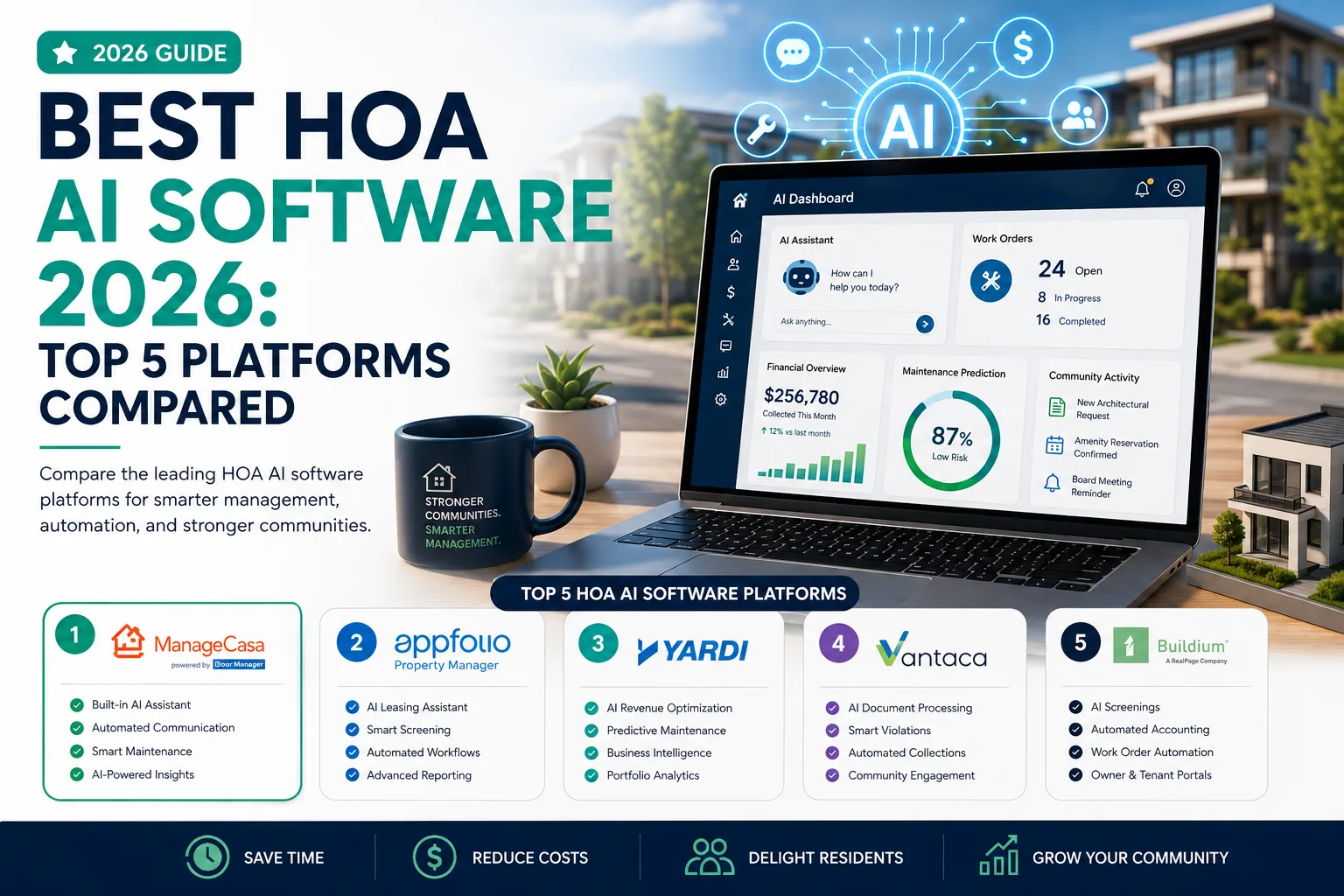
HOA AI software applies artificial intelligence to routine community association tasks: drafting homeowner messages, coding invoices, generating violation notices, and summarizing board reports. Capability varies widely by platform, from simple AI-assisted drafting tools to fully autonomous "agentic" systems that complete multi-step workflows without a person approving each step. Pricing and plan access differ just as much.
Every HOA and community association platform now claims some form of AI. The claims range from a chatbot bolted onto a support widget to systems that read an invoice, match it to the right vendor and general ledger code, and route it for approval with no one touching it in between. That gap matters more than any feature list, because it determines whether AI actually removes work from your board or management team, or just adds another tool to check.
This guide compares five platforms serving the HOA and broader community association space, what their AI actually does, which plan tier includes it, and what it costs where pricing is public. AI is now a standard evaluation criterion alongside the core property management features boards and managers already expect, so treat the plan and pricing details here as a starting point and confirm current terms directly with each vendor before you commit.
What "AI" Actually Means in HOA Software Right Now
Not all AI is the same kind of AI, and the difference shows up fast once you start using it day to day. It helps to sort what you see into three rough tiers before comparing platforms.
- Assisted AI: drafts a message, summarizes a document, or answers a question, then waits for a person to review and send it. Most "AI copilot" features fall here.
- Automated AI: runs a fixed rule or workflow once triggered, such as auto-generating a violation letter from a template after an inspection is logged.
- Agentic AI: reasons through a multi-step task end to end and takes action, such as reading an invoice, matching it to a vendor and budget line, and routing it for approval, without a person initiating each step.
Vendors market all three under the same word, so when you're comparing platforms, ask what specifically the AI does without you clicking through each step. That question separates real time savings from a feature that looks good in a demo. For a broader look at how AI is reshaping the industry beyond just HOAs, see what AI in property management actually does.
The 5 Platforms Reviewed
Below are five platforms with HOA or community association customers, what their AI product is called, what it actually does, and where it sits in the plan lineup.
ManageCasa: Minii AI
ManageCasa's AI product, Minii AI, is built into the platform's accounting, communication, and reporting workflows and is included on every plan, including the entry-level Base plan. It handles tasks like summarizing board reports, drafting resident communications, and surfacing financial or operational patterns a manager might otherwise dig for manually.
Minii AI is built directly into the ManageCasa platform itself, rather than being layered on top through a third-party AI integration. That's a real architectural difference, not just marketing language: it means AI actions happen inside the same system managers already use for accounting and communication, without exporting data to a separate tool or stitching together a third-party assistant.
The distinguishing point is access, not just capability. Where several competitors gate their fuller AI feature set to a top plan tier, Minii AI's core capability is available from the first paid plan at $45 per month, with a fuller feature set on the Growth and Premium tiers. For a self-managed board or a small management company evaluating whether AI is worth paying for at all, that lowers the bar to actually trying it.
ManageCasa also has no minimum unit requirement, so Minii AI scales to larger individual communities and portfolios, not just small associations. That's a different claim than enterprise readiness for a management company running hundreds of communities at once, where more heavily automated, agentic platforms built for that scale are the better fit; ManageCasa's own comparison content acknowledges as much.
Vantaca: HOAi
Vantaca's AI product, HOAi, is built for professional management companies running large community association portfolios, and it operates further along the agentic end of the spectrum than most competitors in this space. Vantaca describes HOAi as executing complete workflows, invoice approvals, budget creation, and violation processes, without requiring manual input at each step, rather than just recommending an action for a person to approve.
Vantaca doesn't publish flat pricing. Access is quote-based and scoped to the size of the management company's portfolio, which reflects who the platform is built for: operators with a procurement process, not an individual volunteer board evaluating software on its own. For a closer, feature-by-feature look at the two platforms, see the full ManageCasa vs. Vantaca comparison.
AppFolio: Realm-X Assistant
AppFolio's AI, Realm-X, is a conversational assistant that lets a manager ask questions about their portfolio, generate reports, and draft or send bulk communications to residents and vendors from a single interface. Realm-X Assistant and Realm-X Messages are available to all AppFolio customers. Realm-X Flows, the automated multi-step workflow layer, is limited to the Plus and Max plan tiers.
AppFolio serves both rental and community association portfolios, so its AI tooling is built more broadly across property types than platforms built specifically for HOAs. That breadth is a strength for a management company running mixed portfolios and a weaker fit for a board managing a single association. See the full ManageCasa vs. AppFolio comparison for a detailed breakdown of pricing and features side by side.
Buildium: Lumina AI
Buildium's AI suite, Lumina AI, covers five specialized areas: maintenance, leasing, accounting, resident experience, and general business operations. It handles tasks like scanning and coding bills, drafting resident communications, and summarizing message threads. As of mid-2026, the full Lumina AI feature set requires Buildium's Premium plan.
Buildium's broader platform was built for residential property managers and later expanded into community association management, so its AI tooling reflects that rental-first history rather than being purpose-built for HOA-specific workflows like architectural review or covenant enforcement.
HOALife: AI Features
HOALife is narrower by design: it's focused on inspections and CC&R violation enforcement rather than full-spectrum HOA management. Its AI features reflect that focus. HOALife's AI parses a community's governing documents to build out violation types automatically and suggests notice language aligned with those rules, and it answers homeowner questions inside the resident portal by drawing directly from the association's governing documents, using integrations with OpenAI and Gemini.
HOALife starts at $49 per month on its All In plan. For a board or management company whose main pain point is violation tracking specifically, rather than accounting or communication broadly, it's worth evaluating as a focused tool rather than a full platform replacement.
Side-by-Side Comparison
Verified starting prices and AI plan access as of August 2026. Confirm current terms directly with each vendor before purchasing, since pricing and plan structure change.
How to Choose Between Them
The right platform depends more on who you are than which vendor has the flashiest AI demo.
- Self-managed board or small association: prioritize AI that's included at the entry plan tier, not gated behind a premium upgrade you may never use.
- Small to mid-size management company: prioritize AI that covers your actual bottleneck (accounting, violations, communication) rather than the broadest feature list.
- Large management company running dozens or hundreds of communities: agentic, workflow-level AI like Vantaca's HOAi becomes worth its enterprise pricing once the labor it removes outweighs the cost of custom onboarding.
- Violation and inspection-heavy portfolios: a focused tool like HOALife may outperform a full platform's AI on that specific workflow, even if it doesn't replace your accounting system.
Whatever you choose, ask for a live demo of the AI handling a real, messy example from your own portfolio, not a curated one from the vendor's script. That's the fastest way to see whether a feature actually saves time or just looks good in a sales call.
If you're still comparing full platforms rather than just the AI layer, the broader HOA software buyer's guide covers accounting, compliance, and communication tools side by side, and the pricing page has current plan details for ManageCasa specifically.
Frequently Asked Questions
What is HOA AI software?
HOA AI software uses artificial intelligence to automate community association tasks such as drafting resident communications, coding invoices, generating violation notices, and summarizing financial reports. Most platforms combine AI features with the accounting, communication, and compliance tools a board or manager already relies on, rather than selling AI as a separate standalone product.
What's the difference between AI-assisted and agentic AI in HOA software?
Assisted AI drafts something and waits for a person to review and approve it, while agentic AI completes a multi-step task on its own and only asks for approval when a decision is actually needed. Vantaca's HOAi is the platform in this comparison built furthest toward the agentic end of that spectrum, executing workflows like invoice approvals without manual input at each step.
Is HOA AI software worth it for a small or self-managed association?
It depends mainly on whether the AI features are included at your plan tier or gated behind a premium upgrade. A small or self-managed association is usually better served by a platform that includes core AI capability from the entry-level plan, since the volume of work rarely justifies enterprise-tier pricing built for large management companies.
How much does HOA AI software cost?
Cost depends heavily on which platform and plan tier includes the AI features you need. Entry-level platforms with AI included start around $45 to $49 per month, mid-tier platforms often gate full AI access behind a premium plan in the $375 to $400 per month range, and enterprise platforms built for large management companies use custom, quote-based pricing.
Will AI replace HOA property managers?
No credible platform in this space markets AI as a replacement for a property manager or management company; every vendor covered here positions it as reducing manual, repetitive work so a manager can focus on judgment calls, resident relationships, and board strategy. The work AI removes is administrative, not the decisions and relationships that require a person.

Content Writer
Patrick Bohan is a content strategist focused on property management technology, HOA operations, and real estate. A Cornell graduate, he began his career at UBS covering housing markets, homeownership policy, and financial regulation experience that now informs his research-driven approach to proptech content. Today he bridges the gap between software teams and the practitioners who use them, producing practical resources on community associations, rental operations, and accounting workflows for property managers.