


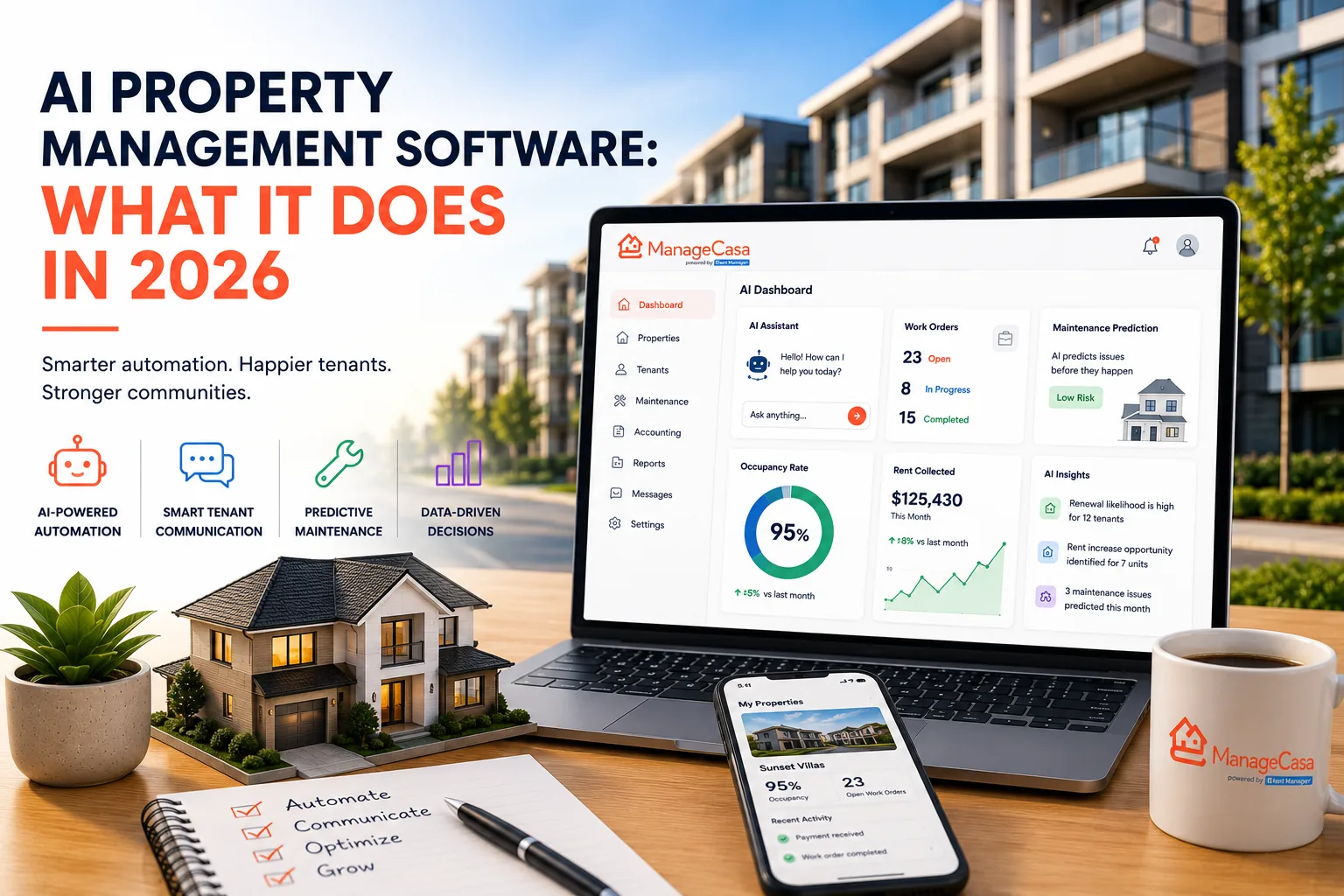
AI property management tools use artificial intelligence to handle repetitive, document-heavy work: answering resident questions from your own rules and leases, turning messages into maintenance tickets, reading invoices, and drafting communications. Newer agentic features can run multi-step workflows. None of them replace a manager's judgment on governance, compliance, or money decisions.
AI is now a standard line on property management feature lists. What it actually does day to day varies a lot, from genuinely useful tools to a chatbot added so the marketing page can say "AI." If you manage rentals or an HOA, the honest answer is that some of it is already useful for specific tasks, and that list is growing quickly.
This guide covers what AI handles well today, what should stay with a person, how fast the industry is adopting it, how availability compares across major platforms, and what to check before you trust a vendor's AI with resident or financial data.
What AI Automates in Property Management Today
The working use cases share one trait: they're repetitive, document-heavy, or time-sensitive tasks that used to eat a manager's day in small pieces.
• Resident and tenant Q&A. Answering routine questions about pool hours, late fees, or pet policies using the community's own rules and lease terms, including after hours.
• Maintenance triage. Turning a resident's text or email into a structured work order with photos and details, then routing it, so nobody retypes the request.
• Document search and summaries. Pulling a clause or a plain-language summary out of a 50-page lease or a set of CC&Rs in seconds.
• Invoice capture. Reading vendor invoices from a photo or upload and drafting the bill for review. This went from emerging to widely available in the past year, with Yardi launching Smart AP for Breeze Premier in October 2025 and Buildium offering AI Bill Scan.
• Drafting communications. Writing first drafts of announcements, notices, and replies, sometimes with translation.
• Leasing follow-up. Responding to rental inquiries and scheduling showings, especially outside office hours.
For a broader look at rules-based automation that doesn't need AI at all, such as recurring charges and late fee schedules, see our property management automation guide.
What AI Still Can't (or Shouldn't) Do
AI shouldn't make decisions where someone has to be accountable for the outcome. Board governance votes, fair housing judgment calls, screening criteria, eviction steps, and interpreting ambiguous lease or bylaw language all need a person who can answer for the result.
Accuracy is the other limit. AI can produce a confident answer that's wrong, especially when a document is outdated or two rules conflict. That's why the most useful setups restrict AI to documents the manager has approved and require review before anything leaves the system as a final notice, payment, or violation.
How Fast Are Property Managers Adopting AI?
Faster than the industry's paper-heavy reputation suggests. In a May 2025 survey by the Foundation for Community Association Research, 71% of 478 respondents said they already use AI in their work. Respondents were a mix of community managers (43%), volunteer leaders (28%), management company executives (18%), and business partners (11%).
The same survey shows most use is still general-purpose. Respondents mainly use large language models such as ChatGPT, Copilot, and Gemini for writing, editing, and meeting summaries rather than AI built into their management platform. Concerns are high too: 75% flagged accuracy and misinformation, 63% data security and privacy, and only 15% said they disclose when content is AI-generated. That gap between use and oversight is exactly where platform-level controls matter.
AI Chatbots vs. Automation vs. Agentic AI
These terms get used interchangeably in marketing, but they describe three different levels of capability.
Agentic features are moving fast. AppFolio's new Realm-X, announced September 29, 2026, adds AI "Performers" for leasing, maintenance, resident messaging, accounting, and reception. Buildium's Lumina AI Workforce includes accounting and business operations agents, which were in beta as of March 2026. Performance figures in these announcements are vendor-reported and not independently audited, so treat them as claims to test in a demo rather than benchmarks.
How AI Availability Compares Across Platforms
AI now ships on the entry plan of most major platforms; the real differences are entry price and how much capability each tier unlocks. That's a change from early 2026, when several vendors held AI back for their top tier. Details below are from vendor pricing and product pages as of October 2026.
The practical takeaway: AI features are becoming standard across leading platforms, with tools like automated workflows, reporting, and resident communication now appearing across multiple solutions. Ask which specific AI features you need, which tier includes them, and whether usage limits apply, such as a cap on how many documents the assistant can read. For side-by-side reviews, see ManageCasa vs AppFolio, ManageCasa vs Vantaca, and our roundup of the top platforms for 2026.
What Does AI in Property Management Cost?
For most buyers, AI is now part of the subscription rather than a separate fee; the cost shows up in which tier you need. Basic assistants usually come with the entry plan. Agents that act on accounting or run multi-step workflows tend to sit on higher tiers, and a few features, like Yardi's Smart AP, require a plan with a $400 monthly minimum.
Before comparing platforms on AI, list the two or three tasks you actually want help with. Then price the lowest tier that covers those tasks for your unit count. That number is more useful than any feature checklist.
Is AI in Property Management Secure?
Security depends on how a platform controls data access, not on whether it has AI. It's also the industry's top worry: in the Foundation's survey, 63% of respondents named data security and privacy as a concern and 48% worried about exposing proprietary content.
Ask every vendor two direct questions. Can you choose exactly which documents and data the AI can see, or does it have blanket access? And is your data used to train models beyond your own account, and where is that disclosed? Clear written answers to both are a reasonable bar before letting AI near resident or financial records.
What to Look For When Evaluating AI Tools
Judge AI features by control, transparency, and fit, not by how long the feature list is.
- Document and resident controls: Can you choose which leases, policies, and governing documents the AI uses, and decide when residents interact with AI versus a person?
- Review and accountability: Do financial or legal actions require approval, and does the vendor clearly identify what still needs manual review?
- Data handling: Is your data used for model training, and is that policy clearly stated in writing?
- Tier and limits: Which plan includes the AI features you need, and are there usage caps or additional fees?
Capability note: Resident Q&A is where most associations start. ManageCasa's Minii AI answers resident questions from the governing documents and policies a manager uploads, and turns resident messages into tickets inside the same resident communication tools boards already use, so managers control what the assistant can read and when a person takes over. See how Minii AI works.
AI for HOAs vs. Rental Portfolios
The core tools are the same, but the documents and decisions differ. HOA teams lean on AI for CC&R and bylaw questions, architectural requests, violation notices, and board meeting summaries. Rental teams use it more for lease questions, leasing inquiries, renewals, and maintenance.
- For HOAs: read our look at how AI is changing HOA management and our comparison of the best AI software for HOA management.
- For rentals: see how AI helps optimize rent and retention and the background on ManageRental AI.
Related Guides
• How AI Is Changing HOA Management
• Best AI Software for HOA Management in 2026
• How AI in Property Management Optimizes Rent and Retention
• Property Management Automation Guide for 2026
• ManageCasa vs AppFolio: Features, Pricing and AI
• ManageCasa vs Vantaca for HOA Management in 2026
Frequently Asked Questions
How do you use AI in property management operations?
Most teams start with resident Q&A, maintenance triage, document search, and drafting messages, because those tasks are frequent and low risk. From there, many add invoice capture and simple automated workflows. Keep a person reviewing anything that touches money, legal notices, or board decisions, and limit the AI to documents you have approved.
How do AI tools reduce workload for property managers?
AI tools reduce workload by absorbing small, repetitive tasks that add up over a week: routine questions, ticket entry, invoice data entry, and first drafts. Residents get faster answers outside office hours, and managers spend less time retyping information. The time saved varies widely by portfolio, so measure your own baseline before and after rollout.
How do you calculate ROI for a property management AI implementation?
Track the hours your team spends on the tasks AI will handle, then multiply the hours saved each month by your loaded hourly cost. Compare that with any added subscription cost, including a higher plan tier if AI requires one. Fewer calls and faster invoice processing are real benefits but harder to price, so treat them as supporting evidence.
How do you manage rental properties with AI?
For rentals, AI is most useful for answering tenant questions about the lease, triaging maintenance requests, and handling after-hours leasing inquiries. Some platforms also screen invoices and draft renewal or notice letters for review. Keep fair housing decisions, screening criteria, and anything involving deposits or evictions with a person, since those carry legal risk.
Will AI replace property managers?
No. Current AI tools take over repetitive tasks, not the accountability that comes with managing people's homes and money. Board decisions, compliance calls, vendor negotiations, and difficult resident conversations still need a person. AI can handle more of the routine administrative work, giving property managers more time to deal with decisions and situations that require their direct involvement.
Put AI to Work Without Giving Up Control
ManageCasa, Powered by Minii AI, includes AI on every plan for HOAs and rentals, with managers deciding which documents the assistant uses. See it for HOA management or rental owners, compare plans and pricing, or learn more at ManageCasa.

CTO
CTO at ManageCasa, specializing in web and mobile application development. Focused on building scalable, high-performance solutions that drive innovation in property management technology.