


Quick answer
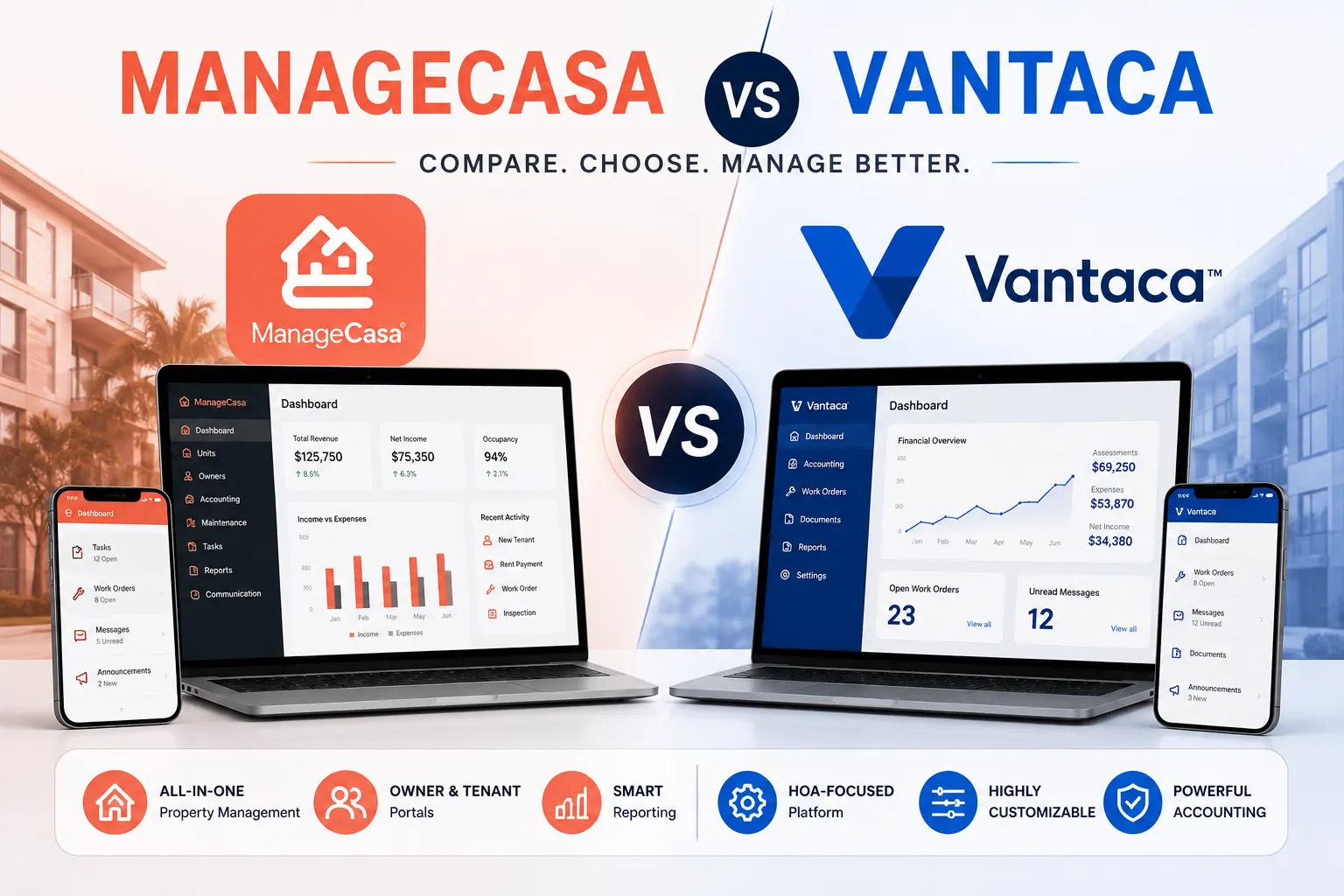
ManageCasa and Vantaca are both built for community associations, but they are bought very differently. Vantaca is an AI-first platform for professional management companies, sold through custom quotes. ManageCasa runs HOAs, condo associations, and the firms that manage them on published pricing, with Minii AI included and rentals and marinas supported in one account.
If you manage community associations, you've likely heard of Vantaca or seen one of its demos. The company has strong financial backing and focuses heavily on AI automation. Its platform uses AI agents to handle back-office tasks, helping management teams take on more associations without needing to hire additional staff at the same rate.
ManageCasa goes after the same buyer from a different direction. It is built on an accounting foundation, keeps operating and reserve funds apart by default, and lets one firm run HOAs, condo associations, rentals, and even marinas from a single set of records. The prices are on the website rather than behind a sales call.
The market both platforms serve keeps getting bigger. The Foundation for Community Association Research estimates there are between 374,000 and 377,000 community associations in the U.S. in 2026, and every one of them needs clean books, a way to collect assessments, and a way to talk to owners.
Who This Comparison Is For
This guide is written for three kinds of buyers:
• Management companies running anywhere from a handful to several hundred associations, who want one system for accounting, owner communication, and operations.
• Large condo and master associations with on-site or in-house staff that need management-company-grade tools.
• Developers and mixed-portfolio operators who hand communities over to boards while holding rental or commercial units of their own.
Self-managed boards use ManageCasa too, but Vantaca sells to professional management firms, so that is where this comparison stays. We cover pricing, AI, accounting, portfolio scope, onboarding, and reviews, and we say plainly where Vantaca is ahead.
Quick Snapshot: ManageCasa vs Vantaca
What Is Vantaca?
Vantaca is a Wilmington, North Carolina company that describes itself as AI-first and built specifically for community association management. In a June 2026 announcement, it said it serves more than 550 management companies representing over 6.5 million doors across the U.S.
Its AI story has two layers. Scout is the everyday assistant built into the platform for research and routine tasks. HOAi is the heavier piece: a suite of AI agents that Vantaca acquired in November 2024. In June 2026, according to WilmingtonBiz, Vantaca introduced HOAi Fleet, a set of agents aimed at the full back office of a management company, with the option to run them in-house or have Vantaca manage them.
Vantaca is also built for big moves. That same June, Miami-based Allied Property Group moved all 115 of its associations onto Vantaca in one full-portfolio cutover. If your firm is already that size and wants a partner focused only on association management, Vantaca belongs on your shortlist.
What Is ManageCasa?
ManageCasa is AI-powered software for HOAs, condo associations, and the management companies that run them, with rental and marina portfolios managed in the same platform. Everything sits on one accounting foundation: financial reporting, online payments, maintenance, inspections, owner and resident records, and communication all share the same ledger, so every community runs on the same set of records.
For management companies, a few things matter most. Association funds are kept apart from management income on dedicated ledgers, management fees can be applied automatically, and role-based permissions control what each team member and board member can see. Minii AI is included in every plan and helps managers and boards answer resident questions, analyze governing documents, handle maintenance requests, and keep track of overdue payments.
ManageCasa does serve self-managed boards, and many of its customers started there. The platform is designed so a firm can start with one association and grow into hundreds without switching systems.
Pricing: ManageCasa vs Vantaca
ManageCasa Pricing
ManageCasa publishes three plans. The listed prices cover the first 1 to 25 units on annual billing, which saves 12% compared with monthly billing. As you add units, the price moves up to the next unit tier, and portfolios above 500 units get a direct quote from the sales team.
Every plan includes guided onboarding and help from a data migration team. There is no long-term contract: you can cancel at any time and export your data. Current rates for your unit count are on the ManageCasa pricing page.
Vantaca Pricing
Vantaca does not publish plan prices. Pricing is quoted by its sales team and depends on the size of your portfolio and which products you add, such as HOAi agents or payment tools. That is normal for software sold to larger firms, and some buyers prefer it because everything is negotiated in one contract.
The practical difference is timing. With ManageCasa, a management company can model its software cost per door before it ever books a demo. With Vantaca, that number arrives later in the sales process.
AI: Minii AI vs Scout and HOAi
This is the area where Vantaca has invested most heavily, and it shows. HOAi agents are built to take over whole back-office processes, and HOAi Fleet adds a managed option where Vantaca runs the agents for you. If your plan is to hand large parts of your operation to an AI workforce, Vantaca is further down that road today.
Minii AI takes a different approach. It is built into the platform rather than sold as a separate product, and it works inside the workflows managers already use:
- It reads CC&Rs, bylaws, and policies, then answers resident questions about them around the clock.
- It turns a resident's description into a maintenance ticket, violation, or architectural review request.
- It captures vendor invoices from a photo or upload and codes them into payables.
Every ManageCasa plan includes Minii AI. Base comes with a limited allowance, Growth and Premium raise it, and usage beyond the plan's capacity is billed separately. For most management companies, the question is less "which AI is more advanced" and more "do we want AI as a separate program, or built into the work we already do?"
Accounting and Fund Separation
Accounting can take up a lot of time for community association management companies, especially when the software makes routine tasks harder than they need to be. Every association needs accurate financial records, while the management company must keep its own revenue separate from the funds it manages for clients.
ManageCasa tracks operating funds, reserves, and special accounts independently, and it separates association funds from management income using dedicated ledgers. Board-ready income statements, balance sheets, budget comparisons, and delinquency reports come straight from live data, and board members can be given read-only access. Every transaction and adjustment is logged, which keeps the audit trail intact.
Vantaca's platform also centers on association accounting and pairs it with integrated payments. It has extended into vendor payments through Vantaca Vendor, which it made available to the broader market in 2026. Both platforms can carry a professional accounting workload; the bigger differences show up in pricing and portfolio scope.
ManageCasa capability: fund and ledger-based accounting
ManageCasa keeps each association's operating funds, reserves, and special accounts on separate ledgers and posts management fees automatically, so a firm can close books for many communities without mixing client and company money. See how it works on the financial capabilities page.
Portfolio Scope: Associations Only vs Mixed Portfolios
Vantaca is built for community association management, and that focus is a strength if associations are all you do.
Plenty of firms are not that tidy. Some manage HOAs and also lease single-family homes. Some developers hand a community to its board while keeping a block of units as rentals. Some operators run a marina next to a condo association. ManageCasa lets that whole mix live in one property management platform, with workflows, accounting, and permissions kept separate by property type. Details are on the portfolio capabilities page.
If your firm touches rentals or other asset types today, or expects to, that can mean one fewer system to run.
Onboarding and Switching Platforms
Many management companies hesitate to switch software because of the time and effort involved in moving their data and adjusting to a new system. Vantaca points to customers like Allied Property Group, which moved 115 associations in a single cutover. ManageCasa assigns an onboarding specialist and a data migration team that move properties, communities, owners, tenants, leases, and vendors into the platform, then train your staff on your own data.
Whichever way you lean, get the migration plan in writing: what moves, who moves it, how much transaction history comes across, and how long you will run both systems in parallel. Our guide on how to choose HOA software has a full list of questions to bring to each demo.
Reviews: What Users Say
On Capterra, Vantaca holds a 4.4 out of 5 average from 110 reviews, and ManageCasa holds 4.0 from 29 reviews, both as of October 27, 2026. Vantaca has the larger review base and the higher average, and that is worth knowing going in.
Vantaca reviewers tend to praise how far the system can be configured for each association and how closely the support team works with them. A few management firms say the cost of adding services can climb quickly. ManageCasa's reviewers score it highest on customer support and value for money (4.3 each) and lower on features (3.8), so ask to see the specific workflows your team relies on during any demo.
Pros and Cons
ManageCasa
Pros
- Published pricing, so you can model cost per door before talking to sales
- Minii AI included on every plan
- Fund and ledger-based accounting that keeps association money apart from management income
- Associations, rentals, commercial units, and marinas in one account
- Monthly or annual billing, with no long-term contract
Cons
- Smaller review base and a lower Capterra average than Vantaca
- Minii AI allowance is limited on Base, and heavy usage is billed beyond plan capacity
- Trust accounting, bank sync, and the open API require Growth or Premium
- Portfolios above 500 units still go through a sales quote
Vantaca
Pros
- Focused entirely on community association management companies
- HOAi agents built to run whole back-office processes, with a managed option
- Large customer base of more than 550 management companies
- Higher Capterra average from a larger number of reviews
Cons
- No published pricing; cost is only known after a sales conversation
- Built for associations only, so rental or marina work needs another system
- Some reviewers say adding services gets expensive
Which Platform Fits Your Operation?
Bottom line
Vantaca is a strong choice for large management companies that want an association-only partner and are ready to put AI agents at the center of their operation. ManageCasa fits management companies, condo associations, and developers that want published pricing, AI on every plan, and one accounting system for associations and everything else they manage.
Related Guides
• ManageCasa vs Yardi: HOA and COA comparison
• ManageCasa vs AppFolio: features, pricing, and AI
• ManageCasa vs Buildium: HOA comparison
• ManageCasa vs DoorLoop: HOA and rental comparison
• How to choose HOA software: a buyer guide
• The complete guide to HOA software in 2026
See ManageCasa with your own portfolio
Explore ManageCasa for HOAs and condo associations, compare plans on the pricing page, or book a live demo to walk through your associations, funds, and workflows with the team at ManageCasa.
Frequently Asked Questions
Is ManageCasa a good Vantaca alternative for management companies?
Yes, for management companies that want published pricing, fund accounting, and AI included on every plan, and that also manage rentals or marinas. Firms that want to hand entire back-office processes to AI agents under a custom contract may find Vantaca's HOAi suite the closer match for how they plan to operate.
How much does Vantaca cost?
Vantaca does not publish a price list, so pricing comes from its sales team and depends on the management company's portfolio size and the products it adds, such as AI agents. ManageCasa lists its plans publicly, starting at $45 per month billed yearly, with the price scaling by the number of units managed.
What is Vantaca HOAi?
HOAi is Vantaca's suite of AI agents for community association management, which Vantaca acquired in November 2024. In June 2026 it introduced HOAi Fleet, which lets management firms run the agents themselves or have Vantaca manage them on their behalf. Scout is a separate, everyday AI assistant built into the Vantaca platform.
What do Vantaca reviews say?
Vantaca holds a 4.4 out of 5 rating from 110 Capterra reviews as of October 2026. Reviewers often praise how far the system can be customized for each association and how responsive the support team is, while some management firms say adding services gets expensive. ManageCasa holds a 4.0 rating from 29 reviews.
Can ManageCasa handle multiple associations and rentals in one account?
Yes, ManageCasa lets a management company run community associations, rentals, commercial units, and marinas in one platform, with workflows, accounting, and permissions kept separate by property type. Operating funds, reserves, and management income sit on their own ledgers, so each association's books stay clean, separate, and easy to audit at year end.

Content Writer
Patrick Bohan is a content strategist focused on property management technology, HOA operations, and real estate. A Cornell graduate, he began his career at UBS covering housing markets, homeownership policy, and financial regulation — experience that now informs his research-driven approach to proptech content. Today he bridges the gap between software teams and the practitioners who use them, producing practical resources on community associations, rental operations, and accounting workflows for property managers.