




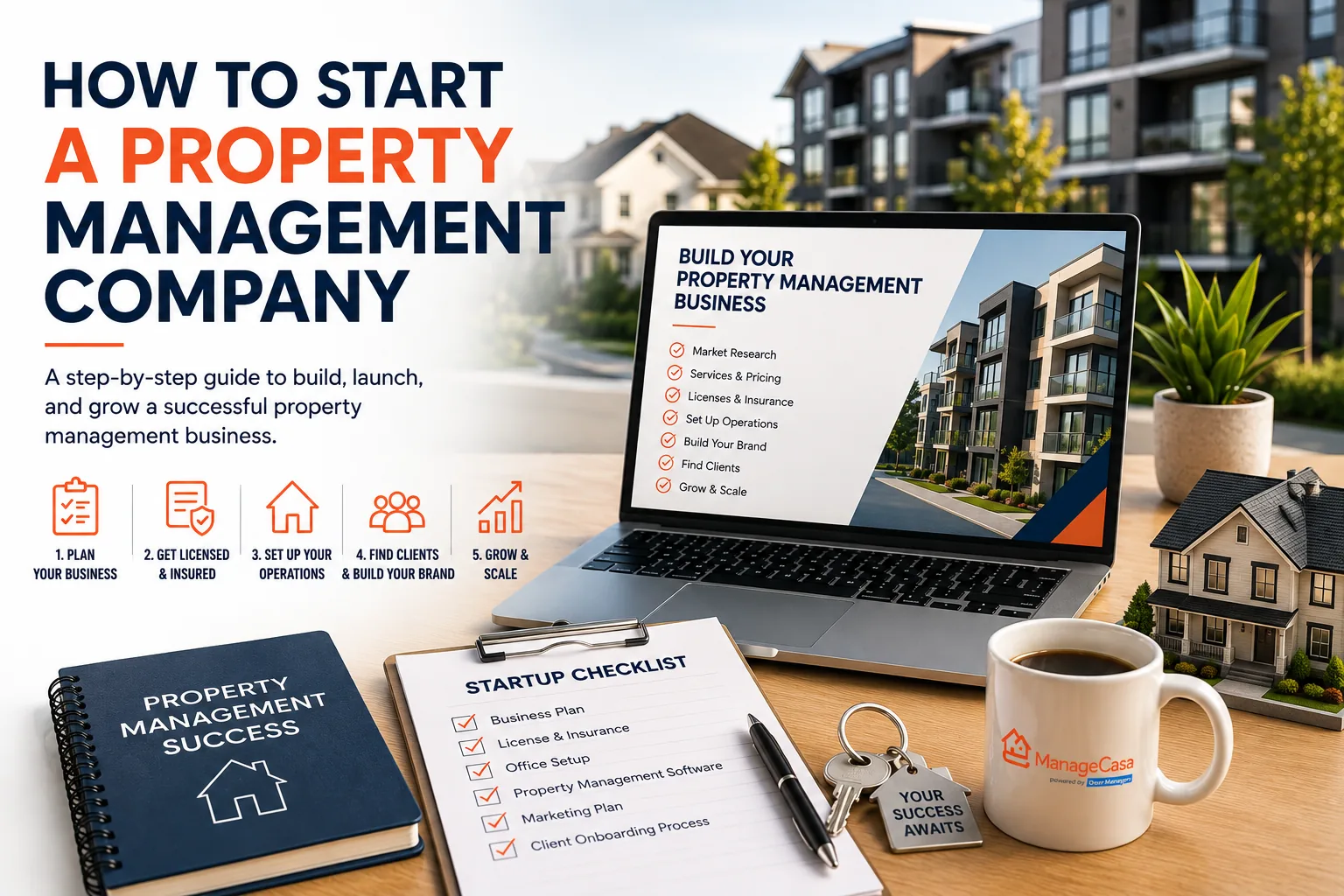
Starting a property management company generally takes seven steps: choosing a business structure, getting licensed, securing insurance, setting a fee structure, choosing software, writing management agreements, and finding your first clients. Most states require a real estate broker license, and startup costs for an independent operator typically run from a few thousand dollars to about ten thousand.
Property management is one of the few real estate businesses you can start without buying property yourself. You're selling expertise, systems, and reliability to owners who don't want to deal with tenants, maintenance calls, or HOA board meetings themselves. That's also why it's more regulated than it looks from the outside: in most states, managing someone else's property for a fee is legally a real estate activity, not just a service business.
This guide walks through the seven steps to get a property management company running, where licensing requirements actually come from, what it realistically costs to start, and the decisions that trip up new operators most often.
1. Decide What You're Managing
Rental property management and HOA or community association management are regulated differently in several states, and the skills and software needs diverge too. Rental management centers on tenant placement, rent collection, and maintenance coordination for individual owners. HOA and condo association management centers on dues collection, reserve funds, board governance, and enforcing community rules for an association rather than a single owner. Some operators do both; many specialize in one, at least at first.
2. Choose a Business Structure
Most new property management companies form an LLC or a corporation rather than operating as a sole proprietor, mainly for liability protection, since property management carries real exposure to tenant disputes, fair housing claims, and fund-handling errors.
One state-specific wrinkle worth knowing before you pick a structure: California's Department of Real Estate does not recognize an LLC as a licensed real estate broker. If you're forming your company in California, you'll need to incorporate as a corporation with a licensed broker officer rather than a standard LLC. Other states don't impose this restriction, so confirm the rule in your specific state before filing formation paperwork.
3. Get Licensed
This is the step most new operators underestimate. In the large majority of states, managing rental property for someone else in exchange for a fee legally counts as a real estate brokerage activity, which means it requires a real estate broker license, not just a general business license. A handful of states either don't require one or offer a lighter-weight, property-management-specific license instead.
Rental Management vs. HOA Management: Different Licenses, Different Rules
Florida is the clearest example of why this distinction matters. A real estate license under Florida Statute Chapter 475 covers rental property management, but managing a homeowners association or condo association is a separate activity requiring a Community Association Manager (CAM) license once the association has more than 10 units or an annual budget over $100,000. Holding a real estate license doesn't authorize you to perform CAM duties, and the reverse is also true. If you plan to manage both rental properties and HOAs in Florida, budget time and fees for both licenses.
California takes a stricter approach than most states on who can run the company itself. A salesperson license lets you perform property management activities under a supervising broker, but only a broker's license lets you operate your own property management company. Texas allows a similar path where a licensed salesperson can operate under a sponsoring broker, but the company itself still needs a broker of record.
4. Budget for Startup Costs
Cost estimates for starting a property management company vary enormously depending on the source, and a lot of the widely circulated figures online come from generic business-plan templates that don't hold up to scrutiny. Sticking to grounded, itemized estimates from operators and consultants who actually work in the space, a realistic range looks like this:
- Licensing and pre-licensing education: $1,000 to $5,000, depending on the state's required course hours
- Business formation and legal fees: $500 to $2,000
- Software subscription for day-to-day operations: roughly $100 to $300 per month to start
- Initial marketing and a basic website: $500 to $2,000
Put together, most independent operators can realistically launch for under $10,000, and some lean startups get there closer to $3,000 to $7,000. Buying into a franchise model is a different math problem entirely, franchise startup costs commonly run from about $27,000 to $59,000, which buys you brand recognition, training systems, and often help navigating licensing, at a real premium over going independent.
5. Get the Right Insurance
General liability insurance covers third-party injury and property damage claims. Errors and omissions (E&O) insurance is the one new operators most often skip and most often need, it covers claims that you made a mistake managing someone's property, missed a deadline, or mishandled funds. Given that property managers routinely handle other people's rent and deposit money, most states also require a separate trust or escrow account for client funds, kept strictly apart from your own operating account.
6. Choose Your Software and Set Your Fee Structure
Trying to run trust accounting, maintenance requests, and owner reporting out of spreadsheets is one of the fastest ways to create a compliance problem, since trust account errors are consistently one of the top reasons state regulators take disciplinary action against property managers. Dedicated software built for this work handles the accounting separation, tenant and owner portals, and reporting from day one.
Most companies charge a monthly management fee as a percentage of collected rent, commonly in the 8 to 12 percent range for residential rentals, plus separate fees for tenant placement, lease renewals, or HOA-specific services like violation processing. Your fee structure should be decided before you approach your first client, not negotiated on the fly.
7. Write Your Management Agreement and Find Your First Clients
A solid management agreement spells out your fee structure, the scope of what you handle versus what requires owner approval, how funds are disbursed, and how either party can end the relationship. Many new operators find their first few clients through their existing real estate network, local investor meetups, or by taking on a friend or family member's property first to build a track record and testimonials before marketing more broadly.
This article summarizes general property management licensing practices and select state requirements as of publication and is provided for general informational purposes only. It is not legal or business advice. Licensing requirements, fee structures, and business formation rules vary by state and change through new legislation. Consult a licensed attorney and your state's real estate commission before forming a company or beginning property management activities.
Software That Handles Licensing-Sensitive Work For You
Trust accounting, owner reporting, and separating funds correctly are exactly the areas where new property management companies run into regulatory trouble. ManageCasa gives new and growing companies built-in accounting, owner and resident portals, and reporting so trust account compliance isn't something you're building from scratch. See how it works for rental owners or compare plans and pricing.
Related Guides
- 22 Tips for First-Time Rental Property Owners
- Landlord Friendly States in 2026: The 6 Best States to Own Rental Property
- Rental Agreements and Lease Terms
Do you need a real estate license to manage property?
In most states, yes. Managing rental property for someone else in exchange for compensation is legally considered a real estate brokerage activity in the majority of states, requiring a broker license or work under a licensed broker.
How do you get a property management license?
Requirements vary by state, but most require completing pre-licensing education, passing a real estate or broker exam, and applying through the state real estate commission. Check your state's specific coursework hours and exam requirements before starting.
How much does it cost to start a property management company?
Independent operators typically spend $3,000 to $10,000 on licensing, business formation, software, and initial marketing. Franchise models cost significantly more, commonly $27,000 to $59,000, in exchange for brand recognition and support systems.
How do you start a property management company in Florida?
Starting a property management company in Florida requires a real estate license under Florida Statute Chapter 475, plus a separate Community Association Manager license if you plan to manage HOAs with more than 10 units or a $100,000 budget. Business formation and licensing exam fees add to the standard startup costs outlined above.
How hard is it to start a property management company?
Starting a property management company is moderately difficult mainly due to licensing requirements, not capital needs, since most states require a real estate broker license before you can legally manage property for others. Budgeting time for licensing exams and coursework is often the biggest hurdle for new operators.

Expert in Property Management and SaaS
Peter Koch is an expert in property management and SaaS, focused on building top digital tools for property managers and growing technology-driven startups. He specializes in enhancing property management operations through smart software solutions that streamline accounting, automate workflows, and improve community communication. Peter writes about HOA management technology, proptech innovation, and scalable SaaS strategies designed to help modern property professionals operate more efficiently.