




Quick Answer:
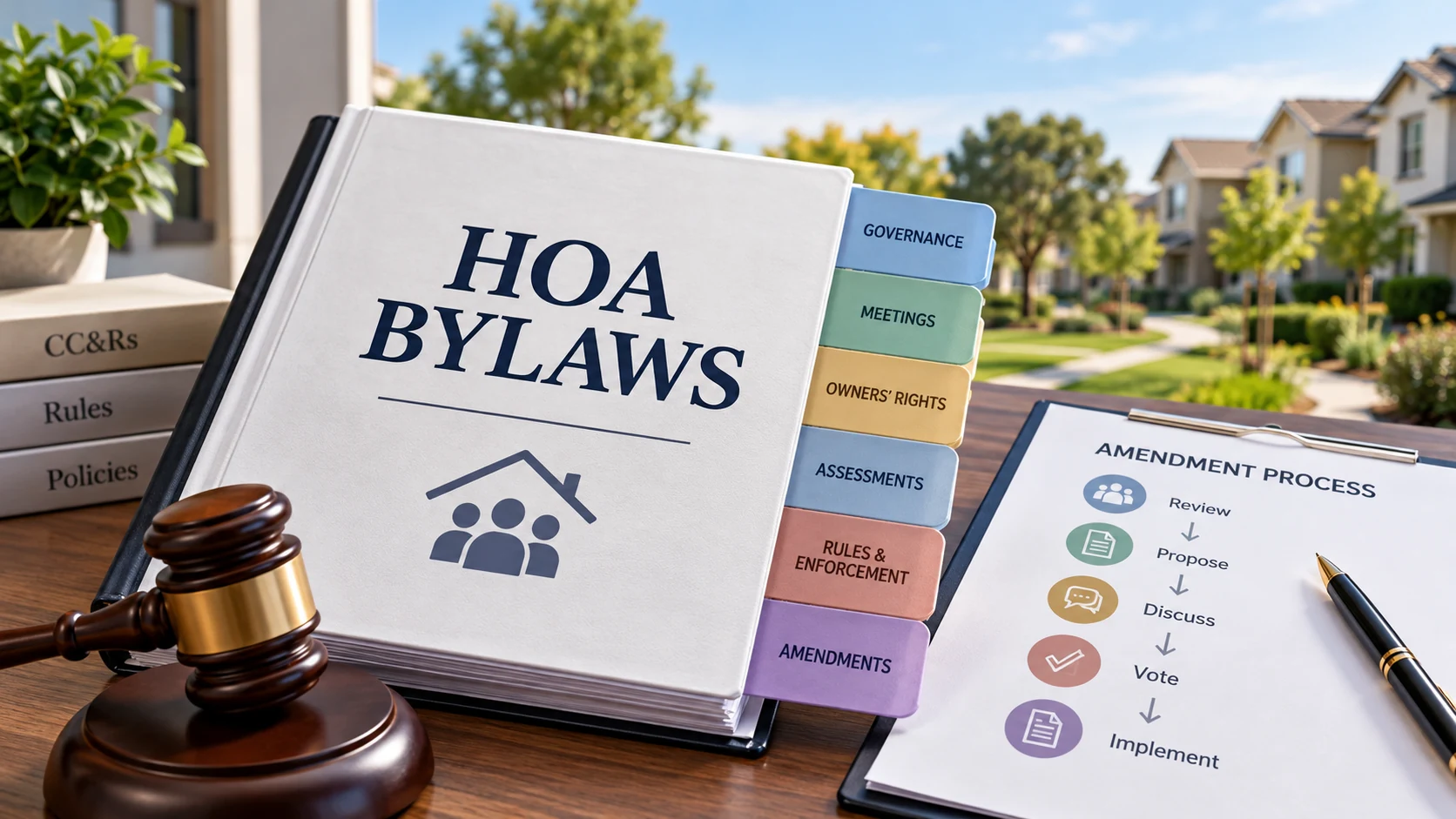
HOA bylaws are the governing document that explains how a homeowners association runs itself: how directors are elected, how long they serve, what officers do, how meetings and votes work, and how the bylaws can be changed. They rank below state law, the CC&Rs, and the articles of incorporation, but above the board's day-to-day rules.
Most homeowners know their HOA has rules. Fewer realize there's a separate document that sets the rules for the board itself. That document is the bylaws, and it's the one that decides how many directors you have, how long they serve, how a meeting becomes official, and what it takes to change any of it.
This guide explains what HOA bylaws are, where they fit among your other governing documents, what a typical set includes, how to amend them, and how to get a copy. It's written for both homeowners and board members.
Legal disclaimer: This article is for general education and is not legal advice. Bylaw requirements depend on your state's HOA and nonprofit corporation laws and on your own governing documents. Talk with a licensed community association attorney before drafting or amending bylaws.
What Are HOA Bylaws?
HOA bylaws are the operating manual for the association as an organization. Most HOAs are set up as nonprofit corporations, and like any corporation they need rules for how decisions get made. According to Nolo's overview of HOA governing documents, bylaws describe how the association is run, set out voting rights and procedures, and cover how meetings are called and how often they're held.
In practice, that means bylaws answer questions like these: How many people sit on the board? How are they elected, and can they be removed? What does the treasurer do? How much notice do owners get before a meeting? How many owners have to show up for a vote to count? And what does it take to change the bylaws themselves?
Bylaws usually don't say whether you can paint your door blue or park a boat in the driveway. Those restrictions live in the CC&Rs and in the board's rules and regulations.
Where Bylaws Fit Among HOA Governing Documents
Bylaws sit in the middle of the governing document hierarchy: below state law, the CC&Rs, and the articles of incorporation, and above the board's rules. That order matters when two documents disagree.
California puts it in statute. Under Civil Code Section 4205, the law beats any governing document, the declaration (CC&Rs) beats the articles of incorporation, the articles or declaration beat the bylaws, and all three beat the operating rules. Colorado's HOA Information and Resource Center describes the same general order: CC&Rs, then articles of incorporation, bylaws, governance policies, rules and regulations, and design guidelines.
What HOA Bylaws Typically Include
Most HOA bylaws follow a similar outline, even though the details vary by community and state. If you're looking for an HOA bylaws sample or template, this is the structure you'll usually see. Use it to review your own bylaws or to brief an attorney, not as a substitute for documents drafted for your association.
Meetings and quorum rules are where bylaws affect owners most directly. Florida's default member quorum is 30% of the total voting interests unless the bylaws set a lower number, under Section 720.306. Our HOA meetings guide covers notice, quorum, and executive session rules in detail, and the board member responsibilities guide explains what each officer actually does.
HOA Bylaws vs. CC&Rs
The simplest way to tell them apart: CC&Rs govern the property, bylaws govern the association. CC&Rs are recorded with the county and run with the land, so they bind every future owner. Bylaws are the association's internal corporate rules. In many communities they're recorded too, but they don't restrict how you use your home.
When the two conflict, the CC&Rs generally control. For a side-by-side comparison of CC&Rs, bylaws, and rules, see our guide to what CC&Rs are and how they work.
How to Amend HOA Bylaws
Start with the amendment article in your own bylaws, because it sets the process and the vote required. State law fills in the gaps and sometimes sets limits the bylaws can't override.
1. Identify what needs to change. Common reasons include outdated meeting rules, missing electronic voting provisions, unclear terms for directors, or provisions that no longer match state law.
2. Check the amendment article and state law. Note who can propose an amendment, the vote threshold, and any notice period. In Florida, Section 720.306(1)(b) sets a default of two-thirds of the voting interests unless the governing documents or law provide otherwise. In Colorado, state law requires bylaws to include an amendment method.
3. Draft the language with counsel. An attorney can confirm the amendment doesn't conflict with the CC&Rs, the articles, or current statutes.
4. Notify owners and hold the vote. Send the proposed text with the meeting or ballot notice. If your state and bylaws allow it, electronic voting can make it easier to reach the required participation.
5. Record and distribute. If your bylaws or state law require recording, file the amendment with the county. Florida requires associations to give members a copy of a recorded amendment, or notice of where to find it, within 30 days of recording.
Can the board change the bylaws without an owner vote?
Usually not for anything significant. Most bylaws reserve amendments to the owners, and state law may add limits. According to Colorado's HOA Information and Resource Center, Colorado boards can't change director qualifications, powers, or terms on their own, and quorum changes must go to the members. Some bylaws do let the board make narrow changes, such as fixing errors or conforming to a new statute, so read the amendment article closely.
What Happens When the Board Doesn't Follow the Bylaws
Board actions that ignore the bylaws can be challenged. An election held without proper notice, a vote taken without a quorum, or a director serving past a term limit can all leave a decision open to dispute.
Owners usually start by raising the issue in writing and citing the specific bylaw provision, then move to mediation or internal dispute resolution before court. The board member responsibilities guide walks through that process in its section on boards that aren't following the bylaws.
How to Get a Copy of Your HOA Bylaws
Ask your board or management company in writing first, since bylaws are an official record owners can inspect in most states.
• Written request. In Florida, Section 720.303 lists the bylaws and every amendment as official records and requires the association to make records available within 10 business days of a written request.
• Association website or app. Florida associations with 100 or more parcels must post their recorded bylaws and amendments online. See our Florida HOA law guide for other posting rules.
• Annual disclosures. Colorado associations must make their bylaws, articles, and rules available to owners each year as part of the annual disclosure.
• Closing documents and county records. Your purchase documents often include the governing documents, and recorded bylaws can be found through the county recorder. In Texas, the Texas State Law Library points owners to county records and the state's HOA management certificate database.
Reviewing Your Bylaws: A Checklist for Boards
Bylaws drafted by a developer years ago often don't match how the association runs today or what current law requires. A periodic review catches problems before they turn into a disputed election.
• Do meeting and voting provisions allow electronic notice, remote meetings, and electronic or absentee ballots where your state now permits them?
• Are board size, terms, and staggered elections clear, and do they match what actually happens?
• Is the quorum realistic, or do meetings regularly fail to reach it?
• Do officer duties and spending authority match current practice?
• Does anything conflict with the CC&Rs, the articles, or a newer state statute?
• Is the amendment process clear enough that owners could follow it?
Our HOA best practices guide covers other governance habits that keep a board on solid footing.
Capability note: Owners can only follow bylaws they can find. ManageCasa's centralized HOA document storage and homeowner portals keep the current bylaws, amendments, and meeting minutes in one place for every owner, and its eVoting tools let boards run amendment votes with a clear record of participation.
Frequently Asked Questions
What are HOA bylaws?
HOA bylaws are the rules for how the association itself operates: elections, board size and terms, officer duties, meetings, voting, and amendments. They don't usually control how you use your home. That job belongs to the CC&Rs and the board's rules. Bylaws are binding on every owner and on the board.
What is the difference between HOA bylaws and CC&Rs?
CC&Rs govern the property, while bylaws govern the association that manages it. CC&Rs cover use restrictions, architectural standards, and assessments, and they're recorded with the county. Bylaws cover elections, meetings, and officer roles. When the two conflict, the CC&Rs generally win, as California Civil Code Section 4205 spells out for that state.
How do you amend HOA bylaws?
Follow the amendment article in your bylaws, which usually requires a board resolution followed by an owner vote at a set percentage. State law may set the default. In Florida, governing documents can be amended by two-thirds of the voting interests unless the documents or law say otherwise. Check whether the amendment must be recorded, then send owners a copy.
Can an HOA board change the bylaws without a vote?
Usually not for anything significant, since most bylaws reserve amendments to the owners. Some bylaws let the board make limited changes, such as corrections or updates required by new law. State law can also restrict board-only changes. In Colorado, for example, boards can't change director terms, qualifications, or quorum without owner approval.
How do I get a copy of my HOA bylaws?
Ask the board or management company in writing, since bylaws are an official record owners can inspect in most states. Florida requires associations to make records available within 10 business days of a written request, and associations with 100 or more parcels must post their bylaws online. You can also check your closing documents or the owner portal.
Related HOA Guides
• What Are CC&Rs? A Homeowner's Guide
• HOA Rules and Regulations: A Complete Guide
• HOA Board Member Responsibilities and Duties
• HOA Meetings: A Complete Guide for Boards
• HOA eVoting and Online Elections Guide
• HOA Best Practices: Complete Board Guide
Keep Your Governing Documents Organized
ManageCasa, Powered by Minii AI, gives HOA boards one place to store bylaws and amendments, run owner votes, and share meeting records. Explore the HOA platform, compare plans and pricing, or learn more at ManageCasa.

Content Writer
Patrick Bohan is a content strategist focused on property management technology, HOA operations, and real estate. A Cornell graduate, he began his career at UBS covering housing markets, homeownership policy, and financial regulation experience that now informs his research driven approach to proptech content. Today he bridges the gap between software teams and the practitioners who use them, producing practical resources on community associations, rental operations, and accounting workflows for property managers.