




What is HOA eVoting?
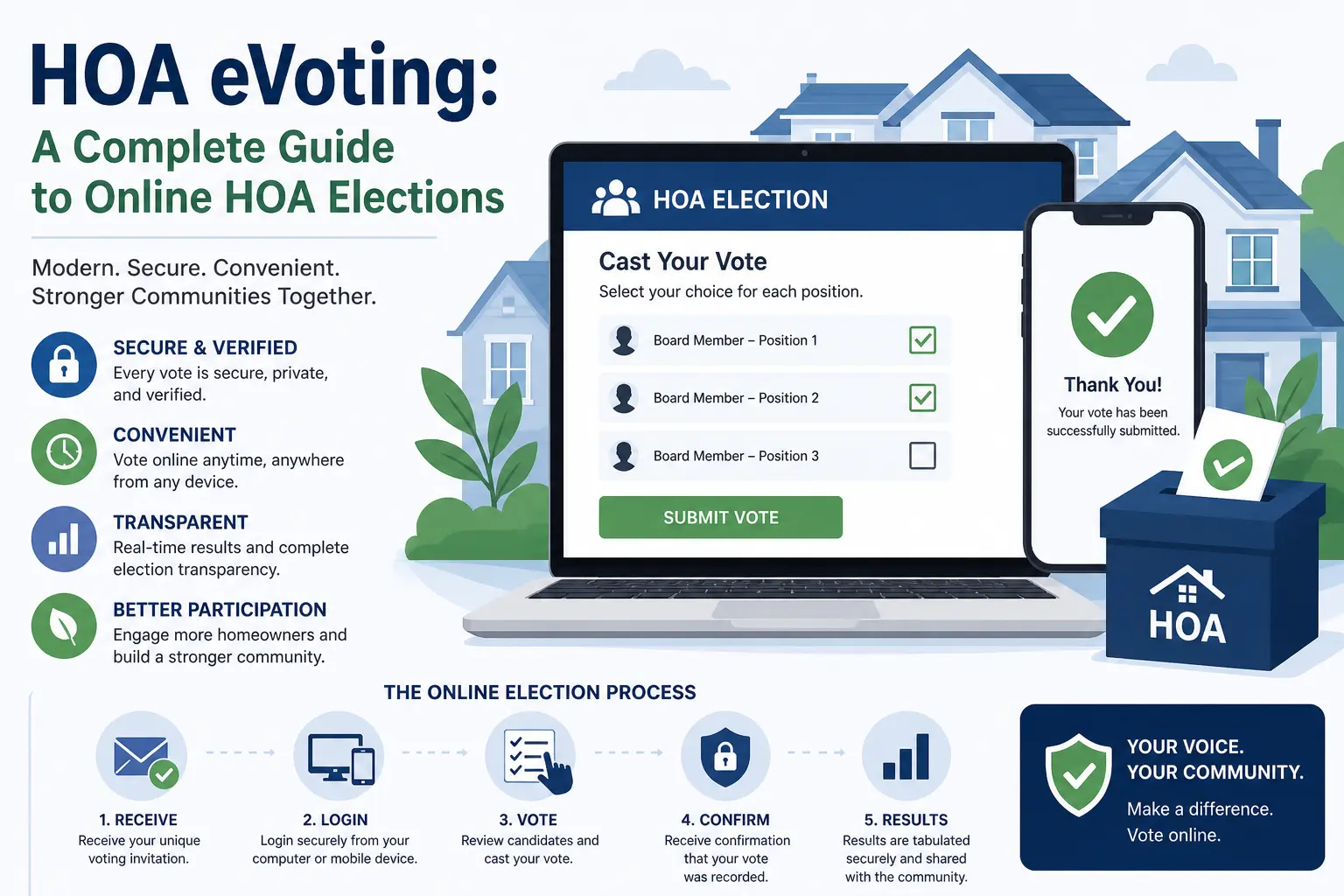
HOA eVoting is the use of secure electronic platforms to conduct homeowners association elections, board member votes, and community surveys. It replaces paper ballots and in-person voting with digital systems that allow members to vote from any device, at any time during the voting period. eVoting increases participation, reduces administrative cost, and produces auditable results.
Paper ballots were never a great way to run an HOA election. They get lost in the mail, sit unopened on kitchen counters, and rarely produce the kind of turnout that gives board decisions real community backing. For larger associations, counting them is a weekend-consuming exercise that still produces disputed results.
Electronic voting for HOAs addresses all of these problems. But implementing it correctly requires understanding what state law actually permits, what your governing documents require, and what security and quorum standards apply. This guide covers all of it.
Why HOA eVoting Matters: The Participation Problem
Low voter turnout is one of the most persistent challenges in HOA governance. When quorum is not met, elections cannot proceed. When only a small fraction of homeowners vote, the results do not reflect community consensus and board decisions made on that basis are harder to defend.
The primary barrier to participation is friction. Homeowners who are traveling, working during meeting hours, or simply do not want to attend in person are effectively disenfranchised under traditional voting methods. Electronic voting removes that barrier entirely. A homeowner can vote from their phone in two minutes at 10pm on the last day of the voting window.
Studies of HOA and condominium communities that have switched to electronic voting consistently show meaningful increases in participation rates, particularly among younger homeowners and those with demanding schedules.
Is HOA eVoting Legal? State Requirements Overview
Whether an HOA can conduct electronic voting depends on state law and the association's governing documents. The Community Associations Institute is the authoritative industry body tracking eVoting legislation across states. The legal landscape has changed significantly in recent years, with most states now permitting electronic voting to some degree.
Legal note
State eVoting requirements change frequently. Always confirm current requirements with a licensed community association attorney before conducting an electronic election. This table is a reference summary only and is not legal advice.
Governing Document Requirements
Even in states that permit eVoting, an HOA's governing documents may have requirements that need to be addressed. Some CC&Rs explicitly require paper ballots or in-person voting for certain decisions. A full overview of how governing documents interact with board authority is in the HOA rules and regulations guide.
Before implementing electronic voting, have your governing documents reviewed by a community association attorney to confirm what is permitted, what requires an amendment, and what procedures must be followed for the election to be legally valid.
Quorum Requirements and eVoting
Quorum is the minimum number of members who must participate for an election to be valid. eVoting does not change quorum requirements, but it typically increases participation, which makes meeting quorum significantly easier. The quorum percentage is defined in the governing documents and varies widely between associations, typically from 10% to 33% of the total membership. For a complete guide to HOA meeting rules and quorum procedures, see the HOA meetings guide.
One practical advantage of electronic voting is that participation can be monitored in real time during the voting window. If quorum is not trending toward being met, the board can send targeted reminders to non-participating members with enough time to respond before the deadline.
Security Requirements for HOA Online Voting
Security is the most common objection to electronic voting, and it is a legitimate concern. A legitimate eVoting platform for HOAs must address three security requirements: identity verification, vote confidentiality, and tamper-evident results.
• Identity verification: the system must confirm that each vote comes from an eligible member and that no member votes more than once
• Vote confidentiality: individual votes should not be traceable back to specific members, consistent with secret ballot requirements in most state statutes
• Tamper-evident audit trail: the final vote count must be independently verifiable, with a complete record of when each vote was cast and any system access events
Platforms that offer end-to-end encryption, multi-factor authentication for voter login, and a separate ballot-counting mechanism that prevents administrators from seeing individual votes before the poll closes meet the standard for legally defensible HOA electronic voting in most states.
Running an HOA eVoting Election: Practical Steps
1. Review state law and governing documents for electronic voting requirements and restrictions
Adopt a formal board resolution authorizing electronic voting. Good HOA board training helps ensure board members understand the governance obligations that come with adopting new election procedures.
2. Select a certified eVoting platform that meets your state's security and confidentiality requirements
3. Update your member contact database to ensure all homeowners have valid email addresses on file
4. Send the required advance notice of the election, including instructions for how to vote electronically
5. Open the voting period and monitor participation daily
6. Send reminder notices to non-participating members before the deadline
7. Close the voting period and generate the official results report from the platform
8. Announce results to the membership and file the results in association records as required by governing documents
9. Retain all voting records for the period required by state law, typically three to seven years
HOA Surveys and eVoting: Collecting Community Feedback
Beyond formal elections, electronic platforms can be used to collect community feedback through surveys. Surveys are advisory and carry fewer legal requirements than binding elections. They are a powerful tool for boards that want to understand homeowner priorities before making decisions on assessments, capital projects, or rule changes. This kind of proactive feedback collection is a core component of HOA financial transparency best practices, giving homeowners a voice before decisions are made rather than only informing them afterward.
Frequently Asked Questions
What is HOA eVoting?
HOA eVoting is the use of secure digital platforms to conduct homeowners association elections, board votes, and community surveys electronically. It allows members to vote from any device during a set voting period, replacing paper ballots and in-person voting. Most states now permit HOA electronic voting, subject to notice, security, and governing document requirements.
Is HOA electronic voting legal?
HOA electronic voting is legal in most states, including California, Florida, Nevada, Texas, Washington, Colorado, and Virginia, though specific requirements vary by state and association governing documents. Some associations must amend their bylaws or CC&Rs before implementing electronic voting. Always confirm your state's current requirements and your governing documents with a licensed community association attorney before conducting an electronic election.
Does eVoting count for HOA quorum?
Yes, electronic votes count toward quorum in states that permit HOA eVoting, provided the election is conducted according to applicable state law and the association's governing documents. The quorum requirement itself does not change. One practical advantage of electronic voting is that real-time participation monitoring allows boards to send reminders to non-participating members before the quorum deadline passes.
What security features should an HOA eVoting platform have?
An HOA eVoting platform should include voter identity verification to prevent duplicate votes, secret ballot protection so individual votes cannot be traced back to specific members, end-to-end encryption for data in transit, multi-factor authentication for voter login, and a tamper-evident audit trail that verifies the final count independently. These features are required by most state statutes that permit electronic voting.
Can an HOA conduct surveys electronically?
Yes, HOAs can conduct homeowner surveys electronically without the same legal requirements that apply to binding elections. Surveys are advisory and do not produce binding decisions, so they carry fewer procedural constraints. Electronic surveys are useful for gathering community input before major decisions on assessments, capital projects, or rule changes, and can significantly improve homeowner engagement with board decision-making.

Expert in Property Management and SaaS
Peter Koch is an expert in property management and SaaS, focused on building top digital tools for property managers and growing technology-driven startups. He specializes in enhancing property management operations through smart software solutions that streamline accounting, automate workflows, and improve community communication. Peter writes about HOA management technology, proptech innovation, and scalable SaaS strategies designed to help modern property professionals operate more efficiently.