


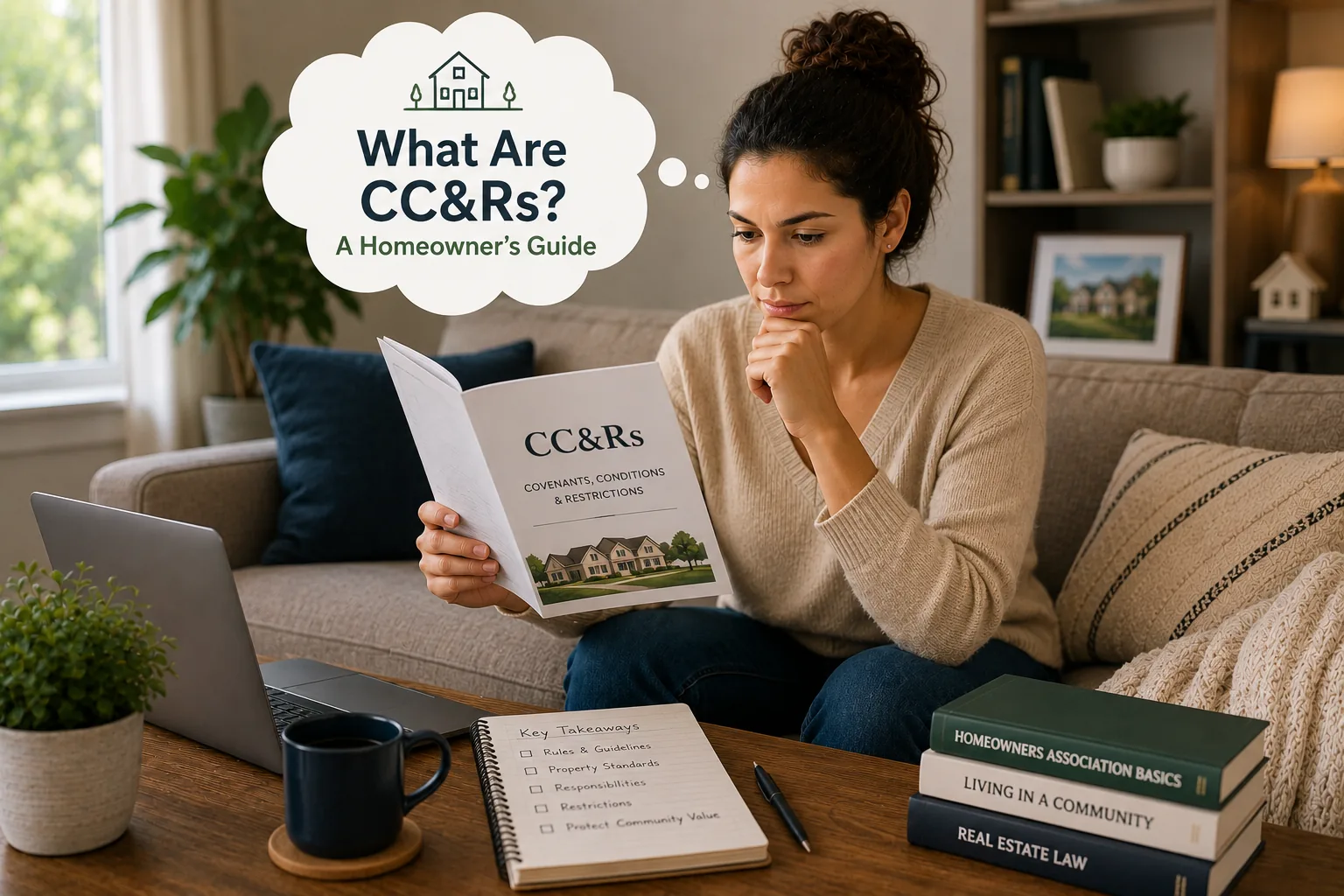
CC&Rs, or Covenants, Conditions, and Restrictions, are the recorded rules that shape life in a planned community. If you want the CC&R definition or the CC&Rs meaning, think of them as HOA covenants that tell owners how they may use, keep, and change a home. They can set limits on paint, pets, parking, and rentals. If you break them, you may face fines, liens, or, in rare cases, foreclosure.
What CC&Rs Really Are
If you buy a home in a planned community, such as a subdivision, a condo, or a co-op, you usually agree to CC&Rs. The full name is the Declaration of Covenants, Conditions, and Restrictions. It is a recorded legal document, not just a homeowner handout.
Cornell Law School's Wex legal guide says these rules govern how real estate may be used in a community. A homeowners association, a neighborhood association, or the original builder or developer may enforce them. In simple terms, a covenant is a promise, a condition is a rule tied to ownership, and a restriction limits what you may do with the property.
Once recorded, these rules run with the land. That means they bind you and every future owner, not just the first signer.
Where CC&Rs Come From and How They Are Recorded
Most of these rules start with the original developer. The developer drafts the declaration before the first homes sell and files it with the county recorder's office. That filing gives the rules legal force. The Texas State Law Library says restrictive covenants are found in the Declaration of Covenants, Conditions, and Restrictions, and a filed declaration becomes part of the county real estate record.
Because they are recorded, these rules are public and searchable. In California, a recorded Declaration of CC&Rs is the main governing document for apartment projects, condo projects, planned developments, and stock cooperatives. State rules differ, so always check your own property code instead of assuming one national rule.
What's Inside a Declaration of CC&Rs
A typical declaration covers several topics at once:
- Design rules, such as approved paint colors, roof materials, or fence height
- Use rules, including pets, short-term rentals, home businesses, and parking
- Care duties for the owner and the HOA
- Fees and dues, including how they are set and collected
- Enforcement steps and penalties for rule breaks
- Insurance rules and lender protections
Not every community covers each item in the same depth. A high-rise condo's declaration will look different from a single-family subdivision's because shared building systems create duties that a detached-home community does not face.
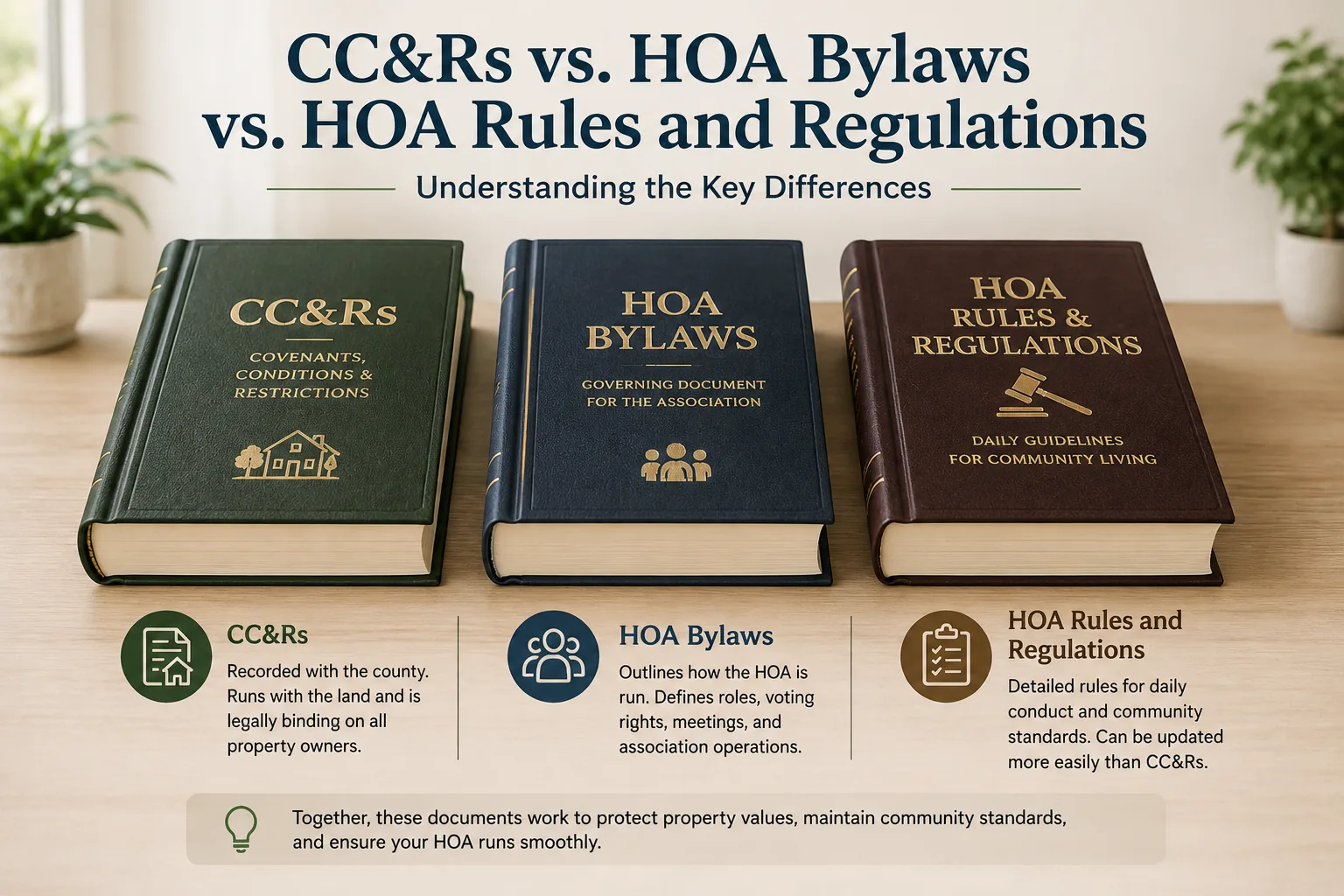
CC&Rs vs. HOA Bylaws vs. HOA Rules and Regulations
People often use these terms to mean every HOA rule. But the National Association of Realtors says HOA governance rests on three different papers, each with its own job and change process. For a deeper look at how day-to-day rules get set and updated, see our guide to HOA rules and regulations.
How CC&Rs Are Enforced
Enforcement often starts small. Nolo's legal guide says HOA rule breaks can lead to fines, loss of access to shared amenities, liens, and, in some cases, foreclosure. Most associations start with a written notice. If the problem continues, they may issue a fine. If the issue still is not fixed, they may place a lien on the property. Boards handling repeated violations often lean on a documented process, similar to what we cover in our guide to HOA board member responsibilities.
A lien does not mean the home is lost right away. It means the association has a legal claim on the property that usually must be cleared before a sale or refinance. Foreclosure for unpaid HOA fines is possible in many states, but it is usually a last resort. Some states also limit foreclosure when the only issue is a rule break.
Can CC&Rs Be Changed?
Yes, but not easily. That is by design. Because these covenants are recorded with the county, changes usually require a formal amendment process in the original declaration. That often means a super-vote of the membership and then re-recording the updated declaration.
The Texas State Law Library points to several Texas Property Code chapters that cover changing restrictive covenants. This is a good reminder that amendment rules are set by state law and can differ a lot by location. If a rule conflicts with state law, courts usually will not enforce it.
How to Find Your Community's CC&Rs
If you already own a home in an HOA, the fastest place to look is your closing papers or your HOA's portal. If you cannot find them there, try these options:
- Contact the county recorder's or clerk's office where the property is located and ask for the recorded Declaration of CC&Rs
- Ask your HOA board or management company, since associations usually must share governing documents with members
- Check your title company records from the home sale, since these rules are often given at closing
If you are buying in a planned community, ask for the rules before you make an offer, not after you close.
Why CC&Rs Matter for Property Values
These covenants are meant to protect property values by keeping the community's look and standards steady. The National Association of Realtors says about 75.5 million Americans live in HOA-governed communities, so CC&Rs affect daily life and resale value for a large part of the housing market.
For buyers, that stability can be a plus. For owners, a rule that feels strict today, such as a fence-height limit or a ban on visible storage sheds, may be the same rule that helps curb appeal and resale value later.
This article gives general education about HOA governing documents and is not legal advice. Enforcement rules, amendment rules, and foreclosure rules vary by state. Talk with a licensed real estate lawyer in your state before you act on your community's covenants.
Next Steps
Serving on a board that's revisiting your community's governing documents? ManageCasa gives HOA boards a central place to store CC&Rs, track violations, and communicate changes to homeowners. See how it works on the property management platform, or check current pricing. Learn more at ManageCasa.
Frequently Asked Questions
What are CC&Rs?
CC&Rs, or Covenants, Conditions, and Restrictions, are legally recorded rules that govern how homeowners can use, maintain, and modify their property within a planned community. They may cover landscaping, parking, pets, rentals, and exterior changes. The HOA typically enforces these restrictions. Because CC&Rs run with the land, they generally apply to both current homeowners and future property owners.
Are CC&Rs legally binding?
Yes. CC&Rs are generally legally binding once they are properly recorded with the county and attached to the property. Because they run with the land, homeowners typically become subject to them when they purchase the property. Violations may result in warnings, fines, legal action, or liens. In serious cases, enforcement may potentially lead to foreclosure, depending on applicable state law.
Can CC&Rs be changed?
Yes, CC&Rs can be changed, but the process is usually more difficult than changing ordinary HOA rules. The association must follow the amendment procedure stated in its governing documents and applicable state law. This commonly requires approval from a specified percentage of homeowners. Once approved, the amendment generally must be formally recorded with the appropriate county office before taking effect.
Who enforces CC&Rs when there is no active HOA?
When there is no active HOA, the CC&Rs do not necessarily disappear. Because recorded covenants typically run with the land, individual homeowners may have the right to enforce certain restrictions against other property owners through civil court. The exact enforcement options depend on the language of the CC&Rs, state law, and whether the particular covenant remains valid and enforceable.
What is the difference between CC&Rs and HOA bylaws?
CC&Rs primarily govern how properties within the community may be used, maintained, and changed. They can address issues such as architectural modifications, rentals, landscaping, and property restrictions. HOA bylaws focus on how the association itself operates, including board elections, meetings, officer responsibilities, and voting procedures. They are separate governing documents and usually have different requirements for amendments.

Expert in Property Management and SaaS
Peter Koch is an expert in property management and SaaS, focused on building top digital tools for property managers and growing technology-driven startups. He specializes in enhancing property management operations through smart software solutions that streamline accounting, automate workflows, and improve community communication. Peter writes about HOA management technology, proptech innovation, and scalable SaaS strategies designed to help modern property professionals operate more efficiently.