




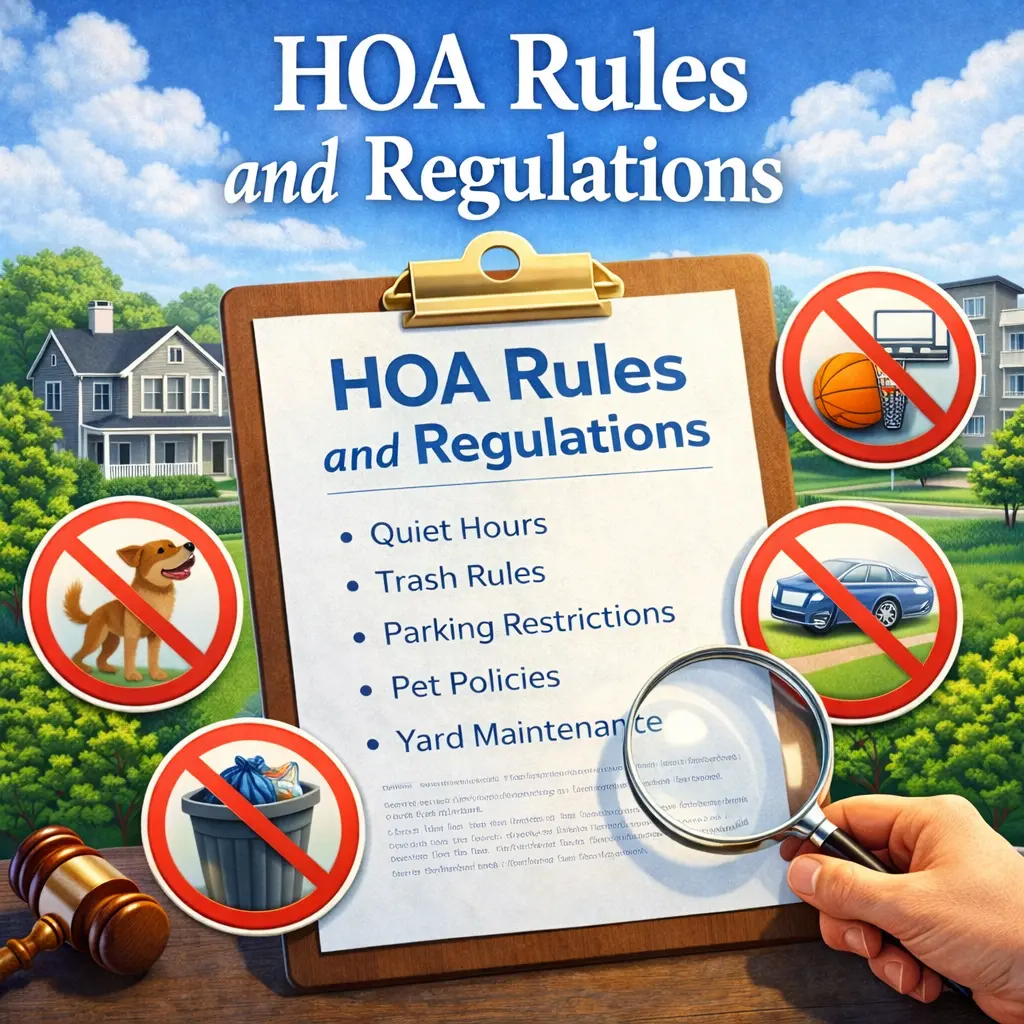
Quick answer: HOA rules and regulations are the binding policies a homeowners association uses to govern how owners use their homes and shared spaces. They come from three layers: recorded CC&Rs, bylaws that run the association, and board-adopted rules for daily matters like parking, pets, and noise. State and federal law override any HOA rule that conflicts with them.
HOA rules shape more of daily life in a planned community than most buyers expect. The Foundation for Community Association Research estimates there are about 373,000 community associations in the U.S., counting HOAs, condominiums, and cooperatives, with roughly 78.1 million residents. Every one of them runs on a written set of rules.
If you live in one, those rules apply from the day you close. They cover details like how you can paint your front door and where guests are allowed to park. These rules can affect everyday decisions, so understanding them before a problem comes up can save homeowners from unexpected violations or fines. Knowing how they work protects your property, your money, and your rights.
This guide walks through the governing document hierarchy, the rules most HOAs adopt, how enforcement works, which rules a board can't legally enforce, how to find your own community's rules, and the state law changes that matter in 2026.
Legal disclaimer: This article is for general education and is not legal advice. HOA law varies by state and by community, and it changes often. Check your governing documents and talk with a licensed real estate or community association attorney in your state before acting on a dispute.
What Are HOA Rules and Regulations?
HOA rules and regulations are the written policies that govern how owners in a planned community use their homes and shared spaces. People also call them HOA guidelines or community rules. Legally, though, they sit inside a layered set of governing documents, and each layer carries different weight.
The three layers that matter most are the CC&Rs, the bylaws, and the rules and regulations adopted by the board. Each document has its own role and its own amendment process, so knowing which layer a rule lives in tells you how binding it is and how hard it would be to change.
CC&Rs (Covenants, Conditions, and Restrictions)
The CC&Rs are the foundation. They're recorded with the county, so they run with the land and bind every current and future owner. They cover property use, architectural standards, assessments, and the association's enforcement powers. In California they operate under the Davis-Stirling Common Interest Development Act. Our guide to what CC&Rs are and how they work goes deeper on this layer.
Changing CC&Rs is hard on purpose. Most declarations require a supermajority of owners, often two-thirds, and the amendment has to be re-recorded with the county.
Bylaws
Bylaws govern how the association itself runs: elections, board terms, officer roles, meetings, and voting. Board members owe the community a fiduciary duty, which means acting in the association's interest rather than their own. The HOA board member responsibilities guide covers those duties in detail.
Bylaws are easier to amend than CC&Rs, though most still require a vote of the membership.
Rules and Regulations
This is the most flexible layer, and it's what most people mean when they say "HOA rules." It handles daily operations: pool hours, guest parking, pet leashing, trash pickup, and quiet hours.
In most communities the board can adopt or change these rules by majority vote without a full owner ballot, provided the new rule doesn't contradict the CC&Rs, the bylaws, or state law. Some states add process. California, for example, requires boards to give owners 28 days' notice before adopting most operating rule changes (Civil Code Section 4360).
Key point: State and federal law sit above every governing document. If a rule in your CC&Rs, bylaws, or board policies conflicts with a statute, the statute wins and the rule can't be enforced.
Do HOA rules override city ordinances?
No. HOA rules and local laws run side by side, and you have to satisfy both. An HOA can be stricter than the city, so a community can ban a fence that zoning would allow. What it can't do is authorize something the law forbids or enforce a rule that a state or federal statute prohibits. Where the two collide, the law controls.
The reverse matters too. Police don't enforce HOA rules. Unless a violation also breaks a local law, such as a noise ordinance, an HOA dispute is a civil matter between you and the association.
Common HOA Rules and Guidelines
Most HOA guidelines fall into a familiar set of categories: HOA rules often focus on changes that affect the look, use, and day-to-day experience of the community. That can include anything from modifying your home’s exterior to parking a vehicle overnight or renting out your property. The details vary a lot from one community to the next, which is why your own governing documents matter more than any general list.
Architectural and exterior. Most HOAs require written approval before you repaint, replace a roof, add a fence, or change the structure. An Architectural Review Committee (ARC) usually handles requests. California, Florida, and Texas all require denials to be in writing with a reason, so it's worth asking for one if you only get a verbal no.
Landscaping. Associations set standards for lawns, trees, and approved plants. Drought rules are the big shift. Texas now bars HOAs from fining owners for brown or discolored turf during a mandated watering restriction and for 60 days after it lifts, under Property Code Section 202.008, added by HB 517 in 2025. California gives similar protection during declared drought emergencies.
Parking. Most communities limit where residents and guests can park. Typical rules ban long-term street parking, commercial vehicles in driveways, and overnight guest cars without a permit.
Pets. Pet rules usually cap the number of animals and require leashes and cleanup. Even in a no-pets community, the board must consider reasonable accommodation requests for assistance animals under the Fair Housing Act. Pet and noise policies also show up near the top of the HOA rules residents dislike most.
Noise. Quiet hours are standard wherever homes share walls. They set acceptable times for music, power tools, and outdoor gatherings.
Rentals. Many communities limit or ban short-term rentals, and some cap how many homes can be leased at once. State law limits how far those restrictions reach, especially for owners who bought before a new rule passed. The HOA rental restrictions guide covers the state-by-state detail.
Solar and energy upgrades. Solar access laws in California, Florida, Arizona, Colorado, Texas, and other states let HOAs regulate placement but not ban panels outright. Our HOA solar panel guide walks through the approval process.
Signs and flags. Boards can regulate size and placement, but federal law protects displaying the U.S. flag, and several states protect political signs.
How HOAs Enforce Rules
HOAs enforce rules through a graduated process: written notice, a chance to fix the problem, a hearing, then a fine, with liens and legal action held back as a last resort. Boards have to follow the steps in their governing documents and state law, and apply each rule the same way to every owner.
A board that skips steps, singles out one owner, or fines without notice exposes the association to a legal challenge. Boards can find the full process in the HOA violations and enforcement guide. Homeowners responding to a notice can start with how to handle HOA violations.
1. Written notice. The HOA names the rule, describes the violation, and sets a deadline to fix it. Every later step depends on this paper trail.
2. A chance to cure. Many states build in time to fix the problem before a fine. California expanded this in 2025: under AB 130's changes to Civil Code Section 5855, an owner who cures the violation before the hearing, or commits to a plan when the fix takes longer, generally avoids the fine.
3. Hearing. Owners can ask for a hearing before the board to dispute the violation, present evidence, or propose a fix. Many states require this before a fine becomes final.
4. Fine. If the violation continues, the HOA applies its published fine schedule. California caps most fines at $100 per violation under AB 130, signed June 30, 2025, and bans late fees and interest on fines. Higher fines are allowed only for health or safety violations, and only after the board makes a written finding in an open meeting. Most other states leave amounts to the governing documents.
5. Lien or legal action. Unpaid balances can lead to a lien and, in some states, foreclosure. Several states draw a hard line here. Texas and Colorado both bar foreclosure on a debt made up only of fines, and Colorado's HB22-1137 requires the HOA to offer a repayment plan before it can foreclose on unpaid assessments.
Example escalation only. Your community's fine schedule and state law control the actual steps and amounts.
Capability note: Consistent enforcement depends on records. ManageCasa's architectural review and compliance tools let boards log each violation with photos and notes, send notices, track cure deadlines and hearings, and keep a dated history of every step. That history is what a board needs if an owner later argues selective enforcement.
Can an HOA enforce rules selectively?
No. Selective enforcement is one of the most common grounds for challenging an HOA fine. If the board penalizes one owner for a violation while ignoring the same thing next door, the fine is open to challenge, and courts in many states have sided with homeowners on exactly that argument.
To make the case, you need evidence that the board is ignoring identical violations by others:
1. Document the pattern. Take dated photos of other homes breaking the same rule, over several days or weeks.
2. Review the minutes. Request recent board meeting minutes and look for whether anyone else was cited for the same issue.
3. Put it in writing. Send the board a letter by certified mail with your evidence, explain why you believe enforcement is selective, and ask that the fine be withdrawn.
What happens if you ignore an HOA fine?
Ignoring a fine doesn't make it go away. Unpaid fines and assessments can turn into a lien, which is a recorded legal claim against your home. A lien shows up in the public record and generally has to be paid off before you can sell or refinance.
In some states an HOA can foreclose on that lien. It's rare, legally complex, and restricted in states like Texas and Colorado, but it does happen. Responding to the first notice is almost always the cheaper path.
Unenforceable HOA Rules: What an HOA Cannot Do
An HOA rule is unenforceable when it conflicts with federal or state law, was adopted without following the governing documents, or is enforced against some owners but not others. Federal law sits at the top, state statutes come next, and the community's own documents sit at the bottom.
Plenty of owners comply with rules they have no legal obligation to follow. These are the conflicts that come up most:
The Fair Housing Act reaches further than many boards realize. An HOA can't enforce a rule that discriminates based on race, color, religion, sex, disability, familial status, or national origin. It also has to make reasonable accommodations for residents with disabilities, which might mean allowing an assistance animal in a no-pets building or approving a wheelchair ramp that doesn't match the usual architectural guidelines.
For a longer list with real examples, see our breakdown of unenforceable HOA rules and the most disliked rules.
How do you know if an HOA rule is unenforceable?
Run three tests. Does the rule contradict a state or federal law? Did the board follow the adoption steps in the governing documents? Is it enforced equally against every owner? If the answer to any of those is no, the rule may not hold up.
How to challenge an unenforceable HOA rule
• Read your CC&Rs, bylaws, and current state law to confirm the conflict is real before you act.
• Ask the board for the adoption records. If it skipped required steps, the rule may be invalid on procedure alone.
• Send the board a letter naming the specific law the rule violates, and raise it at a board meeting if you can.
• Try internal dispute resolution or mediation. Some states, including California, require an offer of alternative dispute resolution before certain lawsuits.
• File a complaint with HUD if the problem involves discrimination under the Fair Housing Act.
• Talk to a real estate attorney if you've already been fined under a rule you believe is invalid.
How to Find Your HOA's Rules
Start with your HOA board or management company, which usually has to give members copies of the governing documents. Your closing packet, the HOA's owner portal or website, and the county recorder's office (for CC&Rs) are the other places to look.
• Ask the board or manager in writing. State records laws generally give owners the right to inspect and copy governing documents, meeting minutes, and financial records.
• Check your closing documents. Sellers usually have to hand buyers the governing documents before closing. California requires this under Civil Code Section 4525, and Florida requires a disclosure summary for HOA properties under Section 720.401.
• Look online. Florida HOAs with 100 or more parcels must post governing documents on a website or app. Texas requires many associations to post their dedicatory instruments online under Property Code Section 207.006, and the Texas State Law Library points owners to the state's HOA management certificate database.
• Search county records. CC&Rs and their amendments are recorded with the county recorder or clerk. Our CC&Rs guide explains how to find your community's CC&Rs.
• Buying? Ask first. Request the full set of rules before you make an offer, not after you close.
HOA Special Assessment Rules in Brief
A special assessment is a one-time charge on top of regular dues, usually for a major repair or shortfall the reserve fund can't cover. Most governing documents and state laws require advance written notice, and many require an owner vote once the amount passes a set threshold.
Emergencies are the usual exception. California's SB 900, effective January 1, 2025, lets boards levy an emergency assessment without a member vote to restore gas, heat, water, or electrical service when reserves fall short. Underfunded reserves are the most common root cause, which the HOA reserve funds guide explains. For approval thresholds, notice rules, payment plans, and how to dispute an assessment, see the full HOA special assessments guide.
HOA Laws by State: Key 2025 and 2026 Updates
The biggest recent changes: California capped most HOA fines at $100, Florida now requires board education and websites for larger HOAs, Texas added electronic voting and drought protections, and Washington applied core WUCIOA rules to every community on January 1, 2026.
California
AB 130 was signed on June 30, 2025, and took effect immediately. According to the California Legislative Action Committee of CAI, it amended Civil Code Sections 5850 and 5855 to cap most fines at $100, require a written board finding before any higher health or safety fine, and give owners a chance to cure before a hearing. Late fees and interest on fines are gone too. The full list of changes is in our guide to California HOA law changes for 2026.
SB 900 requires associations to start repairs within 14 days when an interruption to gas, heat, water, or electrical service begins in a common area, and it lets boards borrow and levy an emergency assessment without a member vote when reserves can't cover the work. SB 326 set January 1, 2025 as the deadline for first inspections of balconies and other elevated elements in condo associations with three or more units.
Florida
Florida HOAs operate under Chapter 720 of the Florida Statutes. Under Section 720.3033, newly elected or appointed directors must complete DBPR-approved education within 90 days, and the certificate is good for up to four years. Directors then need 4 hours of continuing education each year, or 8 hours in associations with 2,500 or more parcels. The Florida HOA law guide covers the 2026 updates in detail.
Associations with 100 or more parcels must keep governing documents on a website or app. Florida law also limits HOA restrictions on items such as vegetable gardens, clotheslines, artificial turf, boats, and recreational vehicles when they aren't visible from the street, a neighboring parcel, the common area, or a community golf course.
Texas
Texas HOAs are governed mainly by Property Code Chapters 202 and 209, which the Texas State Law Library summarizes for owners. The 2025 session added electronic meetings and alternative voting methods (SB 2629), new architectural review committee rules (SB 711), and the brown-turf fine protection in HB 517, all effective September 1, 2025. Our Texas HOA law guide covers owner rights under Chapter 209.
Washington
Under ESSB 5129, key parts of the Washington Uniform Common Interest Ownership Act started applying to every common interest community on January 1, 2026, including older communities that never opted in. They cover meeting requirements, board powers during declared emergencies, how assessments can be paid, EV charging stations, and heat pumps. Full WUCIOA coverage for all communities follows on January 1, 2028.
Colorado
Most Colorado associations fall under the Colorado Common Interest Ownership Act. HB22-1137 made fines and fees ineligible for foreclosure and requires a repayment plan offer before an HOA can foreclose on assessments. The state's HOA Information and Resource Center doesn't regulate associations, but its HOA FAQ is a useful plain-language reference for owners and boards.
Homeowner Rights Under HOA Rules and Regulations
Homeowners generally have the right to see governing documents and records, attend board meetings, vote on major decisions, get notice and a hearing before a fine, challenge unenforceable rules, and use mediation or the courts when the HOA breaks the law or its own procedures.
Living under HOA rules doesn't mean giving up your legal rights. The details vary by state, but these hold in most places:
- Access to governing documents, budgets, reserve studies, financial statements, major contracts, and meeting minutes, usually upon written request
- Attendance at open board meetings, with an opportunity to speak before the board votes
- A vote on CC&R and bylaw amendments, board elections, and, in many communities, large special assessments
Other protections become especially important when a homeowner faces a violation or disputes a board decision. These may include:
- Written notice and a hearing before a fine is imposed
- Internal dispute resolution or mediation before going to court
- Equal and consistent enforcement of community rules
- Protections for satellite dishes, the U.S. flag, solar panels, and, in many states, EV chargers and heat pumps
Frequently Asked Questions
Can an HOA change its rules after you buy your home?
Yes, as long as the HOA follows the amendment process in its governing documents and state law. Boards can usually update day-to-day rules by vote, while CC&R changes need owner approval. Some states shield existing owners from certain new rules, such as California's limits on applying a new rental cap to owners who already rent.
Do you have to follow HOA rules?
Yes. HOA rules are legally binding on every owner in the community from the day you take title, whether or not you read them first. Buying the home is treated as agreeing to the recorded CC&Rs and the rules adopted under them. The exceptions are rules that break state or federal law or were adopted improperly.
How do you find your HOA's rules?
Ask your HOA board or management company first, since owners generally have a legal right to copies of the governing documents. You can also check your closing packet, the HOA's owner portal or website, and the county recorder's office, where CC&Rs are recorded. Buyers should get the full set before making an offer.
What happens if you don't follow HOA rules?
You'll usually get a written violation notice first, with a deadline to fix the problem. If it continues, the HOA can hold a hearing and impose fines under its published schedule. Unpaid fines can become a lien on your home. Foreclosure is possible in some states, though several, including Texas and Colorado, bar foreclosure over fines alone.
Can you sue your HOA for not enforcing its rules?
Often, yes. CC&Rs are generally enforceable by the association and, in many states, by individual owners. California allows owner lawsuits to enforce the governing documents under Civil Code Section 5975. Courts tend to defer to good-faith board decisions, though, so a written demand and mediation usually come first and cost far less than litigation.
Related HOA Guides
• What Are CC&Rs? A Homeowner's Guide
• HOA Violations and Enforcement: The Complete Process Guide
• How to Handle HOA Violations
• HOA Special Assessments: Rules, Limits, and Homeowner Rights
• Unenforceable HOA Rules and the 15 Most Disliked
• HOA Rental Restrictions: State-by-State Guide
• HOA Board Member Responsibilities and Duties
• California HOA Law Changes for 2026
Key Takeaways for Homeowners and Boards in 2026
HOA rules exist to protect shared property and set a baseline for the whole community. The structure is the same everywhere: CC&Rs form the foundation, bylaws run the board, and day-to-day rules handle the details.
The direction of travel across states is just as consistent. Recent changes to HOA laws have added new requirements for boards while giving homeowners more protections. In many states, this includes limits on fines and clearer rules around access to association records and board decisions.
For boards, that means reviewing CC&Rs, fine schedules, and enforcement procedures against current state law. Outdated documents are a real legal exposure. For homeowners, the point is simpler: not every rule on paper is valid. Homeowners should understand both their governing documents and the HOA laws in their state. When a notice or violation comes up, keeping the response in writing also creates a clear record of the issue.
Keep Your Community's Rules Organized and Enforced Fairly
ManageCasa, Powered by Minii AI, gives HOA boards one place to store governing documents, track violations and architectural requests, and communicate rule changes to every homeowner. Explore the HOA platform, compare plans and pricing, or learn more at ManageCasa.

Expert in Property Management and SaaS
Peter Koch is an expert in property management and SaaS, focused on building top digital tools for property managers and growing technology-driven startups. He specializes in enhancing property management operations through smart software solutions that streamline accounting, automate workflows, and improve community communication. Peter writes about HOA management technology, proptech innovation, and scalable SaaS strategies designed to help modern property professionals operate more efficiently.