


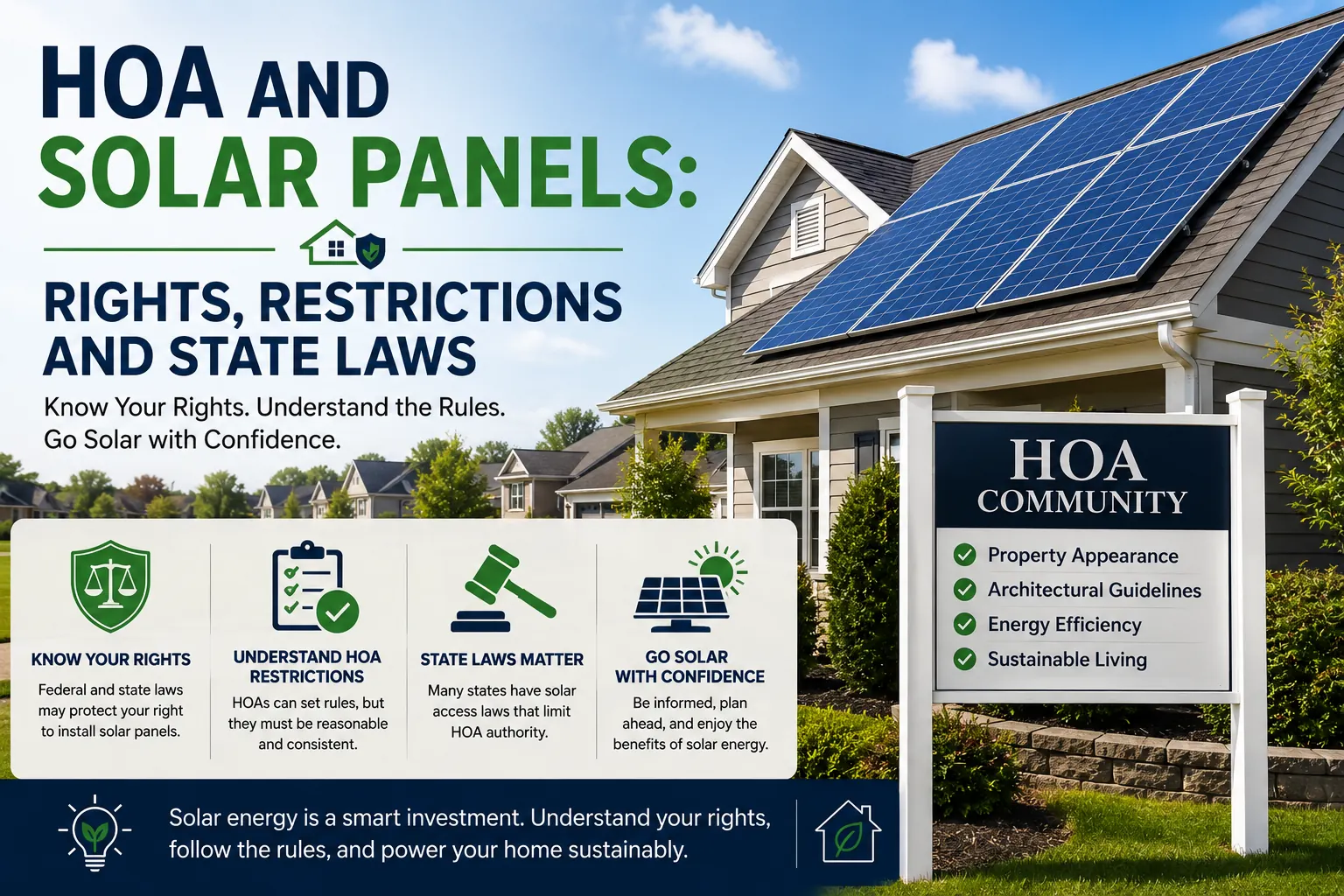
HOAs can restrict but not outright ban solar panels in most US states. State solar rights laws protect homeowners' right to install solar energy systems while allowing HOAs to set reasonable guidelines on placement, appearance, and safety. Restrictions that reduce system efficiency by more than 10% or significantly increase installation costs are generally unenforceable. Homeowners must typically submit an architectural review application and receive HOA approval before installation.
Approximately 74 million Americans live in the roughly 377,000 community associations across the US, according to the Foundation for Community Association Research. For the growing share of those residents who want to install solar panels, the HOA adds a layer of process that does not exist for homeowners in non-governed communities.
The good news is that no state allows HOAs to ban solar outright. The challenge is navigating the guidelines that HOAs are permitted to enforce and understanding where state law limits that authority. This guide covers the federal picture, the key state-level solar rights laws, what HOA guidelines are enforceable, how to get approval, and what to do if your HOA is being unreasonable.
Foundation for Community Association Research — Community Association Fact Book
Does Federal Law Protect Solar Panel Rights in HOAs?
There is no federal law that directly addresses HOA restrictions on solar panels the way state solar access laws do. However, federal policy supports solar adoption in several relevant ways.
• Federal Investment Tax Credit (ITC): Homeowners who install solar panels may claim a federal tax credit worth 30% of the installation cost under the Inflation Reduction Act of 2022. This credit applies regardless of HOA rules and is administered by the IRS, not subject to HOA authority.
• First Amendment protections: HOAs cannot use solar panel restrictions to target specific homeowners in a discriminatory way. While the First Amendment does not directly protect solar installation as a right, federal civil rights law prevents HOAs from applying rules selectively based on protected characteristics.
• Federal housing law: The Fair Housing Act applies to HOAs and prevents rules that have a discriminatory disparate impact on protected groups, including disabled persons who may rely on energy systems for medical equipment.
The practical weight of the federal picture is that the 30% ITC makes solar installation significantly more affordable, and that financial incentive has accelerated homeowner demand in HOA communities considerably. The primary legal framework protecting that right, however, comes from state law.
US Department of Energy homeowners guide to the federal solar tax credit
State Solar Rights Laws: What HOAs Can and Cannot Do
More than 25 states have enacted solar access or solar rights laws that limit HOA authority over solar panel installations. The scope of protection varies by state. Here are the most active markets.
California — Civil Code 714
California Civil Code 714 is one of the strongest solar access laws in the country. It prohibits HOAs from placing any conditions on solar installations that would reduce system efficiency by more than 10%, increase installation costs by more than $1,000 (or $2,000 for systems over 10 kW), or effectively prohibit the installation.
HOAs may set aesthetic requirements for panel color, panel placement relative to the roofline, and other visual standards, but those standards cannot be used to block a technically compliant installation. California also mandates solar panels on all newly constructed single-family homes under its 2020 Building Code.
California Civil Code 714 full text
For a full overview of California HOA law, see California HOA law changes 2026.
Texas — Property Code Section 202.010
Texas Property Code Section 202.010, as amended by HB 362, prohibits HOAs from banning solar panels outright. HOAs may enforce specific standards:
• Panels must be parallel to the roofline and conform to its slope
• Ground-mounted panels cannot extend above the roofline or homeowner's fence
• Panels must use approved tones (silver, bronze, or black)
• Installations must not violate health, safety, or applicable law
• HOA approval must be obtained before installation begins
If a homeowner wants to install panels in a location other than the one suggested by the HOA, they can use the NREL PV Watts Calculator to demonstrate that their preferred placement increases annual energy production by at least 10%.
• SB 1626 note: Developers of subdivisions with 50 or fewer units may prohibit solar panel installations during the development phase. This exception does not apply to established communities.
Texas Property Code 202.010 (solar device provisions)
Florida — Statute 163.04
Florida Statute 163.04 prevents any HOA from prohibiting solar collectors or other energy devices based on energy type if they are protected under this statute. Key provisions:
• Panels must face true south or within 45 degrees east or west
• HOA placement requirements cannot significantly reduce system efficiency
• Installations must adhere to public safety standards
Florida House Bill 697 extends these protections to condominium associations, allowing condo boards to install solar panels on common property without individual unit owner approval, provided the decision follows normal board governance procedures.
For broader Florida HOA law context, see new HOA laws in Florida.
Colorado — C.R.S. 38-30-168
Colorado Revised Statutes 38-30-168 prohibits HOAs from banning solar but allows reasonable guidelines that do not reduce efficiency by more than 10% or increase costs by more than 10%. Additional requirements:
• HOAs must approve or deny a complete solar application within 60 days
• If no decision is made within 60 days, the application is automatically approved
• Homeowners may propose alternate panel placements with an efficiency justification using NREL PV Watts Calculator
Colorado solar access law provisions
Other Key States
What HOA Solar Panel Restrictions Are Enforceable?
HOAs retain real authority to regulate how solar panels are installed, even if they cannot ban them. Understanding which restrictions are enforceable helps homeowners prepare proposals that are more likely to be approved the first time.
Enforceable HOA Solar Panel Guidelines
• Placement on the roof: HOAs may specify which roof faces are acceptable for panel placement, such as rear-facing only, provided the restriction does not reduce efficiency beyond the state threshold.
• Color and appearance standards: Requirements that panels use specific tones (black, silver, bronze) or that panels match the roof material are typically enforceable, provided they do not significantly increase cost.
• Conformity to the roofline: Requirements that panels be flush with or parallel to the roofline, with no visible racking extending above it, are standard and generally enforceable.
• Safety compliance: Requiring that installations comply with local building codes, fire codes, and manufacturer specifications is enforceable and reasonable.
• Prior approval requirement: All states that have solar access laws still permit HOAs to require prior architectural review approval before installation begins.
• No common area installations: HOAs can prohibit individual homeowners from installing panels on shared roofs or common property without board authorization.
Unenforceable HOA Solar Panel Restrictions
• Outright bans: In every state with a solar access law, total prohibition of solar panels is unenforceable.
• Efficiency-killing placement requirements: Restrictions that force panels into positions that reduce system efficiency by more than 10% (the standard in California, Colorado, Arizona, and Nevada) are unenforceable.
• Unreasonable cost increases: Requirements that would increase installation cost by more than the state threshold (typically 10-15%) are void.
• Indefinite review delays: In Colorado, failure to decide within 60 days results in automatic approval. Other states have similar protections against indefinite delay.
• Aesthetic standards that block installation: Guidelines framed as aesthetic that effectively prohibit any compliant installation are treated as de facto bans and are unenforceable.
How to Get HOA Approval for Solar Panels
HOA approval for solar panels follows the same architectural review process as other exterior modifications. A well-prepared application moves faster and faces fewer objections.
Step 1: Review Your CC&Rs and Architectural Guidelines
Find the sections in your governing documents that cover exterior modifications, architectural review, and any specific solar or energy device provisions. Note what the HOA requires in terms of placement, appearance, and submission materials. Understanding these standards before you design your system saves significant time.
Step 2: Know Your State Law
Confirm which solar access law applies to your state and what it protects. If your HOA's guidelines conflict with state law, note the specific statute. You may need to cite it if the board initially denies your application.
Step 3: Prepare a Complete Application Package
Most HOAs require:
• A roof layout or site plan showing panel placement
• Panel specifications including color, dimensions, and manufacturer information
• Energy production estimates from your installer or from the NREL PVWatts Calculator
• Installer credentials, licenses, and insurance certificates
• Mounting system specifications showing roofline conformity
A complete package on first submission is the single most effective way to speed up the process. Incomplete applications are the most common reason for delays.
NREL PVWatts Calculator for energy production estimates
Step 4: Submit and Follow the Timeline
Submit your application in writing through the HOA's documented process. Keep a copy of everything submitted and record the date. If your state has a mandatory response deadline (60 days in Colorado, for example), calendar it. If the deadline passes without a decision, the application may be automatically approved.
Step 5: Respond to Objections Constructively
If the board has concerns about placement or appearance, engage them constructively. Propose an alternative placement and document, using PVWatts, that it meets the efficiency standard. Boards that understand your proposal is both lawful and professionally designed are more likely to approve it quickly.
If the board denies an application that appears to comply with state law, consult a local HOA attorney before escalating to a state regulatory body or civil action.
Solar Panels in Condominium Associations
Condominium HOAs present a more complex situation for solar installations because homeowners typically do not own their roof. The roof is a common element owned by the association. This creates a different legal framework.
• Board-authorized common area installations: In Florida and several other states, condo boards can authorize solar panel installation on shared roofs as a common-area improvement through a board vote, without requiring individual unit owner approval.
• Exclusive-use common areas: In some condominium developments, homeowners have exclusive-use rights to a rooftop terrace or specific roof section. Check your declaration to determine whether you have exclusive-use rights to any roof area before applying.
• Balcony installations: Some condo owners install smaller solar systems on balconies or terraces where they have exclusive-use rights. These installations are still subject to HOA aesthetic guidelines and safety requirements.
• Shared cost programs: Some condominium associations have implemented community solar programs where a single array serves multiple units and costs are shared through assessments. This approach avoids the individual approval complexity entirely.
Benefits of Solar for HOA Communities
Beyond individual homeowner savings, solar adoption in HOA communities produces community-level benefits worth noting in any advocacy effort.
• Property values: Studies consistently show solar-equipped homes sell faster and at a premium. In an HOA community, a critical mass of solar installations has a measurable positive effect on overall community property values.
• Lower common area energy costs: Community solar installations on common areas such as clubhouses, pools, lighting systems, and parking can meaningfully reduce the HOA's operating expenses, lowering assessment pressure on all homeowners.
• Sustainability positioning: Communities that support solar adoption attract environmentally motivated buyers, which in competitive markets translates to stronger demand and shorter days on market.
• Reduced grid dependence: Communities with significant solar penetration are more resilient during grid disruptions, particularly relevant in hurricane-prone states like Florida and Texas.
Related Guides for HOA Boards and Homeowners
• HOA Rules and Regulations Guide
• HOA Board Member Responsibilities and Rules
• California HOA Law Changes 2026
Managing Architectural Reviews and Community Standards
Solar panel applications are one of the most common and most contested architectural review requests HOA boards receive. Streamlined review workflows, documented decision records, and clear communication with homeowners reduce disputes and keep the process moving. Purpose-built HOA management tools help boards track applications, deadlines, and decisions in one place.
Explore HOA management features and pricing, or visit ManageCasa.com to learn more.
Frequently Asked Questions
Can an HOA deny solar panels?
In most states, HOAs cannot deny solar panels outright if the installation complies with state solar access laws and reasonable community guidelines.
Can an HOA ban solar panels completely?
No. Many states prohibit HOAs from completely banning solar panels. Associations may regulate installation details but generally cannot enforce blanket prohibitions.
Do HOAs allow solar panels?
Most HOAs allow solar panels subject to architectural review and reasonable requirements regarding placement, appearance, safety, and compliance with local regulations.
What are typical HOA solar panel guidelines?
Common HOA solar guidelines address panel placement, roof alignment, appearance, safety standards, and architectural approval while preserving system efficiency.
Is there a federal law protecting solar panel rights against HOAs?
No. Solar panel protections primarily come from state solar access laws, although federal policies encourage solar adoption through incentives and renewable energy programs.

Content Writer
Dann is a real estate and property management content strategist specializing in HOA operations, financial management, and community governance. He works closely with industry professionals to produce accurate, practical guidance for property managers and HOA boards.