


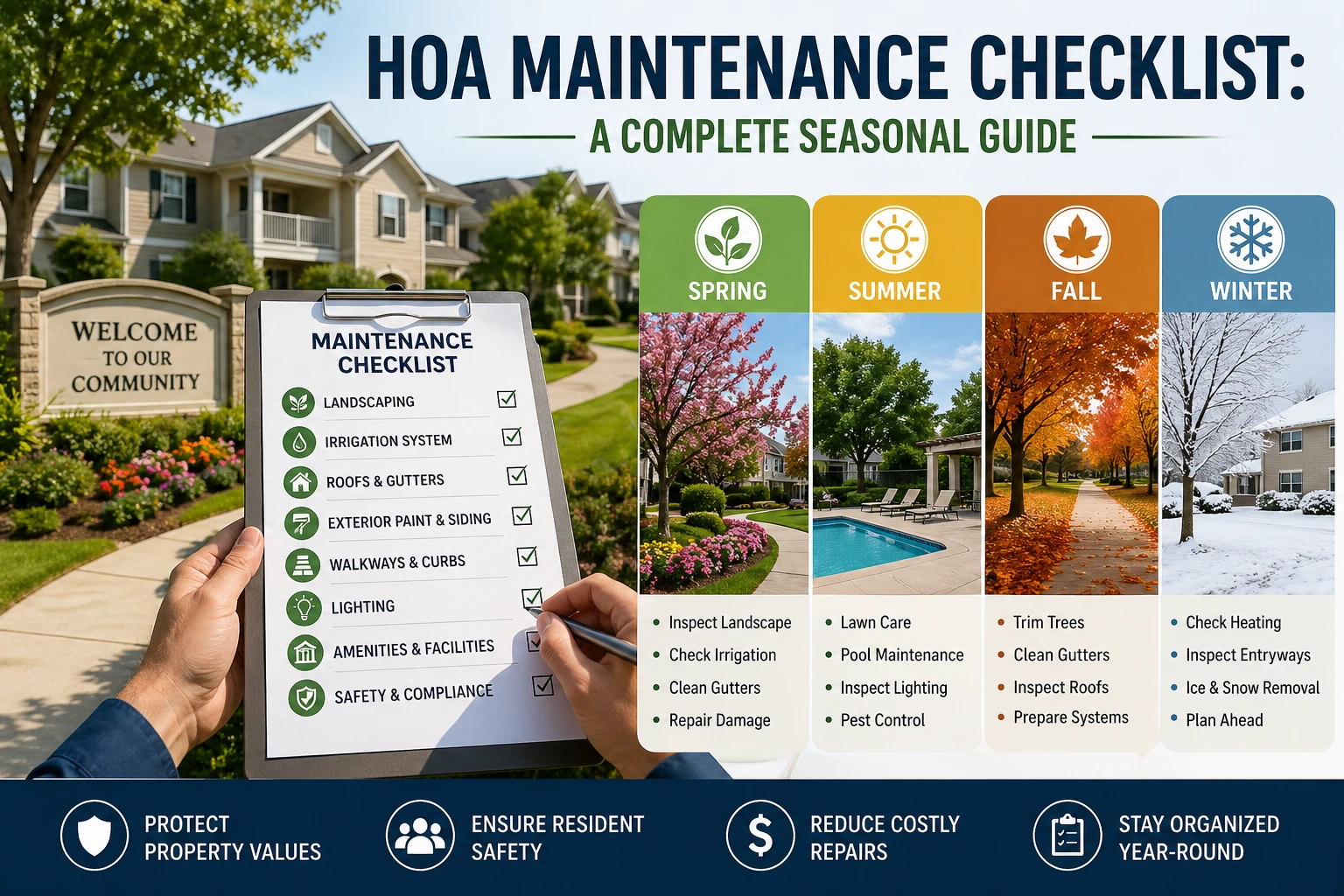
What is an HOA maintenance checklist?
An HOA maintenance checklist is a structured list of inspections, repairs, and upkeep tasks that a homeowners association performs to keep common areas safe, functional, and well-maintained. It organizes maintenance by category and season, ensuring the board and its contractors address every area of the community on a consistent schedule throughout the year.
Maintenance is one of the most visible responsibilities an HOA board carries. When common areas are clean, safe, and well-kept, residents notice. When they are not, the board hears about it quickly. A structured HOA maintenance checklist is what separates proactive management from reactive scrambling.
Without a checklist, tasks get missed. Minor issues become expensive repairs. Liability exposure grows when safety equipment goes uninspected. And when a board member leaves, the institutional memory of what gets checked and when can disappear with them. For a practical overview of how maintenance fits into broader board governance, the guide on HOA best practices covers the operational frameworks that underpin a well-run association.
This guide organizes HOA common area maintenance into the categories and seasonal schedules that keep a community running well year-round.
Why a Formal HOA Maintenance Checklist Matters
A comprehensive maintenance checklist does three things for an HOA. It creates consistency, so that the same tasks are done on the same schedule regardless of which contractor or board member is responsible. It creates accountability, so that completed and outstanding tasks are documented and reviewable. And it creates protection, because documented maintenance records are among the most important evidence an HOA can produce if a safety incident leads to a liability claim.
The financial case is equally clear. HOA preventive maintenance costs a fraction of deferred maintenance. A roof inspection and minor repair done on schedule costs far less than an emergency replacement caused by a leak that was not caught in time. Funding major capital maintenance items through the reserve fund rather than the operating budget is the financial discipline that makes long-term maintenance sustainable. For how that works in practice, see the HOA reserve funds guide.
HOA Exterior Maintenance Checklist
Landscaping and grounds
• Lawn mowing, edging, and weed control on scheduled frequency.
• Tree trimming and pruning to prevent overhanging branches and storm damage.
• HOA sidewalk maintenance: inspect for cracking, uneven surfaces, and trip hazards; schedule repairs promptly.
• Seasonal plantings updated in flower beds and entrance areas.
• Mulch refreshed in planted beds annually.
• Irrigation system inspected at season start and adjusted for drought conditions.
• Pest and disease monitoring for turf and ornamental plantings.
Building exteriors
• Roof inspections conducted at least annually and after major storms.
• Gutters and downspouts cleared of debris each fall and spring.
• Siding inspected for cracks, gaps, or warping requiring repair.
• Exterior paint and caulking inspected; touch-ups completed as needed.
• Foundation perimeter inspected for drainage issues or settling.
• Windows and doors on common buildings checked for seal integrity.
Common areas and amenities
• Playground equipment inspected monthly for structural integrity and wear.
• Pool and spa water chemistry tested and treated per health regulations.
• Pool safety equipment inspected and replaced as needed.
• Clubhouse and meeting rooms cleaned on posted schedule and inspected quarterly.
• Parking lot striping and surface condition reviewed annually.
• Fencing and gates inspected for damage and proper function.
HOA Safety and Security Maintenance Checklist
Security infrastructure requires the same scheduled maintenance discipline as any other HOA asset. The full framework for HOA security strategy, including what to inspect, how often, and what a written security policy should cover, is in the HOA security guide.
Lighting
• All outdoor pathway, parking, and common area lights inspected monthly.
• Burnt-out bulbs replaced promptly; motion sensors tested quarterly.
• Emergency lighting in common buildings tested per local fire code schedule.
Security systems
• Gate and entry system operation tested monthly.
• Access control credentials reviewed and updated when residents or staff change.
• Surveillance cameras inspected and footage retention confirmed quarterly.
• Alarm systems tested per manufacturer schedule; monitoring service confirmed.
Fire safety
• Fire extinguishers inspected annually by licensed provider; tags current.
• Smoke and CO detectors in common buildings tested quarterly.
• Fire hydrant access confirmed clear and unobstructed twice per year.
• Emergency exit signs and emergency lighting in common buildings tested monthly.
HOA Systems and Infrastructure Maintenance Checklist
Plumbing and drainage
• Stormwater drains and retention areas cleared before rainy season.
• Common building plumbing inspected for leaks annually.
• Backflow prevention devices tested per local utility schedule.
HVAC and mechanical
• HVAC filters in common buildings replaced on manufacturer schedule.
• HVAC systems serviced by licensed contractor before heating and cooling seasons.
• Elevator inspections completed per state-mandated schedule and records filed.
Roads and parking
• Pavement condition assessed annually for cracking, settling, or drainage issues.
• Speed bumps and traffic control markings inspected and repainted as needed.
• Parking area lighting confirmed functional during regular evening inspection.
HOA Seasonal Maintenance Schedule
HOA Maintenance Responsibilities: Board vs. Homeowner
One of the most common sources of disputes in HOA communities is disagreement about which HOA maintenance responsibilities belong to the association and which belong to the individual homeowner. The governing documents define this boundary, and every board member should know where it falls for their community. The full framework for communicating and enforcing these responsibilities is covered in the HOA rules and regulations guide.
As a general principle, the HOA is responsible for maintaining all common areas, shared structures, and infrastructure. Homeowners are responsible for maintaining the interior of their unit and, in most planned communities, their individual lot including front and back yard areas subject to the HOA's landscaping standards. In attached housing communities such as condominiums, the boundary may include shared walls, roofs, and plumbing stacks.
When a maintenance issue falls in a grey area, the board should document the relevant governing document language, consult with the association's attorney if needed, and communicate the decision to the homeowner in writing. Consistent application of the responsibility boundary is more important than any individual decision.
HOA Maintenance Best Practices
• Use a written HOA maintenance checklist distributed to all contractors and reviewed by the board quarterly.
• Document all completed inspections and repairs with date, contractor name, and findings.
• Address safety-related items immediately rather than deferring to the next scheduled inspection cycle.
• Fund major capital maintenance items through the reserve study rather than the operating budget.
• Conduct annual contractor performance reviews before renewing any maintenance contract.
• Keep maintenance records for a minimum of seven years for liability protection.
• Communicate planned maintenance to residents in advance to minimisze complaints and disruption.
Track HOA Maintenance with ManageCasa
ManageCasa gives HOA boards a centralized platform for work orders, contractor management, maintenance records, and inspection tracking. When maintenance tasks are logged, assigned, and documented in one place, nothing falls through the cracks and the board has a complete record if a liability question ever arises.
Explore HOA platform features at managecasa.com/hoa-management-software
Frequently Asked Questions
What should an HOA maintenance checklist include?
An HOA maintenance checklist should include exterior maintenance tasks such as landscaping, building inspection, sidewalk upkeep, and parking lot maintenance; safety and security checks covering lighting, gates, surveillance, and fire equipment; systems maintenance covering HVAC, plumbing, and elevators; and seasonal tasks organized by frequency. The checklist should be documented and reviewed by the board on a regular schedule.
How often should HOA common areas be inspected?
HOA common areas should be inspected on a schedule matched to risk and usage frequency. Safety equipment such as fire extinguishers, playground structures, and security lighting should be checked monthly. Building exteriors, roofs, and pavement should be assessed at least annually. Pool and irrigation systems should be inspected at each season change. High-traffic areas benefit from monthly walkthroughs by a committee member or property manager.
Who is responsible for maintenance in an HOA?
The HOA board is responsible for maintaining all common areas and shared infrastructure as defined in the governing documents. Individual homeowners are responsible for maintaining their own units and lots, subject to the standards set in the CC&Rs and rules. The boundary between association responsibility and owner responsibility varies by community type and governing document language and should be clearly communicated to all residents.
What is HOA preventive maintenance?
HOA preventive maintenance is scheduled inspection and upkeep performed to identify and address issues before they become costly failures. It includes routine tasks such as gutter cleaning, roof inspection, HVAC servicing, sidewalk inspection, and pavement assessment conducted on a defined schedule rather than in response to a problem. Preventive maintenance consistently costs less than reactive repair and protects property values over time.
How does an HOA maintenance checklist protect against liability?
An HOA maintenance checklist protects against liability by creating a documented record showing that the association performed regular inspections and addressed known hazards in a timely manner. If a safety incident occurs in a common area, maintenance records demonstrating consistent inspection and repair activity are among the most important evidence an HOA can produce to defend against negligence claims.

Content Writer
Dann is a real estate and property management content strategist specializing in HOA operations, financial management, and community governance. He works closely with industry professionals to produce accurate, practical guidance for property managers and HOA boards.