




Quick Answer
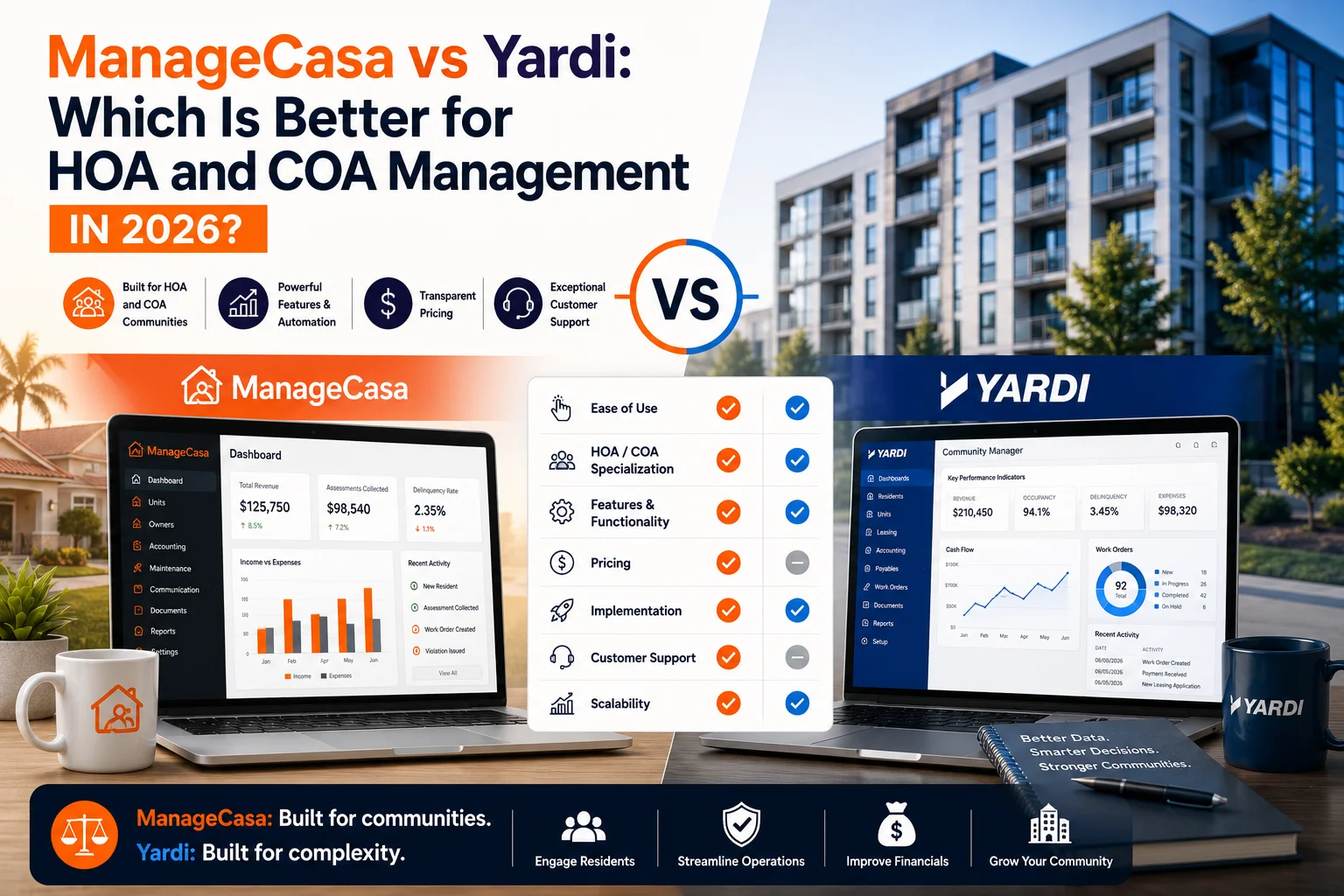
ManageCasa and Yardi serve meaningfully different audiences. ManageCasa is built specifically for HOA and COA boards and management companies, with plans starting at $45 per month for communities up to 25 units, billed yearly, scaling by unit count across three tiers. Yardi offers two distinct products: Yardi Breeze Premier for associations at $1 per unit per month with a $400 monthly minimum, and Yardi Voyager, an enterprise system starting at $30,000 or more annually for complex portfolios. For most small to mid-sized HOAs and COAs, ManageCasa is the more practical fit. For large mixed-use or enterprise portfolios, Yardi Voyager offers deeper configurability.
Choosing between ManageCasa and Yardi for HOA and COA management starts with understanding what each platform is actually designed to do. They are not competing for the same customer. Yardi is a broad property management ecosystem used by residential, commercial, affordable housing, and association operators. ManageCasa is built specifically for community associations: HOAs, COAs, and mixed rental portfolios.
That distinction shapes everything from how the accounting works to how quickly the board can get up and running, and how much it costs. This comparison covers both platforms honestly: where each performs well, where each falls short, what they cost, and which communities should use which.
For a broader comparison of the self-managed HOA software market, see the Best Self-Managed HOA Software guide. For a full overview of what community association software does and how it is priced, see Community Association Software: What It Does and How to Choose.
1. Understanding Yardi: Two Very Different Products
One of the most common mistakes boards make when researching Yardi is treating it as a single product. Yardi offers two platforms with significantly different price points, complexity levels, and target audiences. Comparing ManageCasa against the wrong Yardi tier produces a misleading result.
Which Yardi tier is this comparison about?
This comparison is primarily between ManageCasa and Yardi Breeze Premier for associations, which is the Yardi product most HOAs and COAs will evaluate. Yardi Voyager is included where relevant but is not a realistic consideration for most communities under 500 units.
2. Feature Comparison: ManageCasa vs Yardi Breeze Premier
3. Pricing: What Each Platform Actually Costs
ManageCasa Pricing
ManageCasa uses three plan tiers, each priced per month and billed yearly, with rates that scale based on unit count. The minimum entry point is $45 per month for communities of 1 to 25 units on the Base Plan. Pricing increases as unit count grows: a 51-unit community on the Base Plan, for example, is $95 per month. All three tiers scale upward from there for larger portfolios.
Onboarding and setup fees are not included in the above pricing. No free trial is offered. A demo is available. For current rates at your specific unit count.
See current plans and rates at managecasa.com/pricing. Verified June 18 2026.
Yardi Breeze Premier Pricing for Associations
Yardi Breeze Premier for associations is priced at $1 per unit per month with a $400 monthly minimum on an annual contract. A community of 400 units would pay $400 per month. A community of 200 units would also pay $400 per month due to the minimum. Implementation and training are included at no additional cost. ACH payment processing fees are $0, which Yardi eliminated in January 2024. Optional add-ons such as resident screening carry per-transaction costs. Source: yardibreeze.com (verified June 2026).
Yardi Voyager Pricing
Yardi Voyager pricing is not publicly listed. Every contract is custom-negotiated. Based on cross-referenced industry reporting, annual costs typically start around $30,000 for smaller configurations and reach $75,000 to $150,000 or more for mid-to-large institutional portfolios. Professional services are billed separately at approximately $150 per hour. Voyager is not a realistic evaluation for communities under 300 to 500 units.
Pricing data note
ManageCasa pricing is tiered by unit count and is best verified directly at managecasa.com/pricing, as rates may be updated. Yardi Breeze Premier for associations pricing ($1/unit/month, $400 minimum) is sourced from yardibreeze.com and verified June 2026. Yardi Voyager pricing is based on cross-referenced industry data and Yardi does not publish it publicly.
4. HOA and COA Specific Capabilities: Where the Platforms Differ
For a board evaluating these two platforms, the most important comparison is not headline features but how well each platform handles the specific administrative tasks that occupy the most board and manager time.
Financial Reporting and Fund Accounting
HOA accounting is not the same as general property accounting. Community associations require fund accounting, where revenue and expenses are tracked across separate funds (operating fund, reserve fund, special assessment fund) rather than as a single ledger. Both ManageCasa and Yardi Breeze Premier support this, but ManageCasa's financial architecture is built with HOA fund structures as the default rather than adapting general-purpose accounting to fit association needs.
For a detailed breakdown of what HOA financial management requires, see the complete HOA accounting guide.
Board and Homeowner Experience
Volunteer boards differ from professional property managers in one important way: they do not use the software every day. A platform that requires training and regular use to navigate efficiently is a poor match for a volunteer treasurer who logs in once a month to review financials. ManageCasa's interface is built around this reality. Yardi Breeze Premier is simpler than Voyager but still carries some of the workflow conventions from professional property management.
On the homeowner side, both platforms offer online payment portals and request submission. The difference is primarily in how frictionless the initial setup and ongoing use is for homeowners who may be less technically comfortable.
Onboarding and Implementation Time
ManageCasa's onboarding is designed for communities without a dedicated IT or implementation team. Most associations go live within days to a few weeks. Yardi Breeze Premier also includes free implementation and claims similar timelines for straightforward communities, though reviews note that complex community setups take longer. Yardi Voyager implementations are a separate project with professional services costs that can match or exceed the first year of software licensing.
Mixed Portfolio Support
If your organization manages both HOA communities and rental properties, ManageCasa handles both within a single platform. This is one of ManageCasa's genuine differentiators in the association space: most purpose-built HOA tools do not serve rental portfolios well, and most rental-first platforms handle HOA governance poorly. ManageCasa was architected to serve both from a single dashboard.
5. Which Platform Is Right for Your Community?
6. Where Each Platform Has Limitations
A fair comparison includes the honest limitations of both platforms.
ManageCasa Limitations
• Smaller brand footprint than Yardi in the enterprise property management market. Less name recognition among large institutional operators.
• Mixed portfolios combining HOA and commercial real estate are not a primary use case. Yardi handles commercial more comprehensively.
• Pricing is tiered and not flat-rate, which can make total cost harder to predict for communities with fluctuating unit counts.
Yardi Breeze Premier Limitations
• The $400 monthly minimum means communities under 400 units pay more per unit than the $1/unit headline rate suggests. A 100-unit community pays $4 per unit per month effectively, not $1.
• eVoting capability is not prominently included in Breeze Premier. Verify with Yardi before assuming this is covered.
• Community website is not included in Breeze Premier by default. ManageCasa offers a community website as a separately billed add-on rather than bundling it into plan pricing.
• The interface is designed more for property managers than for volunteer boards with limited software experience.
• Annual contract required. No month-to-month option is publicly available for Breeze Premier.
Yardi Voyager Limitations
• Enterprise pricing ($30,000 to $150,000+ annually) is not appropriate for the vast majority of community associations.
• Implementation is a separate professional services engagement, often taking months.
• Pricing is not publicly listed. Boards must enter a sales process to understand costs.
6. Customer Support: Where ManageCasa Differentiates
For volunteer HOA boards and smaller management companies, customer support is not a secondary consideration. It is the difference between getting up and running quickly and spending weeks struggling through a complicated setup alone. This is one of the areas where ManageCasa draws its sharpest distinction in the market.
ManageCasa Support
ManageCasa offers live support from real humans Monday through Friday, 6am to 7:30pm PST, available via chat, email, and phone. Every subscription plan includes structured onboarding with dedicated training sessions, a 24/7 Help Center, and ongoing support access from day one. Boards do not need technical experience to get started — the onboarding team handles data migration, Stripe payment verification, and system configuration.
The onboarding process includes a Discovery kick-off call followed by three scheduled training sessions tailored to the community's specific needs, conducted using the customer's own migrated data. Premium plan subscribers receive a dedicated success manager for ongoing support beyond the standard team.
User reviews on Capterra, GetApp, and Software Advice consistently highlight ManageCasa's support as a primary reason for choosing the platform. One reviewer noted issues were resolved within five minutes. Another cited the team's responsiveness to customization requests as a key differentiator from rigid enterprise alternatives.
What ManageCasa says about its support
"What makes ManageCasa unique is our unparalleled customer support. You can always reach a real person for support. Every customer has access to structured onboarding, live weekday support from a real human, and a robust Help Center available 24/7. Our team goes beyond answering questions. We help customers succeed." Source: ManageCasa About page (managecasa.com/about-us).
Yardi Breeze Premier Support
Yardi Breeze Premier includes live chat support during business hours, email support after hours, and access to training videos and help documentation within the platform. Phone support is available. Yardi states that implementation and training are included with all Breeze subscriptions at no additional cost.
Yardi's support model is built for property management professionals who use the software daily and are familiar with property management workflows. For volunteer HOA boards with limited software experience, the onboarding support model is less structured than ManageCasa's dedicated training session approach.
See ManageCasa in Action
ManageCasa is built for HOA and COA boards that want purpose-built community association tools with unparalleled human support. Every plan includes live weekday support from a real person, structured onboarding with dedicated training sessions, and a 24/7 Help Center. HOA fund accounting, homeowner portals, violation tracking, eVoting, and mixed rental portfolio support are all included. A community website is available as an add-on. Compare plans at managecasa.com/pricing or explore the platform at managecasa.com/hoa-management-software.
Frequently Asked Questions
Is ManageCasa better than Yardi for HOAs?
For most small and mid-sized HOAs, ManageCasa is the better fit because it combines HOA-specific accounting, board governance tools, homeowner portals, and rental management in one platform. Yardi remains a strong option for larger organizations that need enterprise-scale customization and a broader software ecosystem.
What is the difference between Yardi Breeze and Yardi Voyager for HOAs?
Yardi Breeze Premier is designed for small to mid-sized associations and offers a simpler setup with lower complexity. Yardi Voyager is an enterprise platform built for large portfolios requiring advanced accounting, custom reporting, extensive integrations, and highly configurable workflows.
How much does Yardi cost for HOA management?
Yardi Breeze Premier pricing starts at approximately $1 per unit per month with a monthly minimum, while Yardi Voyager uses custom enterprise pricing. Costs vary based on community size, features, and implementation requirements, making direct vendor quotes important when comparing options.
What kind of customer support does ManageCasa offer?
ManageCasa provides live support by phone, email, and chat, along with guided onboarding, training sessions, and a comprehensive help center. Premium customers receive additional success resources, helping boards and managers get up and running quickly while maintaining ongoing support access.
Does ManageCasa support both HOA and rental property management?
Yes. ManageCasa supports HOA, condo association, and rental property management within a single platform. This allows management companies and property owners to oversee assessments, homeowner communications, leases, rent collection, maintenance, and accounting without switching between multiple systems.

Content Writer
Patrick Bohan is a content strategist focused on property management technology, HOA operations, and real estate. A Cornell graduate, he began his career at UBS covering housing markets, homeownership policy, and financial regulation — experience that now informs his research-driven approach to proptech content. Today he bridges the gap between software teams and the practitioners who use them, producing practical resources on community associations, rental operations, and accounting workflows for property managers.