




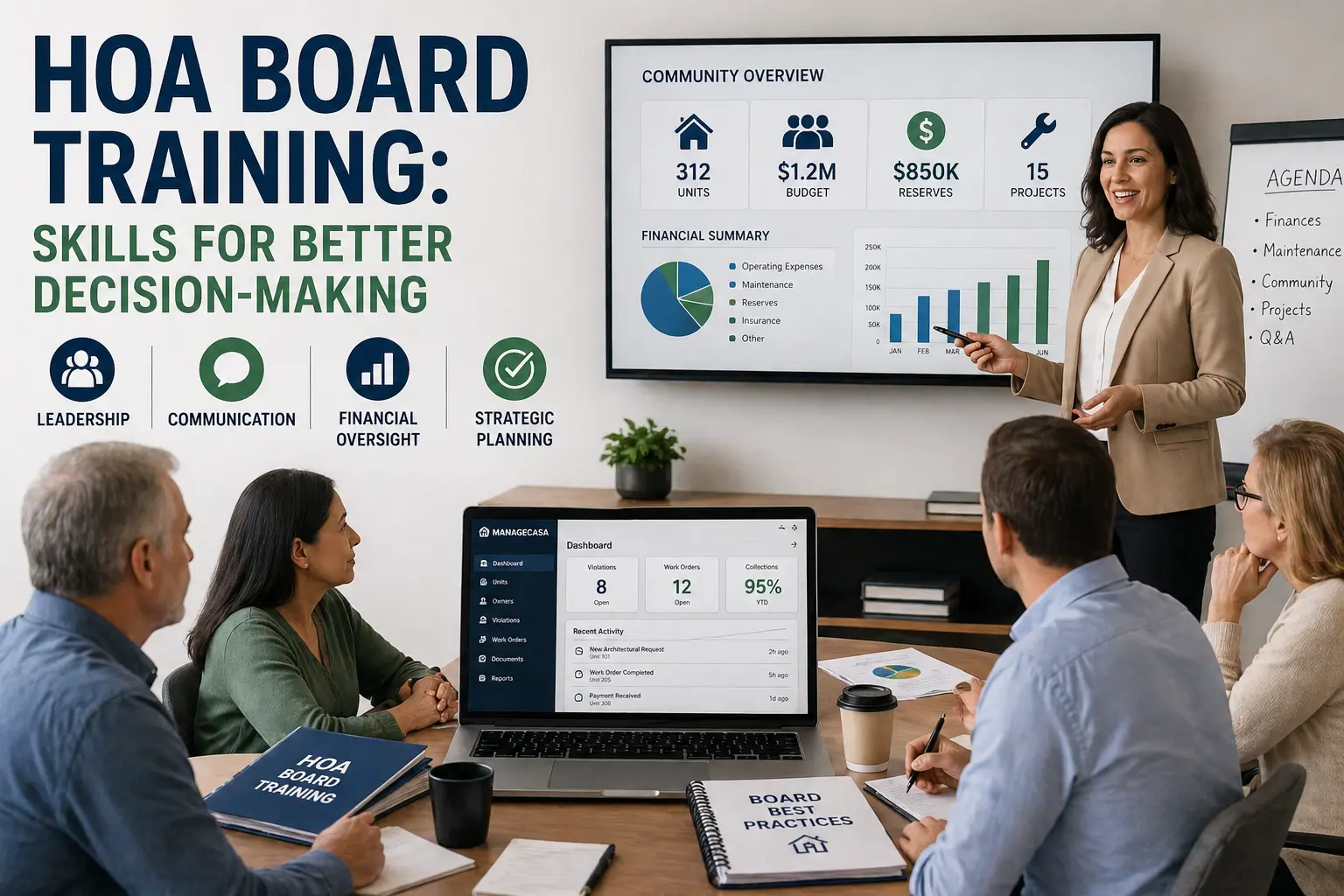
What is HOA board training?
HOA board training is structured education that gives homeowners association directors the knowledge to govern effectively. It covers financial oversight, legal compliance, conflict resolution, meeting management, and fiduciary responsibilities, giving volunteer board members the practical skills to lead their community with confidence and accountability.
Most HOA board members step into their roles as volunteers with genuine community commitment but limited governance experience. That combination is manageable when decisions are simple. It becomes a real problem when the association needs to navigate a contested budget, respond to a legal complaint, or manage a contractor dispute without the right knowledge to fall back on.
Board training closes that gap. It is not about turning volunteers into lawyers or accountants. It is about giving every director enough grounding in the core areas of HOA governance that the decisions they make are defensible, consistent, and in the community's best interest. The skills that matter most overlap significantly with those covered in the HOA board member responsibilities guide, which is worth reading alongside this one.
This guide covers what effective HOA board training looks like, which skills matter most, how to structure onboarding for new members, where formal programs like the Community Associations Institute fit in, and how to build a board that keeps learning over time.
Why HOA Board Training Matters
Homeowners associations have grown substantially over the past five decades. There are now more than 365,000 planned communities across the United States, home to more than 74 million residents. Source: Community Associations Institute, 2023 Statistical Review. The boards governing those communities are almost entirely made up of volunteers, and the financial stakes have risen with the industry.
The cost of an untrained board is concrete: contested financial decisions, legal exposure from governance errors, homeowner disputes that escalate unnecessarily, and reserve funds that end up underfunded because no one on the board knew to push for a reserve study. Training is not overhead. It is risk management.
There is also a legal dimension. Board members carry a fiduciary duty to act in the best interests of the association. The fiduciary duties of HOA board members, including the duty of care, the duty of loyalty, and the business judgment rule, are covered in depth in the HOA board member responsibilities article. Courts in most states have held board members personally liable for decisions that fell below the standard of care expected of a reasonably diligent director.
Core Skills Every HOA Board Member Needs
Effective HOA board training covers five interconnected skill areas. None requires professional credentials, but all require deliberate learning.
Financial literacy and oversight
Board members do not need to be accountants, but they do need to read a balance sheet, understand what a reserve study says, and recognize when an income statement signals a problem. For a detailed walkthrough of what sound HOA financial management looks like in practice, see the guide on HOA financial management.
Legal knowledge and governing document literacy
Every board decision is made within a legal framework built from the CC&Rs, bylaws, and rules and regulations, plus state HOA statutes. Legal training for HOA board members covers how to read governing documents, how to identify when a proposed action might conflict with them, and which state laws apply to common situations including elections, enforcement, and financial disclosure.
This is particularly important in states with detailed HOA legislation, including California under the Davis-Stirling Act, Florida under Chapters 718 and 720, and Nevada under NRS Chapter 116. For a full overview, the HOA rules and regulations guide covers the key provisions and how to apply them.
Communication and conflict resolution
Training in communication gives board members a framework for conducting difficult conversations, running productive meetings, and addressing disputes before they become formal matters. For specific frameworks, the HOA conflict resolution strategies guide is a practical companion to this one.
Meeting management
Effective meeting management training covers agenda construction, parliamentary procedure, how to manage public comment, how to document decisions in minutes, and how to close a meeting with clear action items. The full framework for running productive board meetings is in the HOA meetings guide.
Strategic and long-term planning
Beyond day-to-day operations, board members need to think about the community's trajectory: when major capital projects are coming, how reserve funding levels are tracking, and how the association's rules need to evolve as the community ages. Long-term planning skills give board members the tools to make forward-looking decisions rather than purely reactive ones.
Onboarding New HOA Board Members
The transition when a new director joins the board is one of the highest-risk moments in HOA governance. A structured HOA board member onboarding process should cover at least three areas.
Orientation to governing documents and current operations
Every new board member should read the CC&Rs, bylaws, and current rules before attending their first meeting, and have a conversation with an experienced board member or the management company about how those documents are currently being interpreted and applied.
Role clarity
Each board position carries specific responsibilities. The President runs meetings and represents the association externally. The Treasurer owns financial reporting and the budget process. The Secretary maintains records and meeting minutes. Defining these roles clearly at the start prevents both duplication of effort and gaps in coverage.
Mentorship and committee involvement
Pairing new board members with more experienced directors accelerates the learning curve significantly. Some boards also use committee structures, such as a finance committee or architectural review committee, to give newer members hands-on experience before they take on broader board responsibilities.
Formal HOA Board Training Programs and Certifications
Beyond internal onboarding, several formal training options exist for HOA board members who want structured, credentialed education. The Community Associations Institute is the most established source, with more than 45,000 members across the United States and a curriculum designed specifically for community association professionals and volunteer board members.
Building a Culture of Continuous Learning
Practical habits that support continuous learning include reviewing financial statements carefully each month rather than approving them without discussion, attending at least one CAI chapter event per year, debriefing after difficult situations, and allocating budget for board education as a standard line item rather than a discretionary spend.
Boards that invest consistently in HOA board leadership development tend to have lower homeowner complaint rates, fewer governance errors, and stronger financial performance over time.
HOA Board Training Best Practices
• Provide formal onboarding for every new board member before their first official meeting.
• Ensure all board members have read and understand the CC&Rs, bylaws, and current rules before voting on enforcement matters.
• Cover financial literacy, legal compliance, and conflict resolution as core training topics, not optional extras.
• Use mentorship to accelerate new member development and preserve institutional knowledge.
• Consider CAI certification for boards managing complex or large-scale communities.
• Budget for ongoing education as a standard line item rather than a discretionary spend.
• Keep training current with state law changes, particularly in California, Florida, and Nevada.
• Document training participation in board records as part of governance accountability.
Give Your HOA Board Better Tools with ManageCasa
ManageCasa helps HOA boards put training into practice with a centralized platform for document management, meeting minutes, violation tracking, financial reporting, and resident communication. When the tools match the governance standards the board is working to maintain, decisions are easier to document, enforce consistently, and defend.
Explore HOA platform features at managecasa.com/hoa-management-software
Frequently Asked Questions
What is HOA board training?
HOA board training is structured education that prepares volunteer directors to govern a homeowners association effectively. It covers financial literacy, governing document interpretation, conflict resolution, meeting management, and fiduciary responsibilities, typically through internal onboarding, management company resources, and programs from organizations such as the Community Associations Institute.
Is HOA board training required by law?
HOA board training requirements vary by state and most states do not mandate specific training hours. Some states, including California and Florida, have governance and disclosure requirements that make foundational legal knowledge a practical necessity. The fiduciary duties of HOA board members create a strong practical case for structured preparation even where training is not legally required.
What should HOA board training cover?
Effective HOA board training covers five core areas: financial management and budget oversight, legal compliance and governing document literacy, communication and conflict resolution, productive meeting management, and long-term strategic planning. Financial literacy is particularly important because every director carries a fiduciary duty from the moment they take office.
How do new HOA board members get up to speed?
New HOA board members get up to speed most effectively through a structured onboarding process that includes reviewing all governing documents and meeting with the management company or outgoing board members. The process should clarify each director's specific role and pair them with a more experienced board member as a mentor through at least the first governance cycle.
What is the Community Associations Institute and is CAI certification worth it?
The Community Associations Institute is the leading professional organization for the community association industry in the United States, with more than 45,000 members and a curriculum of board leadership courses and certification programs. CAI certification is most valuable for boards managing large or complex communities or those in states with detailed HOA legislation where governance errors carry significant legal exposure.

Expert in Property Management and SaaS
Peter Koch is an expert in property management and SaaS, focused on building top digital tools for property managers and growing technology-driven startups. He specializes in enhancing property management operations through smart software solutions that streamline accounting, automate workflows, and improve community communication. Peter writes about HOA management technology, proptech innovation, and scalable SaaS strategies designed to help modern property professionals operate more efficiently.