




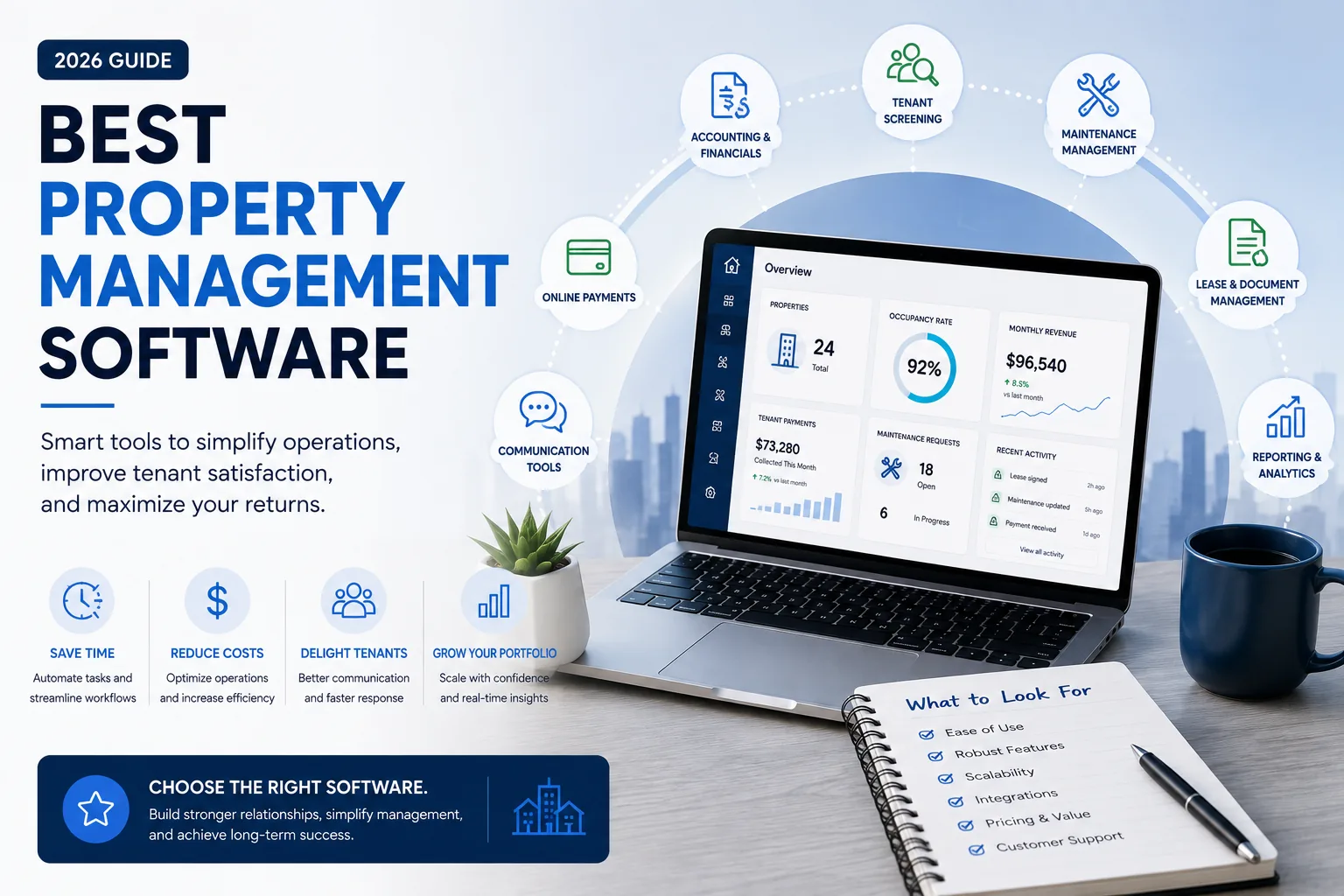
The best property management software is not necessarily the platform with the longest feature list. What matters more is whether the software matches the type of properties you manage, the size of your portfolio, and the work your team handles every day.
A landlord managing a handful of rentals has very different priorities from a company overseeing hundreds of doors. HOA and condo managers have another set of needs altogether, including board reporting, association accounting, architectural requests, violations, elections, and homeowner communication. Large institutional operators may care more about integrations, configurability, and enterprise reporting.
That is why this comparison does not treat every buyer as if they need the same product. The six platforms below are grouped by the use case they fit best, using the pricing, feature, and positioning information supplied for this article as of August 2026.
If your search is specifically focused on community associations, see the Best HOA Software 2026 roundup. For a comparison focused on artificial intelligence in HOA management, read the Best HOA AI Software 2026 comparison.
The 6 Property Management Platforms Reviewed
1. AppFolio: Best all-round
AppFolio is the broadest all-around option in this comparison. It supports several property categories, including single-family rentals, multifamily housing, affordable housing, student housing, commercial properties, and community associations. Its feature set includes financial reporting, online payments, CAM tracking, and API access.
The platform uses per-unit pricing across Core, Plus, and Max plans. Based on the research supplied for this article, AppFolio tends to make more financial sense once a portfolio reaches roughly 50 units. Smaller landlords may find that they are paying for more platform than they actually need.
AppFolio also includes Realm-X, its AI assistant, for tasks such as reporting, communication, and bulk work. More advanced workflow automation through Realm-X Flows is associated with the higher Plus and Max tiers.
Best for: property management companies with 50 or more units, especially those managing multiple property types and looking for a broad platform.
2. Rentec Direct: Best for Independent Landlords
Rentec Direct is a more straightforward choice for landlords and smaller property managers that want core rental management tools without a long contract. Rentec Pro is aimed at landlords, while Rentec PM is designed for professional management companies.
Both versions cover common rental workflows such as accounting, rent collection, tenant screening, and rental listing websites. The supplied pricing research lists Rentec Pro at $2.00 per unit and Rentec PM at $2.50 per unit, with no setup fee and no contract requirement.
That simple pricing structure is a big part of the appeal. A small operator can evaluate the software without taking on the kind of onboarding commitment that often comes with larger property management systems.
Best for: independent landlords and smaller portfolios that value transparent per-unit pricing and flexibility. It is also one of the stronger candidates for buyers searching for the best property management software for small landlords.
3. ManageCasa: Best for HOA, Community Associations, and Self-Managed Communities
ManageCasa is built around community association management while also supporting rental, marina, and mixed portfolios. It is particularly well suited to self-managed communities that want professional management tools without hiring a full-service management company. Its HOA-focused features include trust accounting, homeowner and board portals, architectural review workflows, online elections, and violation or compliance tracking.
The supplied research lists the Base plan at $45 per month with no minimum unit requirement. Minii AI is included from the entry plan, with broader capabilities available on higher tiers. This makes the platform accessible to a single association while still giving management companies room to grow.
Its main distinction in this comparison is that HOA governance functions are part of the core workflow. Boards, volunteer leaders, and association managers do not have to adapt rental-first tools to handle elections, architectural requests, and community compliance processes. For self-managed HOAs and condo communities, having these functions in one system can make it easier for board members to organize association finances, homeowner requests, records, and recurring administrative work.
For a more detailed HOA-only comparison, see Best HOA Software 2026.
Best for: HOA and condo boards, self-managed communities, community association management companies, and growing associations that want HOA-specific workflows and built-in AI without requiring an enterprise plan.
4. Buildium: Best for Rental Accounting Depth
Buildium stands out for accounting and financial management. Its feature set includes trust accounting, separate operating and reserve ledgers, financial reporting, and automated bank reconciliation. It can support residential rentals as well as HOA, commercial, and student housing portfolios.
Published pricing in the supplied brief ranges from $62 per month for Essential to $192 for Growth and $400 for Premium. The subscription price, however, may not represent the full operating cost. Independent reviews referenced in the source document report that payment, bank setup, eSignature, and other transaction-related fees can materially increase monthly spending for an active portfolio.
Buildium's Lumina AI features include tools for tasks such as bill processing, writing assistance, and conversational support, with the AI suite associated with the Premium tier in the supplied research.
Best for: management companies with roughly 50 to 1,000 doors that put accounting depth near the top of the requirements list and are prepared to model additional fees.
5. MRI Software: Best for Enterprise Portfolios
MRI Software is aimed at a different buyer from most small-landlord platforms. It is designed for larger and more complex real estate operations, including commercial, multifamily, and affordable housing portfolios.
Its strengths include detailed financial reporting, lease administration, configurable workflows, and an integration ecosystem through Partner Connect. Pricing is not presented as a simple public per-unit rate. Instead, it is typically quoted according to modules, portfolio requirements, and deployment complexity.
That flexibility can be useful for institutional operators, but it also means implementation may require more planning and internal resources. The independent review information in the source brief points to a steeper learning curve, which is worth considering if a team does not need enterprise-level configuration.
Best for: institutional owners, REITs, and large multi-asset organizations with the staff and implementation resources to support a more complex system.
6. Vantaca: Best AI-Powered Automation for Large HOA Portfolios
Vantaca focuses on professional community association management companies, particularly firms overseeing many HOA communities. Its HOAi product is positioned around agentic automation rather than simple writing assistance or recommendations.
According to the supplied research, HOAi can execute broader workflows such as invoice approvals, budgeting processes, and violation-related tasks with less manual input at each stage. That approach can be valuable when a management company needs to automate repetitive processes across a large association portfolio.
Vantaca uses quote-based pricing, which reflects its target market. It is more naturally suited to management organizations with formal procurement and implementation processes than to a single small board looking for inexpensive software.
Best for: large HOA management companies running dozens or hundreds of communities and looking for workflow-level AI automation.
Side-by-Side Comparison
Pricing and positioning below reflect the supplied research as of August 2026. Buyers should confirm current pricing and plan terms directly with each vendor before purchasing.
How to Choose the Best Property Management Software for Your Portfolio
- Independent landlord or small portfolio: Look for clear pricing, essential rental workflows, and a low commitment level. Paying for enterprise functionality you will not use can make a platform unnecessarily expensive.
- HOA, condo association, or self-managed community: Prioritize association-specific functions such as homeowner accounting, board reporting, architectural requests, elections, violations, and resident communication. Rental features alone are not enough for many community associations.
- Growing management company: Compare accounting depth, automation, reporting, and the total monthly cost. Include payment fees, onboarding charges, add-ons, and other recurring expenses instead of comparing subscription prices alone.
- Large or institutional portfolio: Integration depth, configuration, controls, and implementation support become more important as complexity grows. Make sure your organization has the resources to implement and maintain an enterprise platform.
A demo is most useful when you test the software against a real workflow from your own portfolio. Bring an actual reporting problem, maintenance process, reconciliation task, or board workflow. A realistic test usually reveals more than a polished vendor presentation.
Related Articles
· Best HOA Software 2026: A focused comparison for HOA boards and community association managers.
· Best HOA AI Software 2026: Top 5 Platforms Compared: A closer look at AI capabilities in HOA-focused property management platforms.
· Property Management Software Pricing: What It Actually Costs for Under 100 Doors: A deeper look at subscription pricing, transaction costs, and real-world software expenses.
Managing HOA, Rental, or Mixed Portfolios?
ManageCasa supports HOA, rental, marina, and mixed portfolios, with Minii AI included from the entry plan according to the supplied August 2026 research. See the HOA management software toolset or review the pricing options available for your portfolio.
Frequently Asked Questions
What is property management software?
Property management software brings common management tasks into one system. Depending on the platform, that can include accounting, rent or assessment collection, maintenance, tenant or homeowner communication, reporting, screening, documents, and operational workflows for landlords, management companies, or community associations.
What is the best property management software?
There is no single platform that is best for every portfolio. The best property management software depends on what you manage and how large the operation is. Small landlords may prioritize simple pricing, HOA boards need governance tools, and enterprise operators often need deeper integrations and configuration.
How do I choose property management software?
Start with portfolio type and size. Next, compare the accounting model, pricing structure, maintenance and communication tools, reporting, integrations, and any AI or automation included in the plan you are considering. Test the product with a real workflow before signing a contract.
How much does property management software cost?
Pricing varies widely. The source research for this comparison includes per-unit rates around $2.00 to $2.50 for Rentec Direct, flat monthly plans from $45 for ManageCasa and $62 for Buildium, and custom quote-based pricing for enterprise-oriented platforms such as MRI Software and Vantaca.
What is rental property management software?
Rental property management software is designed around landlord and tenant workflows, including rent collection, lease administration, tenant screening, maintenance, accounting, and portfolio reporting. It differs from HOA software, which typically focuses more heavily on boards, association funds, shared-property operations, governance, and homeowner processes.