




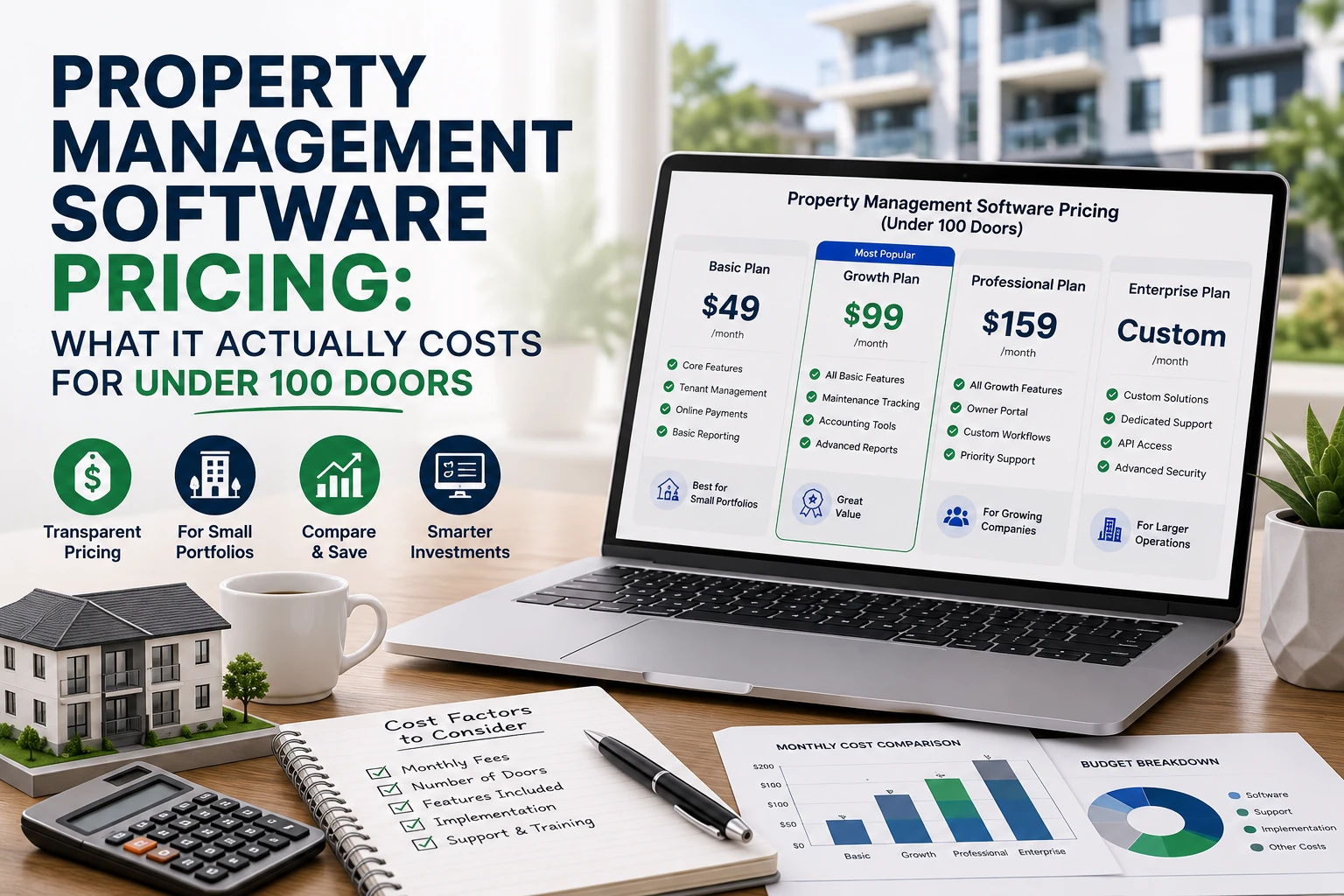
Most landlords and small property managers underestimate property management software pricing because they price each tool separately. A 40-unit portfolio stitching together separate screening, accounting, and maintenance software typically pays $150 to $300 or more a month combined, once minimum fees, per-transaction charges, and overlapping features are added up.
Why Property Management Software Pricing Adds Up Fast
Good property management shouldn't require stitching together five separate subscriptions just to keep a small portfolio running. If you manage fewer than 100 units, the sticker price on any single piece of property management software rarely looks alarming. A tenant screening subscription might run $20 to $50 a month. A basic accounting tool might be $30. A maintenance tracker, another $25 or so. None of those numbers, on their own, look like a budget problem.
The problem shows up when you add them together.
Most small property managers and independent landlords do not run one piece of software. They run several: a CRM or leasing tool, an accounting system, a maintenance work order tracker, a tenant screening service, a messaging or communication platform, a reporting tool, and a payment processor. Each one is chosen separately, often at a different point in the business's growth, and each one is billed separately.
Individually, these tools are marketed as affordable. Together, they compound.
Here is what the standalone cost of each category typically looks like for a small portfolio:
The AppFolio row is where the real waste tends to happen. Its Core plan carries a $298 monthly minimum (and requires a 50-unit minimum to sign up at all), because its pricing is built around the assumption of much larger scale. By contrast, a tool like Rentvine prices as low as $1.50 per unit with no visible minimum, and TenantCloud and TurboTenant both offer sub-$20 entry tiers, which is the range most small landlords actually need.
Platforms built specifically for smaller portfolios avoid that trap by pricing in fixed tiers instead of a large flat minimum. ManageCasa, for instance, starts at $45 a month on its Base plan, which covers portfolios of 1 to 25 units, before stepping up to $80 a month on Growth and $130 a month on Premium as a portfolio or feature needs grow, all billed yearly, with no unit minimum required to sign up. A 25-unit portfolio pays a flat $45 a month rather than the several-hundred-dollar minimum built for a much larger operator.
The tiers differ mainly in depth, not in whether core functions exist at all. Base covers accounting and reporting, maintenance and lease management, owner and tenant portals, and document management, along with limited access to the built-in Minii AI assistant. Growth adds advanced accounting and reporting, bank connect and sync, budgeting, and a fuller Minii AI assistant for maintenance, compliance, and messaging tasks. Premium adds custom branding, unlimited data storage and dashboards, open API access, and Minii AI's most advanced assistance tier. The notable point for a small operator is that AI assistance is included starting at Base rather than reserved entirely for a higher tier, unlike AppFolio's Realm-X AI, which sits behind the Plus plan and its $960/month minimum.
The Math on a Typical Small Portfolio
Take a landlord managing 40 units who has stitched together a stack over time: a $62 per month base platform for accounting and resident portal access (Buildium's Essential tier, for instance), a $25 to $55 per applicant tenant screening add-on used a handful of times a month, a separate $35 per month messaging or CRM tool, and per transaction payment processing fees on top.
Individually, each piece looks reasonable. Added up, it is easy to land in the $150 to $300 or more per month range, before payment processing fees, before onboarding costs, and before the time spent reconciling data across tools that do not talk to each other.
That same 40-unit landlord evaluating a single consolidated platform instead would likely land on a tier priced closer to $80 a month, well under the stitched-together total, since the cost comes from one bill instead of several overlapping ones.
That is the gap between what property management software costs on paper and what your full stack costs in practice. The first set of numbers is on a pricing page. The second number is on your bank statement.
Staying on the Same Platform as You Grow Past 100 Doors
The numbers above assume a portfolio that stays roughly the same size. In practice, portfolios grow, and software that fits well at 20 units does not always fit at 150. That mismatch is where a lot of the stack-switching pain in this article actually comes from: not the starting price, but what happens a few years later.
Enterprise platforms solve this by requiring scale from day one. AppFolio's 50-unit minimum and $298 monthly floor exist because the platform is built around larger operators, which means a small landlord either overpays now or has to migrate everything later once they finally hit that scale. Flat-fee small-portfolio tools often have the opposite problem: they cap out at a unit count and force a re-platform once a landlord outgrows the entry tier.
A platform priced in fixed tiers with per-unit pricing layered on top avoids both failure modes. ManageCasa's Base, Growth, and Premium tiers cover the first 25 units at $45 to $130 a month, and per-unit pricing takes over as a portfolio scales past the tiered structure, dropping to $0.50 per unit once a portfolio passes 500 units. At 1,000 units, that works out to roughly $500 a month on ManageCasa versus $1,400 a month on AppFolio's Core plan at its $1.40 per unit rate, a gap that widens rather than closes as the portfolio grows. The practical effect is that a 20-door landlord and the same operator managing hundreds of doors years later are not necessarily choosing between two different platforms, just two different points on the same pricing curve, with no unit-count minimum blocking either end.
For a reader evaluating software today, that matters as much as the sticker price: a tool that is cheap now but has a hard ceiling just moves the switching cost to a later, more disruptive point.
Why This Happens Even to Careful Operators
None of this is really anyone's fault. Real estate has historically been slow to adopt integrated technology, so tools built for narrow use cases such as screening, accounting, and maintenance grew up as separate products rather than modules of one system. Landlords and small property managers adopt what solves the immediate problem in front of them, not what fits a five year roadmap.
The result is a familiar pattern: legacy tools stick around even after better options exist, overlapping subscriptions pile up because no one audits the full stack at once, and a small operation ends up paying for a level of complexity it never actually needed.
A Framework for Right-Sizing Your Property Management Software Spend
Before adding or renewing any tool, it is worth asking a few direct questions:
Does this tool's pricing model match my portfolio size, or the vendor's target customer?
A platform with a $300 or higher monthly minimum is often built for portfolios in the hundreds of units. Paying that minimum at 40 units means subsidizing features you will never use.
Am I paying twice for the same function?
It is common to find a maintenance tracker bundled into a platform's mid tier plan that a landlord is also paying for separately through a dedicated app.
What does the full stack cost per unit, not per tool?
Adding every subscription together and dividing by unit count gives a clearer picture than looking at any single price tag in isolation.
Would consolidating into fewer, more scalable tools reduce total cost, even if one line item goes up?
Sometimes a $60 per month all-in-one platform costs less overall than four $20 to $30 per month point solutions, even though it looks like a bigger number on its own.
The goal is not the cheapest tool available. It is a stack that matches the actual size and complexity of the portfolio being managed, so a smaller operation is not quietly funding enterprise grade overhead it will never use, and is not locked out of basic AI assistance until it reaches a higher tier or a much larger bill. This is the gap platforms like ManageCasa are built to close, with fixed monthly tiers starting at $45 for portfolios up to 25 units and AI assistance included from that first tier, rather than a large flat minimum or an AI paywall built for enterprise scale.
Related Rental Guides
- Best Payment Software for Property Management 2026
- How AI in Property Management Optimizes Rent and Retention
- US Housing Market Trends Impacting Renters and Investors in 2026
Curious how a fixed-tier platform compares to piecing together a stack yourself?
See how ManageCasa prices for actual por tfolio size, or explore the full rental platform and current pricing tiers before renewing a stitched-together stack.
How much should a landlord with under 100 units expect to pay for property management software?
Most small landlords and property managers pay somewhere between $50 and $300 a month total, depending on how many separate tools are involved and whether pricing is flat fee or per unit based.
Is per-unit pricing or flat-fee pricing better for a small portfolio?
Flat fee pricing tends to offer more predictable costs for smaller, stable portfolios, while per unit pricing scales more naturally for portfolios expecting growth. The tradeoff is that per unit costs rise every time a unit is added.
Why do minimum monthly fees matter so much for small portfolios?
A high minimum fee, often $250 to $400 per month on platforms built for larger operators, effectively erases the benefit of per unit pricing for a small portfolio, since the minimum applies regardless of actual unit count.
What is the biggest hidden cost in a property management tech stack?
Beyond the visible subscription fees, the largest hidden cost is usually staff time spent reconciling data across disconnected tools, plus per transaction payment processing fees that do not show up on a monthly pricing page.
Does consolidating onto one platform actually save money for a small portfolio?
Consolidating can lower total cost mainly by removing the compounding effect of separate subscriptions and per-transaction fees, but the savings only show up when a platform's tier price is compared against the full stitched-together stack rather than against a single competing tool.

Content Writer
Dann is a real estate and property management content strategist specializing in HOA operations, financi al management, and community governance. He works closely with industry professionals to produce accurate, practical guidance for property managers and HOA boards.