




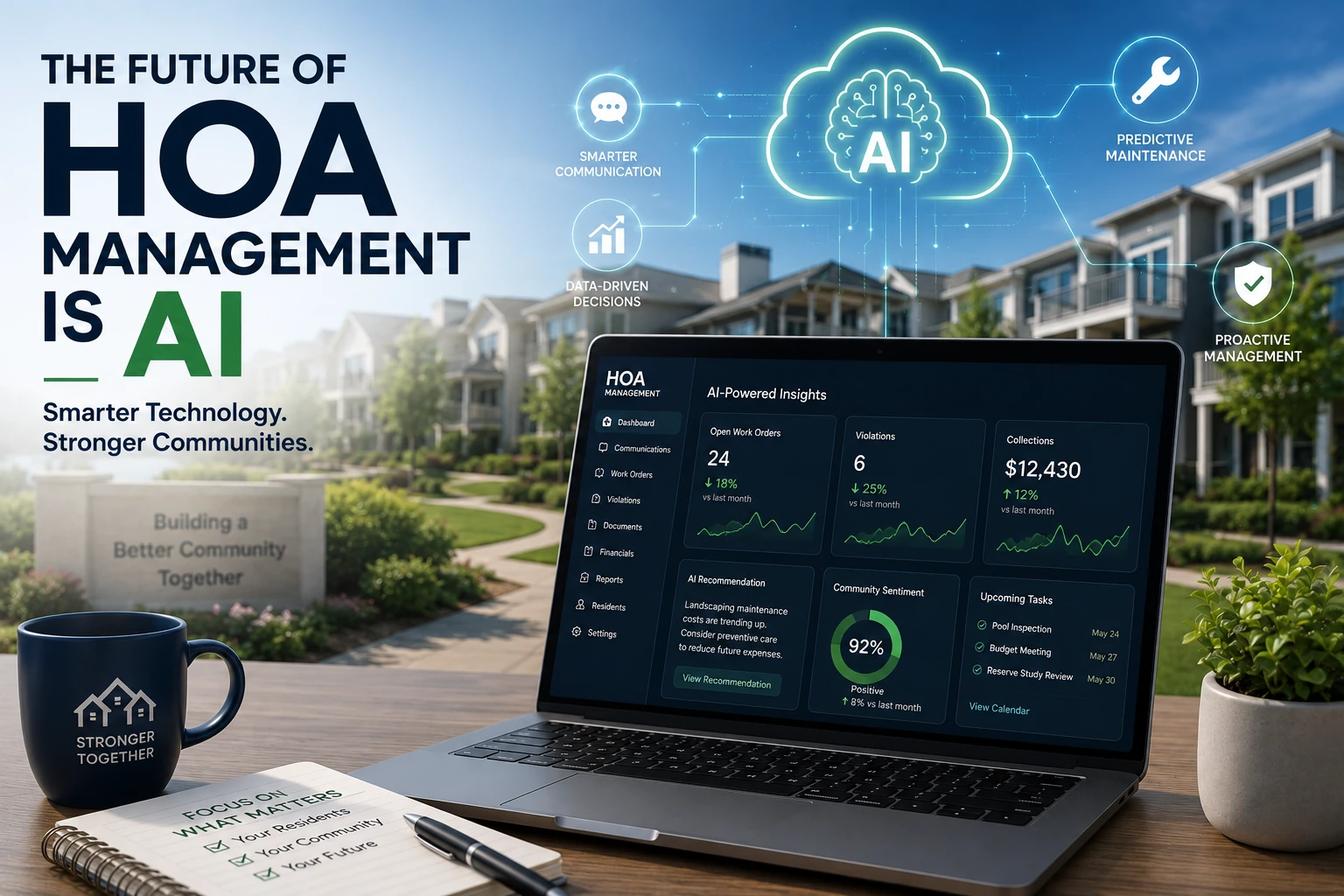
AI in HOA management means using tools like large language models, chatbots, and predictive analytics to handle communication, financial reporting, and maintenance planning for community associations. As of 2025, 71% of community managers and board members already use AI in some form, most often for resident communication and document drafting.
Two years ago, AI in HOA management meant a board member asking ChatGPT to clean up a meeting summary. In 2026, it means predictive maintenance flags, AI-drafted violation notices, and resident chatbots answering questions at 11pm on a Sunday. The shift happened faster than most community associations expected, and the data backs that up.
The clearest picture of where things actually stand comes from the Foundation for Community Association Research, the research arm of the Community Associations Institute (CAI). Its May 2025 Snap Survey polled 478 managers, board volunteers, and industry professionals specifically about AI use in community associations. The results are the closest thing this industry has to a reliable baseline, and they show an industry that has moved past the experimentation phase faster than most people assume.
How HOA Boards and Managers Are Actually Using AI Right Now
Adoption is already mainstream. Per the CAI survey, 71% of respondents said they currently use AI in their community or to serve their community association clients, and 29% report using it every day. Familiarity tracks closely behind: 82% describe themselves as somewhat or very familiar with AI tools, and only 1% call themselves completely unfamiliar.
Among those already using AI, the tools breakdown looks like this:
- Large language models such as ChatGPT, Copilot, or Gemini — used by 80% of AI adopters
- AI meeting summary tools (Zoom AI Companion, Otter, and similar) — 51%
- Chatbots and virtual assistants for resident questions — 29%
- Language translation and text-to-speech — 27%
- Smart technology such as water sensors, security cameras, and parking monitoring — 15%
- Predictive analytics specifically for maintenance — 4%
That last figure is worth sitting with. Predictive maintenance gets talked about constantly in industry marketing, but actual adoption is still in single digits. The gap between the AI capabilities boards hear about and the ones they're actually using is one of the more consistent findings in the data, and it shows up again in the following section.
Where AI Is Already Paying Off
When the survey asked which specific areas had benefited from AI, communication ran away with it. Here's how the full breakdown looks:
Source: Foundation for Community Association Research (CAI), AI & Community Associations Snap Survey, May 2025, n=478
Communication is the runaway leader for a simple reason: it's the highest-volume, lowest-risk use case. Drafting a resident email or summarizing a board meeting doesn't carry the same downside as an AI tool flagging a structural issue incorrectly. That risk asymmetry is exactly why boards are comfortable experimenting with AI on the communication side long before they trust it with financial reporting (16%) or predictive maintenance (8%).
For boards evaluating where to start, that pattern is a reasonable roadmap: communication and document drafting first, with financial and physical-asset applications following once trust in the underlying data improves. Platforms that centralize HOA financial management in one system tend to make that second phase easier, since AI tools work better on clean, structured data than on records split across spreadsheets and email threads.
The Trust Gap: What's Holding Boards Back
Adoption being high doesn't mean skepticism is low. The same survey found real, specific hesitation, and it's concentrated in a few areas:
Source: Foundation for Community Association Research (CAI), AI & Community Associations Snap Survey, May 2025, n=478
Trust in AI-generated content specifically is split: only 15% of respondents said they trust it more than a traditional search, 28% said no, and 57% said it depends on the topic. That's a healthy, calibrated level of skepticism, not blanket rejection. Boards aren't refusing AI; they're refusing to trust it uncritically, which is a different and more sustainable posture.
On the ethics side, the concerns get more specific to governance. When asked directly about ethical risks in community association management, 75% pointed to accuracy and misinformation risk, 70% to privacy and data security, and 68% to over-reliance on AI at the expense of human oversight. That last number matters most for boards: the concern isn't that AI will make bad decisions on its own, it's that people will stop checking its work.
What This Means for Board Decision-Making
Editorial note: AI tools can draft, summarize, and flag patterns, but the survey data above is clear that board members and managers still need to review and approve anything tied to compliance, enforcement, or financial decisions. Treat AI output as a first draft, not a final answer, particularly for violation notices, assessment calculations, and anything that could become a dispute.
This lines up with how the survey respondents themselves think about accountability: 57% said a central open question is who is responsible when an AI-assisted decision goes wrong, and the answer boards are converging on is that the human signing off stays accountable, regardless of what tool helped draft the document. That's also consistent with the direction of state-level rulemaking on HOA governance and disclosure requirements, where the trend is toward more documentation and more board accountability, not less.
Interestingly, most managers aren't worried about being replaced. 62% of respondents said they're not concerned about AI replacing the services they or their company provide, versus 11% who are. The more common framing among managers is that AI removes the repetitive parts of the job, which frees up time for the judgment calls that still require a person.
How to Evaluate AI Tools for Your Association
For boards weighing whether to adopt AI features in their community management platform, the survey points to a few practical filters:
- Training and documentation. 80% of respondents said training programs would help them adopt AI, more than any other factor. If a vendor can't show you how their AI features actually work in plain language, that's a real gap.
- Cost-benefit clarity. 50% wanted better cost-benefit analysis tools before committing. Ask any vendor for concrete examples of time saved, not just a features list.
- Case studies over promises. 49% wanted real success stories from similar-sized associations, not marketing claims. Ask specifically for a reference from a community close to your unit count.
- Data security practices. With 63% citing data security as their top concern, ask directly how resident and financial data is stored, who can access it, and whether AI features are trained on your association's data or a shared model.
- Human-in-the-loop design. Look for tools that draft and flag rather than auto-execute on enforcement, financial, or compliance-adjacent tasks.
Associations that already run on a single, consolidated management platform tend to get more out of AI features than those running four disconnected tools, simply because the AI has clean, centralized data to work with instead of having to reconcile records across systems.
See AI-Powered HOA Management in Action
The data is clear that AI works best for HOA boards when it's built into a single, centralized platform rather than bolted onto disconnected spreadsheets and email threads. ManageCasa's AI-powered HOA software handles resident communication, maintenance triage, and administrative work automatically, with your board staying in control of every decision. See how it fits your community's HOA management software needs, or check pricing to find the right plan.
Watch: ManageCasa's July 2026 webinar walks through these same AI applications live inside Minii AI, including how it triages a maintenance ticket and handles a resident's amenity booking start to finish.
Learn more about how property management platforms are evolving at managecasa.com.
Related Guides
- HOA Software Comparison Guide (2026)
- State of HOA & Community Management 2026
- HOA Management Challenges (and How Boards Are Solving Them)
Frequently Asked Questions
What does AI in HOA management actually mean?
AI in HOA management refers to software tools, such as chatbots, meeting-summary assistants, and predictive analytics, that help boards and managers handle communication, documentation, and planning tasks. It does not mean AI makes governance decisions on its own; per CAI survey data, human review remains standard practice.
How many HOA boards and managers are already using AI?
According to the Foundation for Community Association Research's May 2025 Snap Survey of 478 respondents, 71% currently use AI in some form, and 29% use it daily. Adoption is highest for communication and document drafting, and lowest for financial reporting and predictive maintenance.
What are the most common AI use cases in community associations?
The most common uses are large language models for writing and editing (used by 80% of AI adopters), AI meeting-summary tools (51%), and chatbots for resident questions (29%). Predictive maintenance and automated financial reporting remain the least-adopted use cases.
What concerns do boards have about using AI?
Data security and privacy top the list at 63%, followed by lack of training (55%) and worry about proprietary community information ending up in public AI models (48%). Most respondents describe these as reasons for caution rather than reasons to avoid AI altogether.
Will AI replace HOA managers or property management companies?
Survey data suggests no: 62% of respondents are not concerned about AI replacing their services, compared to 11% who are. The more common view is that AI removes repetitive administrative work, leaving more time for judgment-based tasks that still require a person.

Content Writer
Dann is a real estate and property management content strategist specializing in HOA operations, financial management, and community governance. He works closely with industry professionals to produce accurate, practical guidance for property managers and HOA boards.