




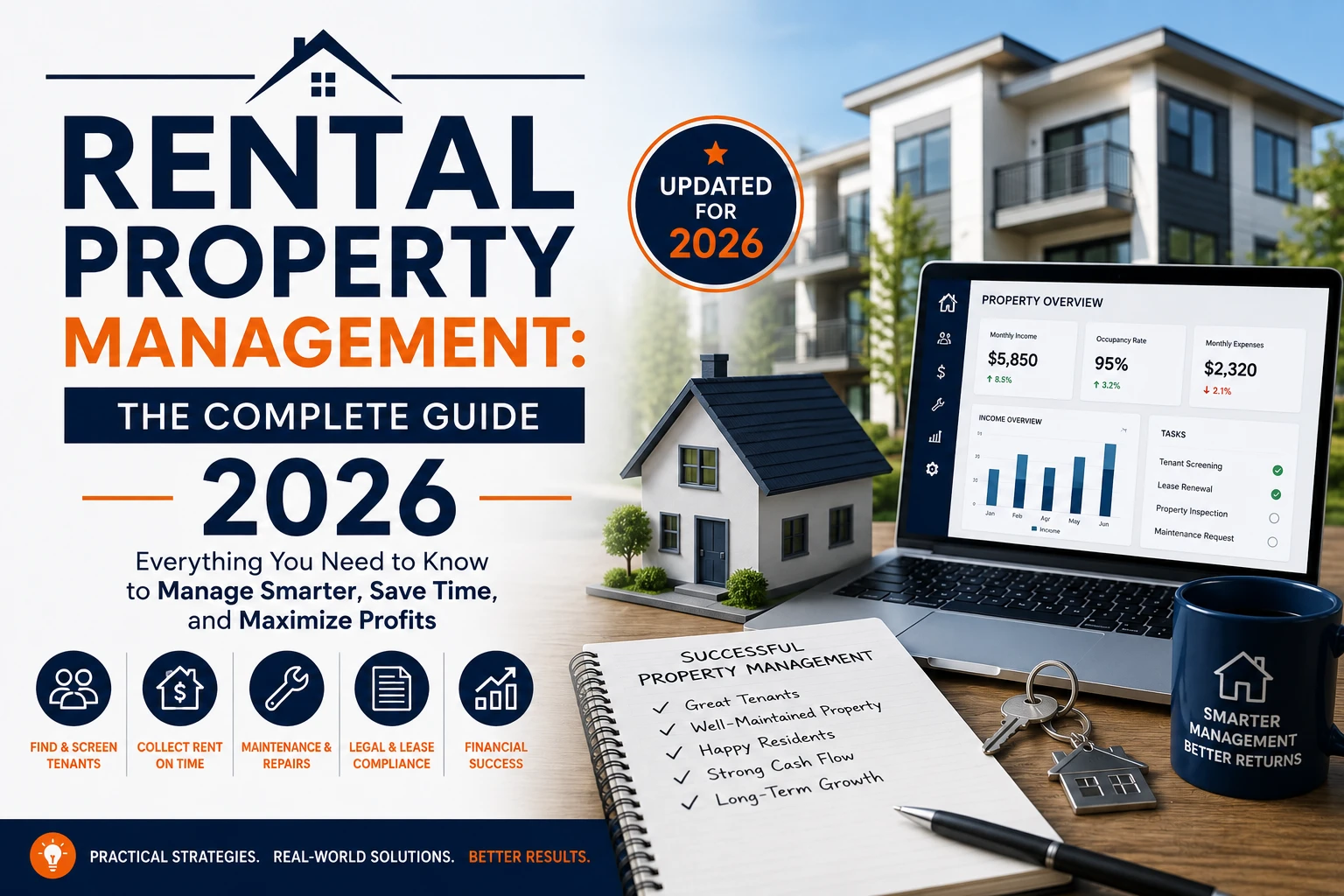
What is rental property management?
Rental property management is the process of overseeing a residential rental property on behalf of an owner. It covers everything from finding and screening tenants, drafting lease agreements, collecting rent, handling maintenance and repairs, maintaining financial records, and ensuring compliance with landlord-tenant law. Landlords can self-manage or hire a professional management company to handle some or all of these functions.
Managing a rental property is not passive income. It is running a small business. You have a customer (the tenant), a product (the unit), legal obligations to both parties, financial records to maintain, and a physical asset to keep in working order. Get these things right and the property generates steady income and builds equity over time. Get them wrong and you are dealing with vacancies, costly disputes, and deferred maintenance that compounds into much larger problems.
This guide covers every major domain of rental property management: finding and screening tenants, lease agreements, rent collection, maintenance, financial management, legal compliance, and the decision of whether to self-manage or hire professional help. Each section links to deeper guides where the topic warrants more detail.
If you are still evaluating whether a rental property is worth buying in the first place, start with What to Look for in a Rental Property. If you have already purchased and are ready to manage, read on.
1. The Rental Property Management Lifecycle
Rental management is cyclical. Each tenancy follows a predictable sequence, and understanding that sequence helps you anticipate what is coming rather than constantly reacting to it.
2. Finding and Screening Tenants
The tenant you place determines almost everything else about the tenancy. A reliable, financially stable tenant who respects the property makes management straightforward. A poorly screened tenant creates problems that can take months and significant legal cost to resolve.
Setting the Right Rent
Rent that is too high creates vacancy. Rent that is too low leaves money on the table and can be difficult to increase at renewal without losing a good tenant. Research comparable rentals in your immediate area using listing platforms, and verify that your asking rent covers all monthly expenses including mortgage, taxes, insurance, and a maintenance reserve, with positive cash flow remaining.
A commonly referenced benchmark is the 1% rule: monthly rent should be at least 1% of the property's purchase price. This is a quick screen, not a guarantee of profitability. Markets vary significantly, and in high-cost metros, 0.5% to 0.75% may be realistic while still producing acceptable returns. Always run the full cash flow calculation.
Marketing the Property
List on the major rental platforms: Zillow, Apartments.com, Trulia, and Facebook Marketplace for residential rentals. Professional photos are not optional; they significantly affect application volume. Write a listing that accurately describes the unit, its features, and what is included. Misleading listings waste your time and the applicant's.
Tenant Screening
Screening is the single most important thing you do as a landlord. A rigorous, consistent screening process for every applicant reduces delinquency, property damage, and eviction risk dramatically.
A complete screening process should cover: income verification (typically 3x monthly rent as a minimum), credit history, background check, rental history and landlord references, and employment verification. For a step-by-step breakdown, see How to Screen Tenants: 6 Essential Steps.
Fair Housing Act compliance is non-negotiable
Federal Fair Housing Act prohibits discrimination based on race, color, national origin, religion, sex, familial status, or disability. Many states add additional protected classes. Apply the same screening criteria to every applicant, document your decisions, and never make selection decisions based on any protected characteristic. Violations carry significant legal and financial penalties.
3. Lease Agreements: What Every Landlord Must Include
The lease agreement is the legal foundation of the tenancy. A well-drafted lease prevents the majority of landlord-tenant disputes by making expectations explicit before anyone moves in.
Key Clauses Every Lease Must Cover
• Names of all adult tenants
• Lease term, start date, end date, and renewal terms
• Monthly rent amount, due date, grace period, and late fee policy
• Security deposit amount, what it covers, and the return timeline
• Maintenance responsibilities: what the landlord covers, what the tenant covers
• Right of entry: required notice period before landlord access
• Occupancy limits and guest policy
• Pet policy: permitted breeds, sizes, deposits, and monthly fees
• Early termination terms and consequences
• Default and eviction grounds
• Severability clause
Fixed-Term vs. Month-to-Month
A fixed-term lease (typically 12 months) locks in rent and terms for the full period and provides income stability. A month-to-month agreement gives both parties flexibility but exposes you to more frequent turnover. In strong rental markets, a 12-month lease is almost always preferable for the landlord. In uncertain markets or for transitional situations, month-to-month may be appropriate.
For a complete guide to lease clauses, required legal disclosures, and 2026 state law updates, see Rental Agreements and Lease Terms: A Landlord's Guide.
4. Rent Collection: Setting Up a System That Works
Collecting rent is not just about receiving money. It is about creating a reliable, documented system that makes on-time payment easy for tenants and gives you clean financial records. The landlords who have the most trouble with late payments are almost always the ones running manual, informal collection processes.
Online Rent Collection
Online rent collection reduces late payments, creates an automatic payment record for both parties, and eliminates the chase involved in collecting checks. Tenants can set up autopay, payments post to the ledger automatically, and delinquency is visible in real time.
For a breakdown of every payment method, what each costs, and how to set up automated collection, see the Online Rent Payment guide.
Late Fees and Delinquency Policy
State your late fee clearly in the lease: the amount, when it applies (which day after the due date), and whether it is a flat fee or a daily charge. Most states cap late fees; verify your state's limits before setting them. Consistency matters. A policy you enforce inconsistently is a policy that will not hold up in court.
When a tenant stops paying rent, there is a specific legal sequence to follow. See What to Do When a Tenant Stops Paying Rent for the step-by-step process from written reminder through eviction proceedings.
5. Maintenance and Repairs: Your Legal Obligation and Operational Strategy
Maintenance is both a legal obligation and a financial strategy. Legally, landlords in every state are required to maintain habitable conditions: working heat, plumbing, structural integrity, and freedom from pest infestations. Failing to maintain habitability exposes you to rent withholding, repair-and-deduct remedies, and legal liability.
Strategically, proactive maintenance costs far less than reactive repair. A $200 HVAC service call prevents a $4,000 system replacement. A $50 caulking job prevents water damage that takes out a ceiling. The landlords who budget for maintenance consistently outperform those who treat it as an expense to defer.
Maintenance Reserve
Budget 1% of the property's value per year for maintenance. On a $300,000 property, that is $3,000 per year, or $250 per month set aside into a dedicated account. This is a rough guideline; older properties or those with aging systems may need more. Without a reserve, a single unexpected repair can create a cash flow crisis.
The Move-In and Move-Out Inspection
A documented move-in inspection, signed by both parties with timestamped photos, is your primary protection against deposit disputes at move-out. Without it, you cannot deduct for damage because you cannot prove the damage was not pre-existing. This is one of the most commonly skipped steps by new landlords and one of the most expensive mistakes to make.
Emergency vs. Routine Maintenance
Define what constitutes an emergency in your lease: loss of heat in winter, broken door locks, flooding, gas leaks. Have a response plan for emergencies that does not depend on you being available 24/7. Build a reliable vendor list for plumbing, electrical, HVAC, and general repairs before you need it. Finding a contractor urgently during an emergency costs more and takes longer.
6. Rental Property Financial Management
Rental properties generate income and expenses. Managing both properly is what determines whether the investment actually performs the way you projected when you bought it.
Core Financial Records Every Landlord Needs
• Rent roll: a record of every tenant, their unit, monthly rent, and payment status
• Income ledger: all rental income received, by property and by month
• Expense ledger: all property expenses with receipts, categorized for tax purposes
• Security deposit ledger: deposits held, amounts, and disposition at move-out
• Cash flow statement: monthly income minus all expenses, by property
• Year-end profit and loss: required for tax filing
Key Financial Metrics
Tax Considerations
Rental income is taxable, but so are most expenses associated with the property: mortgage interest, property taxes, insurance, repairs, depreciation, professional fees, and management costs. Depreciation alone — the ability to deduct the property's value over 27.5 years under IRS Publication 527 — can significantly offset taxable income. Keep receipts for every expense. Consult a CPA who specializes in real estate investment before your first tax year.
The IRS distinguishes between passive rental activities and active participation. This classification affects how losses can be deducted against other income. Most small landlords qualify as active participants, which allows up to $25,000 in rental losses to offset other income, subject to income phase-out rules under IRS Publication 925. Verify your classification with a tax professional.
7. Landlord-Tenant Law: What Every Landlord Must Know
Landlord-tenant law governs almost every aspect of the rental relationship: how much you can charge for a deposit, how much notice you must give before entering the unit, what conditions qualify as habitability failures, and how the eviction process works. These laws vary significantly by state and in some cases by city.
Federal Requirements That Apply Everywhere
• Fair Housing Act: prohibits discrimination on seven protected classes. Applies to marketing, screening, and tenancy terms.
• Lead-based paint disclosure: required for all pre-1978 properties. Includes an EPA pamphlet. Civil penalty up to $22,263 per violation.
• Servicemembers Civil Relief Act (SCRA): active-duty military may terminate a lease without penalty under specific conditions.
• Americans with Disabilities Act (ADA): applies to multifamily properties with 4+ units; reasonable accommodation requests must be evaluated individually.
State-Level Requirements to Verify
For a full breakdown of landlord obligations under federal and state law, including tenant rights, see 7 Essential Tenant Rights and Rental Owner Obligations. For your obligations specific to the lease document, see Rental Agreements and Lease Terms.
8. Self-Management vs. Professional Management: The Decision Framework
The central decision every rental property owner faces is whether to manage the property themselves or hire a professional management company. There is no universally right answer. The right choice depends on your portfolio size, time availability, proximity to the property, and how much the management cost affects your financial returns.
For a deeper look at this decision including cost analysis and what professional managers actually do, see HOA Self-Management vs. Property Management: Key Pros and Cons. For what a professional management company costs and how to evaluate one, see HOA Management Company: What They Do and How to Choose.
9. The Most Common Rental Management Mistakes
Most rental property problems are predictable and preventable. These are the mistakes that consistently cost landlords time and money.
• Skipping the move-in inspection: No documentation means no defensible deposit deductions at move-out. Every tenancy needs a signed move-in checklist with photos, no exceptions.
• Accepting the first applicant to fill a vacancy quickly: A one-month vacancy is expensive. An 18-month problem tenancy is more expensive. Screen every applicant thoroughly regardless of vacancy pressure.
• Setting rent based on your mortgage payment: Market conditions determine what tenants will pay, not your expenses. Price based on comparable rentals and run the cash flow calculation separately.
• No written maintenance records: If a tenant claims you ignored a repair request and you cannot show you received it and responded, you are in a weak legal position. All maintenance requests and responses should be in writing.
• Ignoring lease renewal timing: A lease that converts to month-to-month by default gives the tenant optionality you do not have. Start the renewal conversation 60 to 90 days before the lease expires.
• Accepting partial rent after serving a Pay or Quit Notice: In many states this invalidates the notice and restarts the clock. Know your state's rule before accepting any payment after serving legal notice.
• Treating the security deposit as income: The security deposit belongs to the tenant until move-out. In many states it must be kept in a separate account. Spending it creates legal liability.
For a first-time landlord overview covering setup, screening, and early management best practices, see 22 Tips for First-Time Rental Property Owners.
Related Rental Guides
Further reading from the ManageCasa rental cluster:
• How to Screen Tenants: 6 Essential Steps to Protect Your Investment
• Rental Agreements and Lease Terms: A Landlord's Guide
• What to Do When a Tenant Stops Paying Rent
• 7 Essential Tenant Rights and Rental Owner Obligations
• 22 Tips for First-Time Rental Property Owners
• Landlord Insurance: Coverage and Cost Guide 2026
• Best Rental Property Accounting Software for 2026
• Best Rental Listing Websites for Landlords 2026
Frequently Asked Questions about Rental Property Management
What does a rental property management company do?
A rental property management company oversees the daily operations of rental properties on behalf of the owner. Services typically include marketing vacancies, tenant screening, lease management, rent collection, maintenance coordination, inspections, owner reporting, and compliance tracking. Modern property management software centralizes these functions in one system, reducing manual work and giving owners real-time visibility into portfolio performance.
How much does property management cost?
Property management costs vary by property type, portfolio size, and service level. Traditional full-service management companies typically charge 8% to 12% of monthly collected rent, plus a leasing fee (often one month's rent) when a new tenant is placed. Self-managing landlords who use property management software generally pay a flat monthly or per-unit fee instead, which can be significantly lower. The right cost structure depends on how much of the day-to-day work the owner wants to handle themselves.
How do property managers screen tenants?
Effective tenant screening goes beyond a simple credit check. Professional property managers typically evaluate income, employment history, rental references, background reports, and eviction records to assess an applicant's reliability. A consistent screening process helps reduce risk, improve on-time rent payments, and support longer tenant retention. Digital property management platforms can further streamline application reviews and document collection while maintaining compliance with fair housing regulations.
How are maintenance requests handled?
Maintenance requests are most effective when tracked through a centralized system that keeps tenants, property managers, vendors, and owners informed. Modern property management software allows residents to submit requests online, attach photos, monitor progress, and receive updates. This improves response times, creates a documented repair history, and helps property managers prioritize urgent issues while maintaining transparency throughout the repair process.
Is hiring a property manager worth it?
Hiring a property manager is generally worth it when the cost of your time exceeds the management fee, or when the property is out of state or part of a larger portfolio. A management company handles tenant calls, maintenance coordination, legal notices, lease renewals, and compliance. For owners with one or two local properties who have the time and knowledge to self-manage, keeping management in-house retains more cash flow. The break-even point is typically around 5 to 8 units, though it varies by market and property type.

Content Writer
Patrick Bohan is a content strategist focused on property management technology, HOA operations, and real estate. A Cornell graduate, he began his career at UBS covering housing markets, homeownership policy, and financial regulation — experience that now informs his research-driven approach to proptech content. Today he bridges the gap between software teams and the practitioners who use them, producing practical resources on community associations, rental operations, and accounting workflows for property managers.