




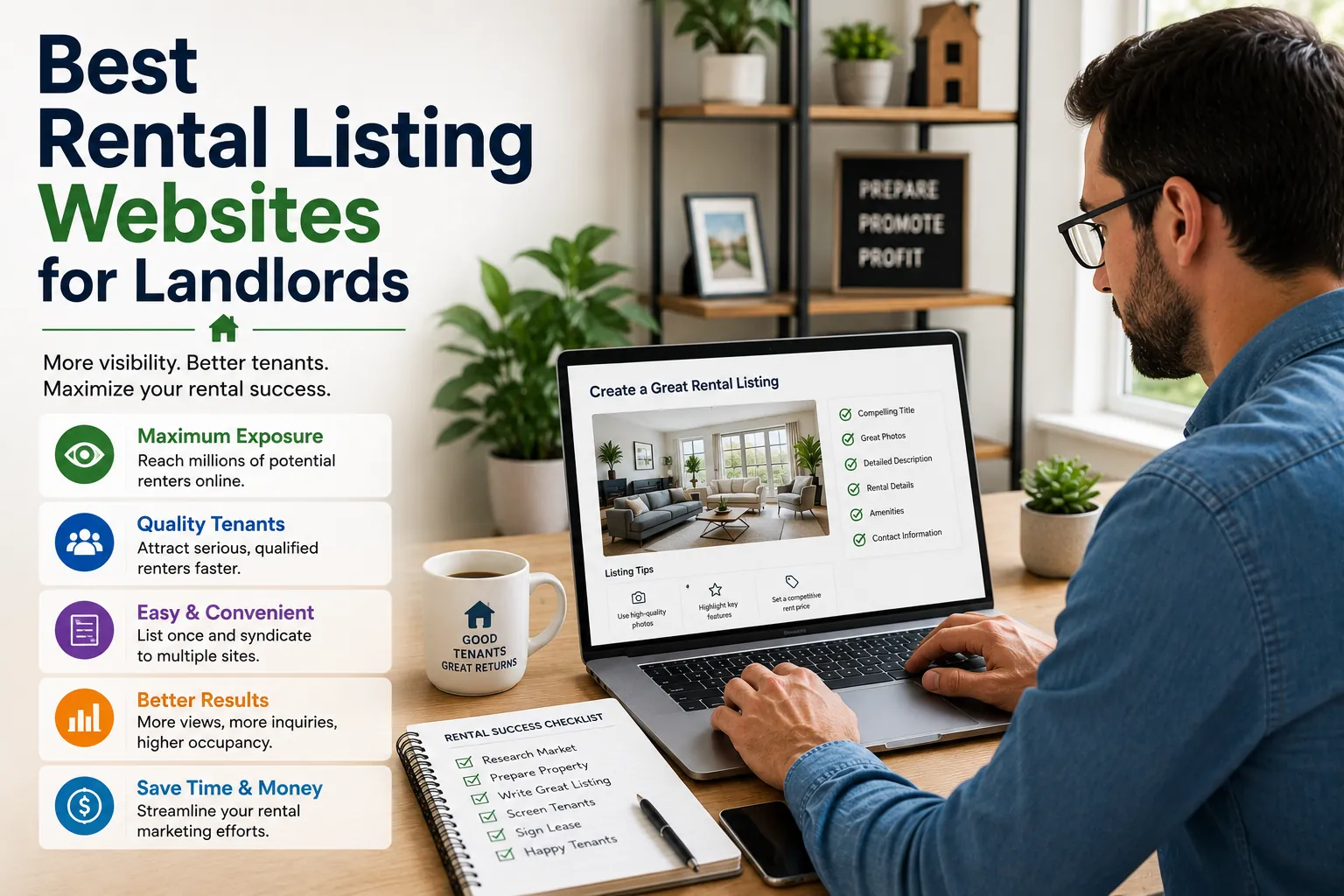
The best rental listing websites for landlords in 2026 are platforms that combine wide renter reach, accurate listing distribution, and tools that reduce the time spent filling a vacancy. The top platforms include RentSmart, Zillow Rental Manager, Apartments.com, Zumper, Realtor.com, TurboTenant, and Avail. The right choice depends on portfolio size, budget, and whether you need syndication, screening, or end-to-end leasing workflow support.
Most renters start their search online. By 2025, about three out of four renters were beginning their housing search on a digital platform before ever contacting a landlord directly, according to data cited by multiple rental market research sources. For landlords, that means the question is no longer whether to list online. It is which platforms give you the best shot at reaching qualified renters quickly.
This guide covers the eight best rental listing websites for landlords in 2026 — what each platform does well, what it costs, and which type of landlord it suits best.
What Makes a Good Rental Listing Platform?
Not all listing sites are equal. Some have enormous renter traffic but high competition and limited tools. Others are smaller but deliver more qualified leads with less manual work. Before choosing where to list, consider these factors:
• Renter reach: How many active renters are searching on this platform and in your market?
• Lead quality: Does the platform filter or validate applicants, or do you receive every inquiry regardless of fit?
• Cost: Free-to-list platforms vary widely in what features require payment. Understand the full cost model.
• Screening and workflow: Does the platform help you move from listing to lease, or just generate inquiries?
• Syndication: Does a single listing post to multiple sites, multiplying reach without multiplying effort?
• Time investment: How much manual coordination — showings, follow-up, document chasing — does the platform remove?
The Best Rental Listing Websites for Landlords in 2026
RentSmart
Free end-to-end platform for long-term residential leasing — from listing to validated tenant profile
Best for: Independent landlords (1-50 homes) and property management firms (50-500+ homes) managing traditional long-term residential leases who want to reduce leasing time without adding headcount or paying per-unit fees
Cost to landlords: Free to list and lease. No per-unit fees. No credit card required.
Pros:
• Free for landlords and property managers — no platform fee, ever
• Validated tenant profiles: credit, income, employment, bank statements, and lease ledger data all verified before you review
• Live in under 10 minutes — company profile, screening criteria, and first listing go up fast
• Self-access showings with time-limited access codes reduce scheduling back-and-forth
• Averages 21 hours saved per vacancy compared to manual leasing processes
• Fraud detection built into the screening process
• Adverse action support if you need to decline an applicant
• 7x validated prospective tenants per vacancy on average — only candidates who meet your criteria reach you
Cons:
• Newer platform — smaller renter audience than Zillow or Apartments.com currently
• Self-access showing model requires properties where access code entry is practical
RentSmart's core differentiator is what it does before you ever review an applicant. Rather than sending landlords a stream of raw inquiries to manually qualify, it requires prospective tenants to build a validated profile covering credit, income, employment, bank statements, and lease ledger history. Landlords only see candidates who already match their screening criteria. That shift from reactive screening to pre-validated inbound profiles is what drives the 21-hour-per-vacancy time savings the platform publishes.
The completely free model is unusual in the leasing platform market, where most competitors either charge per listing, per lead, or per unit. For landlords managing a few properties or property managers running portfolios up to several hundred units, the absence of platform fees changes the economics of vacancy filling significantly.
For independent landlords: list your first property free at RentSmart
For property managers: explore the RentSmart PM platform
Zillow Rental Manager

Largest rental audience in the US — maximum top-of-funnel reach
Best for: Landlords who prioritize raw reach and brand recognition over cost efficiency. Best for high-demand markets where volume matters.
Cost to landlords: Free basic listing. Premium boost: $30 for 90 days (non-refundable if filled early). Some markets charge per listing.
Pros:
• Approximately 57 million monthly users — the largest rental audience in the US
• Reusable Zillow Application streamlines initial applicant intake
• Strong brand recognition means renters trust listings on the platform
• Listings syndicated across Trulia and HotPads at no additional cost
Cons:
• Intense competition in dense markets — free listings can get buried quickly
• Premium boost cost is non-refundable if the vacancy fills before 90 days
• Limited workflow tools beyond the application — no built-in showing coordination or document validation
• Paid premium increasingly necessary to stand out in popular metros
https://www.zillow.com/rental-manager/
Apartments.com

CoStar-backed premium platform — best for professionally managed multifamily
Best for: Property management companies with multifamily portfolios wanting premium listing presentation and verified content.
Cost to landlords: Free basic listing. Premium plans required for top placement and enhanced features — pricing varies by market.
Pros:
• Part of CoStar Group — significant resources and verified listing infrastructure
• Premium listings support Matterport 3D tours and HD video
• Strong presence in multifamily search — well-positioned for larger portfolio operators
• Immersive search experience that converts high-intent renters
Cons:
• Premium plan investment often required to stand out meaningfully
• Lead quality and volume inconsistent by market — not uniformly strong everywhere
• Less suited for small independent landlords managing a few single-family homes
https://www.apartments.com/rental-manager/
Zumper

Mobile-first platform with AI search — strong with younger renters
Best for: Landlords targeting millennial and Gen Z renters. Strong in urban markets. Good for single-unit and small portfolio operators.
Cost to landlords: Free basic listing. Zumper Pro subscription available for enhanced features.
Pros:
• Over 1 million active listings across US and Canada
• AI rental search assistant helps match renters to appropriate listings
• Mobile-first design suits on-the-go renter behavior
• Short-term and flexible lease length options available alongside standard long-term leases
• Detailed city and neighborhood data helps renters evaluate locations
Cons:
• Less dominant than Zillow or Apartments.com in many suburban and rural markets
• Pro features require subscription — free tier is limited
https://www.zumper.com/list-your-property
Realtor.com Rentals

Strong trust brand — reaches renters who also consider buying
Best for: Landlords in markets where renters and potential buyers overlap. Good for high-quality unit listings at mid-to-upper price points.
Cost to landlords: Free to list.
Pros:
• Strong brand trust — renters who also follow home buying trends use Realtor.com heavily
• Free to list with no premium requirement for basic reach
• Integration with the broader Realtor.com real estate ecosystem
Cons:
• Smaller dedicated rental audience than Zillow or Apartments.com
• Less workflow tooling than management-oriented platforms
• Better suited for higher price point units than entry-level rentals
https://www.realtor.com/myrealtor/
TurboTenant
Free syndication hub — one listing across dozens of platforms
Best for: Independent landlords who want to maximize reach without managing multiple listings manually.
Cost to landlords: Free syndication and listing. Paid add-ons for premium screening reports and lease management.
Pros:
• Syndicates to Realtor.com, Craigslist, Redfin, and other sites from one submission
• Unlimited listings at no cost
• Built-in tenant screening, online applications, and rent collection available
• Good all-in-one option for landlords wanting more than just reach
Cons:
• Not a high-traffic destination platform itself — reach depends on syndication partners
• Screening and advanced features require paid plans
• Less suited for large portfolio operators who need enterprise-level workflow tools
Avail (by Realtor.com)

All-in-one landlord tool with listing syndication built in
Best for: Small independent landlords who want listing plus rent collection, lease management, and maintenance tracking in one place.
Cost to landlords: Free plan available. Unlimited Plus plan: $9 per unit per month for premium features.
Pros:
• Listing syndication included in the free tier
• Rent collection, digital lease management, and maintenance tracking built in
• Good onboarding for first-time landlords
• Owned by Realtor.com — reliable institutional backing
Cons:
• Free plan has limitations — per-unit fee required for full feature access
• Not a high-traffic destination for renters searching independently
• Less suited for portfolio operators who need bulk management tools
Rent.com

Network reach for professionally managed multifamily — part of the Rent. Network
Best for: Large-scale property management operators managing professionally managed multifamily communities.
Cost to landlords: Pricing varies — primarily suited to property management companies with dedicated marketing budgets.
Pros:
• Part of the Rent. Network including ApartmentGuide and Rentals.com — consolidated reach
• Strong in professionally managed multifamily segment
• Lead generation focused — built for volume
Cons:
• Primarily built for professional property management companies, not independent landlords
• Less practical for smaller portfolios or single-unit operators
• Cost structure less transparent for smaller operators
https://www.rent.com/rental-manager
Quick Comparison: Best Rental Listing Websites at a Glance
How to Get the Most from Your Rental Listings
Getting listed is just the start. How you present a vacancy directly affects how many qualified inquiries you receive and how fast you fill it.
Write a listing that answers the questions renters actually ask
Most rental listings are too vague. Renters want to know: how much is it really (including utilities), what are the lease terms, is parking included, are pets allowed and on what terms, and what does the neighborhood actually look like. A listing that answers these questions upfront gets more qualified inquiries and fewer wasted showings.
Use quality photos — it matters more than any other single factor
Listings with high-quality photos receive significantly more interest than those with poor photos or none at all. Natural light, straight angles, and showing every room clearly outperforms staged photography in most rental contexts. A clean, well-lit smartphone photo is better than a blurry DSLR shot in poor light.
Set your screening criteria before you publish
Define your minimum requirements before the listing goes live: minimum income threshold, acceptable credit range, prior eviction policy, pet policy, and maximum number of occupants. Platforms like RentSmart let you set these criteria upfront so that only candidates who meet them move forward. Having criteria documented also protects against fair housing claims by demonstrating consistent, objective standards.
For a full framework on tenant screening, see how to screen tenants: 6 essential steps.
Respond to inquiries the same day
Qualified renters are typically applying to multiple properties simultaneously. A landlord who responds the same day converts significantly more inquiries to showings than one who waits 24 to 48 hours. Speed of response is one of the most actionable ways to improve vacancy fill rates regardless of which platform you use.
Use virtual or self-access showings to eliminate no-shows
No-shows are one of the most frustrating costs of the leasing process. Platforms that offer self-access showing options with time-limited access codes (as RentSmart does) eliminate the scheduling burden and ensure the property is only accessed by credentialed prospective tenants who have committed to a specific window.
Related Guides for Landlords
• How to Screen Tenants: 6 Essential Steps
• Rental Agreements and Lease Terms Guide
• Rental Security Deposit Guide
• 22 Tips for First-Time Rental Property Owners
• Communication Tips for Tenants and Landlords
Frequently Asked Questions
What is the best free rental listing website for landlords?
RentSmart, Zillow Rental Manager, and Realtor.com are popular free rental listing platforms. The best choice depends on whether you prioritize qualified leads, audience reach, or leasing workflow tools.
Should I list on multiple rental websites?
Yes. Listing on multiple rental websites increases exposure and applicant volume. Using a syndication platform can help keep listings consistent across multiple sites.
How do I list a rental property online for free?
Create an account on a free rental listing platform, enter property details, upload photos, set rental terms, and publish the listing to start receiving inquiries.
What information should I include in a rental listing?
Include rent amount, lease terms, bedrooms, bathrooms, square footage, pet policy, parking details, utilities, amenities, screening criteria, and high-quality photos.
What is the difference between a listing site and a leasing platform?
A listing site advertises vacancies and generates inquiries. A leasing platform manages the full rental process, including applications, screenings, showings, and lease execution.

Content Writer
Patrick Bohan is a content strategist focused on property management technology, HOA operations, and real estate. A Cornell graduate, he began his career at UBS covering housing markets, homeownership policy, and financial regulation — experience that now informs his research-driven approach to proptech content. Today he bridges the gap between software teams and the practitioners who use them, producing practical resources on community associations, rental operations, and accounting workflows for property managers.