


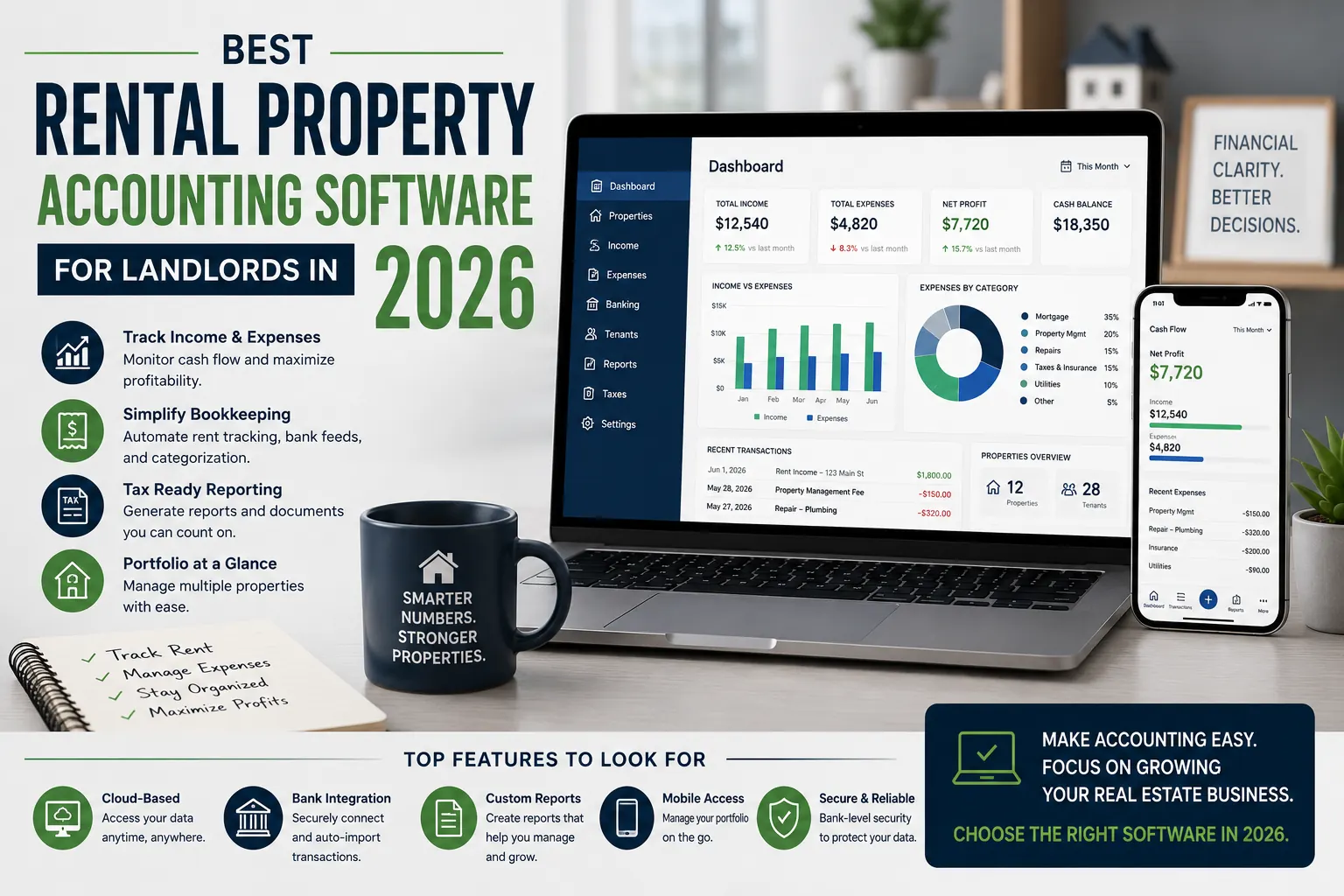
What Is Rental Property Accounting Software?
Rental property accounting software helps landlords and property managers track rent, sort expenses, build reports, and prep tax records for rentals. Unlike general business tools, the best rental property accounting software groups money by property and unit, supports Schedule E income and loss reports, tracks asset write-offs, and separates operating costs from capital improvements. That fit matters because rental properties need a different setup than a normal business.
Many buyers also compare it with landlord tax software or accounting software for property management before they pick a tool.
Why Generic Accounting Tools Fall Short for Landlords
At first, I thought any accounting app or even a good spreadsheet would work. Once I started tracking rent, repairs, owner draws, and tax write-offs across several properties, I saw the gap. General tools can log transactions, but they are not built around a landlord's daily work. I spent more time sorting data than using it.
As rental portfolios grow, the risks also grow. Missed deductions, wrong reports, late bank checks, and hours of manual work can pile up fast. Tax season makes the problem clear. It can lead to extra CPA fees, compliance stress, and doubt about whether the books are complete.
Purpose-built rental property accounting software fixes this with automatic workflows, property-level records, and reports made for real estate investors and managers. In this guide, we cover the key features to look for, compare the best rental property accounting software for different portfolio sizes, and show how to choose the right fit.
This is general guidance, not tax advice. Talk with a CPA who knows rental tax rules.
What Rental Property Accounting Software Does
Purpose-built rental accounting software handles four things that general accounting tools handle poorly or not at all.
1. Property-Level Financial Tracking
Rental homes are separate income assets. Good software tracks every rent payment, repair, insurance bill, and mortgage interest charge by property and unit. That lets you see what each property earns and costs without manual sorting.
General tools like QuickBooks can record these costs, but they do not natively understand the property-by-property structure. You often need workarounds that take time to maintain and can break down as you grow.
2. Schedule E Reporting
Rental income and losses go on IRS Schedule E. The expense groups on Schedule E advertising, auto and travel, cleaning and maintenance, write-offs, insurance, legal and professional fees, management fees, mortgage interest, repairs, supplies, taxes, and utilities are the natural categories for landlord software.
Software that creates Schedule E-ready reports saves time at tax season and lowers the risk of missed deductions or wrongly tagged expenses. Most landlord platforms export to tax software or create reports a CPA can use without extra work.
IRS Schedule E — Supplemental Income and Loss
3. Write-Off Tracking
Write-offs are one of the best tax breaks for landlords and one of the easiest to mishandle. Residential rental property is written off over 27.5 years under MACRS. Improvements, appliances, and some parts may follow shorter schedules. Tracking built-up write-offs and knowing what has already been used matters for the yearly return and for gain on sale.
Purpose-built rental accounting software tracks these schedules by property and asset, which cuts down on manual math.
IRS Publication 946 — How to Depreciate Property
4. Cash Flow and Portfolio Performance Reporting
Beyond tax prep, rental accounting software gives landlords a clear view of portfolio health. It can show net operating income by property, cash-on-cash return, occupancy, year-over-year income, and cost breakdowns by category. These reports help with rent prices, repair plans, and deciding whether a property is meeting goals.
Why QuickBooks Falls Short for Rental Property Accounting
QuickBooks is the most common small business accounting tool, and many landlords start there. For small portfolios with simple books, it can work well enough. But three structural gaps show up as the portfolio grows.
- No property-level accounting out of the box: QuickBooks is general accounting software, not property management software. To track each rental, you usually need Class Tracking or Locations and one class for each property. Every rent payment, repair bill, utility bill, and vendor invoice must then be tagged by hand. Miss one entry and the property profit and loss report is off. This can work for a few rentals, but it gets slow and error-prone as you grow.
- No Schedule E fit: QuickBooks categories do not map to Schedule E on their own. Tax prep needs a manual fix or a CPA who adjusts the reports. That is time and cost that purpose-built software can remove.
- No rental-specific tools: Write-off tracking, rent roll reports, vacancy tracking, and tenant ledgers are not built in. You either skip them or add tools, which raises cost and complexity.
QuickBooks can still make sense for property managers who also run a business with payroll, accounts payable, and complex multi-entity books. For landlords whose main need is rental income, expenses, and Schedule E, a purpose-built platform is usually faster, cheaper, and more accurate.
Best Rental Property Accounting Software in 2026
The platforms below are grouped by the type of landlord they fit best, from free tools for small portfolios to all-in-one systems for professional managers.
Prices verified June 2026. All figures are based on entry-level plans and are subject to change. Always check the provider's website for the most current pricing.
ManageCasa - Best for HOA and Rental Portfolio Accounting
The ManageCasa accounting module was built for HOA fund accounting and rental property finance. For landlords, it covers rent tracking, expense tagging, bank reconciliation, profit and loss reports, owner statements, and property-based financial reports.
The big advantage for owners with both HOAs and rentals is one view. One platform handles the full picture across both asset types instead of separate systems. The financial module links to rent collection and maintenance, so income and expense entries flow in on their own instead of needing manual entry.
ManageCasa Accounting Pricing (verified June 1, 2026)
Base Plan: $45/month covers up to 25 units, billed yearly. Growth Plan: $80/month. Premium Plan: $130/month. Accounting features are included across all plans. See managecasa.com/pricing for current rates.
For a full overview of ManageCasa's financial tools, see financial management capabilities.
Baselane - Best Free Option for Independent Landlords
Baselane gives landlords a full money system, and its core tools are free. It combines landlord banking, auto rent collection, and expense tracking in one platform. That integration is its main strength. When a tenant pays rent or you use the Baselane debit card for a repair, the entry is logged and tagged to the right property.
For landlords with 1-10 units, that cuts manual work and gives a live view of each property's performance. It is a strong pick for owners who want solid financial tools without a monthly fee.
Stessa - Best for Real Estate Investor Reporting
Stessa is built for investors who want to track portfolio performance along with bookkeeping. Its free plan includes expense tracking, rent collection, and core financial reports. The Pro plan starts at $20/month and adds budgeting tools, pro forma analysis, and faster rent payments.
Stessa's dashboard shows cash-on-cash return, net operating income, and appreciation. That makes it a good fit for owners focused on growth.
Landlord Studio - Best Mobile-First Option
Landlord Studio is made for landlords who work on the go. Its mobile app is one of the best in the group. Users can log income and expenses, scan receipts, track mileage, set reminders, and message tenants.
Starting at $12/month for up to three properties, it is a cost-friendly way to keep accounting and basic property work in one mobile app.
REI Hub - Best for Multi-Entity and Investor Accounting
REI Hub is built for the challenge of managing properties across several LLCs or other entities. Its main feature is separate financial records for each entity, so funds stay apart. At the same time, it gives you a combined report of the whole portfolio.
That is key for liability protection and makes tax season much easier for complex owners. It is a pure accounting tool and does not include rent collection, but its focus on investor-grade, multi-entity bookkeeping makes it a strong choice for serious portfolio builders.
Buildium - Best for Professional Management Companies
Buildium's accounting module is mature and tied closely to its property management workflow. It handles full general ledger accounting, trust accounting, bank reconciliation, owner statements, 1099s, and CAM reconciliation for commercial properties.
Starting at $62/month, it is the priciest entry option here. But for professional managers who need accurate books and compliance, the depth can be worth it.
Rent Manager - Best for Customizable and Mixed Portfolios
Rent Manager stands out because it can handle complex and mixed portfolios. It is a strong all-in-one choice for operators with both residential and commercial properties. Its accounting system is highly flexible, with support for special lease setups, CAM reconciliations, and property-specific reports.
With more than 450 built-in reports and flexible workflows, it is a strong platform for managers who need one system that fits many property types or day-to-day needs.
Choosing the Right Rental Property Accounting Software by Portfolio Size
What to Look for in Rental Property Accounting Software

Over the years, I have tested a wide range of rental property accounting software, and one feature I missed at first was automated bank reconciliation. It looked like a simple nice-to-have until I managed larger portfolios and saw how much time it saved and how much it cut bookkeeping errors.
That changed how I judge accounting platforms. Today I look past basic bookkeeping and focus on the parts that have the biggest impact on accuracy, speed, and long-term growth. The best rental property accounting software should do the jobs below without adding extra work. If you are comparing accounting software for property management or landlord tax software, these are the features that matter most.
- Property-level transaction organization: Every income and expense entry should be linked to a specific property and unit automatically, not sorted by hand. This is the base of useful rental accounting.
- Schedule E category alignment: Expense groups should map directly to Schedule E. That saves time at tax prep and lowers deduction mistakes.
- Bank feed integration: Automatic bank imports with tagging rules cut manual entry. Look for software that connects to your business bank account and tags rental transactions automatically.
- Write-off tracking: The software should track built-up write-offs by property and asset, not just remind you to do it by hand.
- Rent collection integration: Separate rent collection creates extra reconciliation work. Platforms where rent collection and accounting are built together, like ManageCasa, Baselane, and Buildium, post income automatically when rent is paid.
- Multi-property reporting: You need both property-level and portfolio-level views. Both matter for rent prices, repair work, and future buys.
- Export and CPA compatibility: The software should export reports your CPA can use, or create Schedule E summaries that tax software can import.
- Key integrations: Beyond the core tools, look at bank links, tax software like TurboTax, and tenant screening or listing tools to keep your workflow smooth.
Integration with QuickBooks and Xero vs. All-in-One Systems
Some landlords and property managers use a special tool for rent collection and maintenance, while keeping the books in a general accounting system like QuickBooks or Xero. That hybrid setup has trade-offs.
Pros of an integrated approach:
- Powerful general accounting: You keep the deep reports, invoices, and payroll tools of QuickBooks.
- CPA comfort: Your accountant is likely already comfortable with QuickBooks or Xero, which makes teamwork easier.
- Business consolidation: If you run other businesses, you can keep all your books in one place.
Cons of an integrated approach:
- Complexity and cost: You are paying for and managing two software subscriptions.
- Sync issues: Data sync between the two platforms can fail or lag, so you may need manual checks.
- Fragmented workflow: You may need to switch systems to see the full picture of your operations and finances.
Platforms like TenantCloud and AppFolio offer direct integrations with QuickBooks Online, which can help. If you go this route, check the quality and reliability of the sync carefully.
Why Multi-Entity Accounting Is Crucial for Serious Investors
As a real estate portfolio grows, investors often hold properties in several legal entities, such as different LLCs for each property or group of properties. This is done to limit liability, but it creates an accounting challenge: the need for multi-entity accounting.
Multi-entity accounting means keeping separate, clean records for each legal entity while still being able to see one combined view of the whole portfolio. This is more than a best practice. It is essential for:
- Liability protection: Keeping finances strictly separate for each LLC helps protect the corporate veil that shields your personal assets and other properties from a lawsuit tied to one property.
- Accurate reporting: It lets you build a clear profit and loss statement for each entity, which is needed for tax filing and performance checks.
- Investor clarity: If you have partners or investors in certain deals, multi-entity accounting gives them the clear reports they need.
Software with strong multi-entity tools, like REI Hub, Rent Manager, or Buildium, makes this easier with inter-company transfers and the ability to run both entity-specific and combined reports.
Rental Property Accounting vs Property Management Accounting
A key difference exists between software for landlords who manage their own properties and software for property managers handling money for clients. The big issue is trust accounting.
Rental Property Accounting for Landlords: This software focuses on the landlord's own finances. It tracks income, expenses, write-offs, and tax data to manage personal investments. Platforms like Stessa, Baselane, and REI Hub fit here.
Property Management Accounting for Third-Party Managers: This goes one step further by adding trust accounting. When a property manager collects rent or security deposits, that money does not belong to the manager. It is held in trust for the property owner. Trust accounting keeps these funds apart from the company's operating cash.
Key features of property management accounting include:
- Separate trust accounts: The ability to manage multiple bank accounts, including separate trust accounts for owner funds and tenant security deposits.
- Owner disbursements: Tools to pay owners their net rental income, with detailed statements that show all income and expenses.
- Three-way reconciliation: A required process in many states that matches the bank statement, the checkbook balance, and the property ledgers so all trust funds are accounted for.
Not following trust accounting rules can lead to serious legal and financial penalties. Platforms like Buildium and Rent Manager are built to handle these rules. Regulations vary by state, so check your state's real estate commission or licensing board for the rules that apply to your business.
Rental Property Accounting and Schedule E: What You Need to Know
Schedule E is the IRS form used to report rental income and losses. Knowing how it works helps landlords choose software that cuts tax prep time and captures every deduction.
Many owners compare the best tax preparation software for rental property or the best tax software for rental property when they reach this stage. Schedule E is the main reason why.
- Deductible operating expenses: Advertising, cleaning and maintenance, insurance, legal and professional fees, management fees, mortgage interest, repairs, supplies, taxes, and utilities are deductible in the year you pay them.
- Capital improvements vs repairs: Repairs that restore a property to its old condition are deductible in the year paid. Improvements that add value or extend the property's life must be capitalized and spread out over time. Mislabeling improvements as repairs is one of the most common rental property accounting errors.
- Depreciation: Residential rental property depreciates over 27.5 years on a straight-line basis. Personal items in the rental, like appliances and carpet, depreciate on shorter schedules. Bonus depreciation rules have changed a lot in recent years, so talk to a CPA for the current rules.
- Passive activity rules: Rental income is usually passive, which means losses can only offset other passive income. Exceptions apply for active participants under $150,000 MAGI and for real estate professionals. See the rental property portfolio mix guide for more on the passive vs non-passive rule.
For more on the IRS passive vs non-passive rental income rule, see how to diversify your rental property portfolio.
Conclusion: Choosing the Right Financial Tool for Your Rentals
The right accounting software turns rental management from a messy spreadsheet job into a clean, data-based business. For new landlords, free tools like Baselane or Stessa can bring fast value by automating property tracking and tax prep.
As your portfolio grows, integrated platforms like ManageCasa or Buildium become more important. They combine accounting with rent collection and maintenance, which creates one source of truth for your operations. By focusing on property-level reporting, Schedule E fit, and bank links, you can choose a tool that saves time and gives you the clarity to grow wisely.
Related Guides for Rental Property Investors
- How to Diversify Your Rental Property Portfolio
- Single Family Rental Property Management
- Landlord Insurance Guide
- Best Payment Software for Property Management
- 22 Tips for First-Time Rental Property Owners
Rental Accounting Built Into ManageCasa
ManageCasa's financial module includes full general ledger accounting for rental portfolios: income tracking by property, expense categorization, bank reconciliation, owner statements, and financial reports — connected to the same platform that handles rent collection, maintenance, and tenant management. HOA fund accounting and rental property accounting in one system.
Explore financial management features and rental management tools, or visit ManageCasa.com to learn more.
Frequently Asked Questions
What is the best accounting software for rental properties?
The best rental property accounting software depends on portfolio size and needs. Baselane is a popular free option for small landlords, while ManageCasa, Buildium, and AppFolio provide integrated accounting, rent collection, reporting, and property management tools suited to larger portfolios and professional property managers.
Is QuickBooks good for rental property accounting?
QuickBooks can handle rental accounting, but it requires workarounds to organize finances by property and does not include many landlord-specific tools. Purpose-built rental accounting software typically makes expense tracking, rent reporting, and tax preparation easier, especially for landlords managing multiple properties.
What is the best free accounting software for rental properties?
Baselane and Stessa are popular free accounting options for rental properties. Both provide property-level expense tracking, financial reporting, and tools designed specifically for landlords. They are particularly suitable for independent landlords and smaller portfolios that need organized rental finances without paying for a monthly software subscription.
What accounting software do professional property managers use?
Professional property managers commonly use platforms such as Buildium, AppFolio, ManageCasa, and Yardi Breeze. These systems combine property accounting with operational tools such as rent collection, owner reporting, bank reconciliation, and portfolio management, making them better suited to professional operations than basic bookkeeping software.
How does rental property accounting software handle depreciation?
Rental property accounting software can help organize asset costs, depreciation schedules, and records needed for financial and tax reporting. Capabilities vary by platform, so landlords should confirm whether depreciation is calculated automatically or simply tracked. A tax professional can help determine the correct depreciation treatment for each property and asset.

Sales Leader
Noah Gerboff is a strategic sales leader with deep experience in SaaS, real estate, and lending. He specializes in market-driven insights, sales optimization, and helping organizations scale through data-informed strategies.