


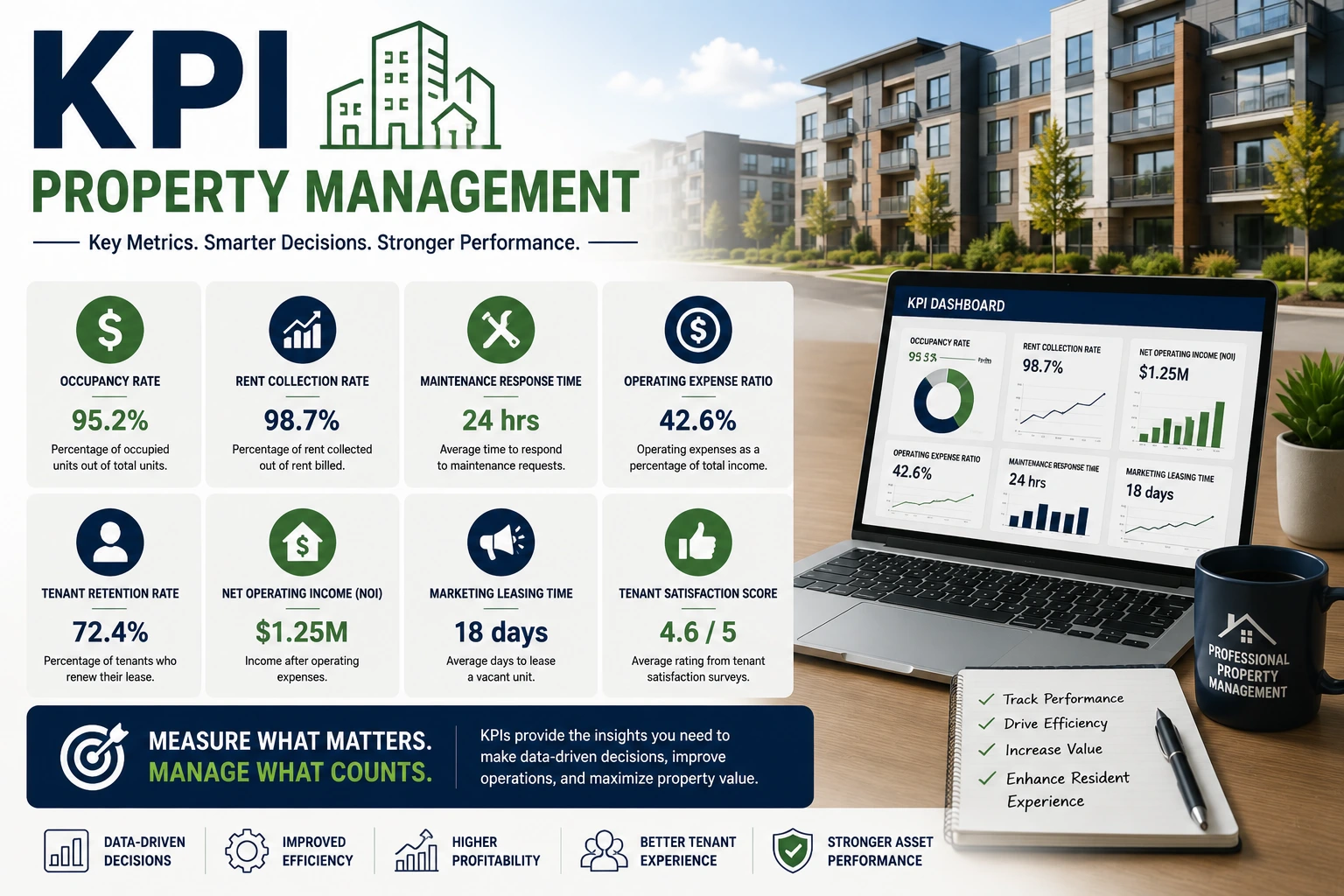
What are KPIs in property management?
KPIs in property management are measurable financial and operational metrics that rental owners and managers use to evaluate portfolio performance. They cover income, expenses, occupancy, leverage, and return on investment. Tracking the right KPIs consistently allows landlords to spot problems early, benchmark properties against each other, and make decisions based on data rather than intuition.
Why Property Management Metrics Matter More Than Ever
Rental property management has always involved numbers, but the discipline of actively tracking performance metrics is a more recent habit for most landlords. Many owners know their monthly rent income and their mortgage payment, but have no clear picture of their actual cash-on-cash return, their vacancy rate relative to the local market, or whether their operating expense ratio is creeping in the wrong direction. That gap between activity and insight is where returns leak.
The ten KPIs in this guide cover the full picture: income, efficiency, leverage, returns, and occupancy. Each one is explained with its formula, what a healthy number looks like, and what a poor reading usually signals. For context on how financial reporting connects to day-to-day operations, the rental property owner guide covers the operational foundations these metrics sit on top of.
One note before the list: no single KPI tells the full story. Net cash flow and cap rate together reveal more than either one alone. The goal is to track them as a system, not in isolation.
The 10 Property Management KPIs at a Glance
1. Net Cash Flow
Net cash flow is the starting point for any serious rental property analysis. It is the money left over after every expense has been paid: mortgage, taxes, insurance, maintenance, property management fees, and any other operating cost. A positive number means the property is self-sustaining. A negative number means the owner is subsidizing it from other income.
Cash flow is not the same as profit. A property can show a paper profit while running negative cash flow if depreciation and amortization are obscuring the real monthly picture. Tracking actual cash movement is what matters for day-to-day operations.
Formula
Net Cash Flow = Gross Rental Income - Total Operating Expenses - Debt Service (mortgage, taxes)
A healthy cash flow position is generally considered to be at least 10% of gross rental income after all expenses. Properties running below this threshold have limited cushion for vacancy periods or unexpected repairs.
2. Cap Rate (Capitalization Rate)
Cap rate measures a property's income-generating potential relative to its market value, independent of how it is financed. It is the metric most commonly used to compare investment properties to each other because it strips out the effect of leverage, making it an apples-to-apples comparison even when two properties have completely different financing structures.
A higher cap rate signals a higher return but also tends to reflect higher risk, whether from location, tenant quality, or property condition. A lower cap rate in a stable, high-demand market often reflects lower risk and more reliable income. Knowing your local market cap rate average is essential context for evaluating any individual property.
Formula
Cap Rate = Net Operating Income / Current Property Market Value
Investors typically target cap rates between 5% and 10%, though this varies significantly by market. A cap rate of 6% in a major metro is often more defensible than a 10% cap rate in a volatile secondary market.
3. Net Operating Income (NOI)
NOI measures a property's profitability from operations alone, before any debt payments are factored in. It includes all income the property generates, rent plus ancillary income from parking, pet fees, laundry, or storage, minus all operating expenses. It deliberately excludes mortgage payments and capital expenditure, making it a pure measure of operational efficiency.
NOI is the numerator in the cap rate formula and the denominator in the DSCR calculation, which means errors in NOI flow through into every other metric that depends on it. Keeping operating expenses tightly managed and minimizing income-reducing vacancies are the two primary levers for improving NOI.
Formula
NOI = Gross Rental Income + Ancillary Income - Operating Expenses (excluding debt service)
Comparing NOI period over period is one of the most reliable ways to track whether a property is improving or deteriorating operationally. For guidance on the financial statements that support this tracking, see the HOA financial management guide for a framework transferable to rental portfolios.
4. Vacancy Rate
Vacancy rate is one of the most operationally sensitive metrics in the list. Every day a unit sits empty is a day of revenue permanently lost, and the carrying costs continue regardless. A vacancy rate that is consistently above the local market average is a signal that something is wrong: rent is priced too high, the property needs attention, or the marketing and leasing process is underperforming.
The national vacancy rate for rental housing has been rising since 2021 lows, but performance varies enormously by market and property type. Tracking your own vacancy rate against local benchmarks rather than national averages gives a more accurate picture of where you stand.
Formula
Vacancy Rate = (Number of Vacant Units / Total Units) x 100
A vacancy rate below 5% is generally considered healthy in most markets. Above 10% warrants a pricing and marketing review. For a look at how tenant screening affects vacancy outcomes, see the guide on how to screen tenants.
5. Return on Investment (ROI)
ROI is the broadest performance metric on this list. It captures the total return on a property investment relative to everything spent to acquire and operate it. Unlike cash-on-cash return, ROI can incorporate appreciation, equity build-up from mortgage paydown, and tax benefits, making it a long-term portfolio metric rather than a current-period operating one.
The challenge with ROI is that it depends heavily on the time period measured and the assumptions used for appreciation. Two investors in the same property could calculate meaningfully different ROI figures depending on whether they include unrealized appreciation. Being consistent in what you include and exclude is more important than the specific number.
Formula
ROI = (Total Earnings - Total Expenditures) / Total Cash Invested x 100
A good ROI for rental properties is generally considered to be in the 8-12% range, though this varies by market and investment strategy. Value-add investors targeting distressed properties may accept lower short-term ROI in exchange for higher projected appreciation.
6. Loan-to-Value (LTV) Ratio
LTV measures how much debt is carried against the current market value of the property. It is primarily a lender's metric, used to assess risk when underwriting a loan or refinancing. But it is equally useful for investors tracking their equity position and leverage level across a portfolio.
As property values rise, LTV naturally falls if the loan balance is not increasing. As values fall, LTV rises and can exceed 100% in declining markets, leaving the owner in a negative equity position. Monitoring LTV regularly keeps landlords aware of their refinancing options and overall financial exposure.
Formula
LTV Ratio = Outstanding Loan Balance / Current Property Market Value x 100
Most lenders consider an LTV of 70-80% acceptable for investment properties. Above 80% typically triggers higher interest rates or additional insurance requirements. Below 70% provides meaningful equity cushion and better refinancing terms.
7. Cash-on-Cash Return (CoC Return)
Cash-on-cash return is the metric most useful for evaluating leveraged rental investments in the current period. Unlike ROI, it does not require assumptions about future appreciation. It simply asks: of the actual cash I put into this deal, how much am I getting back as cash this year? That makes it highly comparable across properties with different financing structures.
The cash-on-cash return on a rental property depends heavily on the financing terms. A property with a low interest rate and modest down payment can deliver strong cash-on-cash returns even at a moderate cap rate. The same property with a higher rate and larger down payment will show a very different CoC, which is why this metric is particularly relevant in rising rate environments.
Formula
Cash-on-Cash Return = Annual Pre-Tax Cash Flow / Total Cash Invested x 100
8. Debt Service Coverage Ratio (DSCR)
DSCR tells you how comfortably a property's income covers its debt obligations. A DSCR of 1.0 means income exactly equals debt payments, leaving zero cushion for vacancies, repairs, or income disruptions. A DSCR of 1.25 means the property generates 25% more income than needed to service its debt, which is the minimum most commercial lenders require.
DSCR is critical for portfolio-level planning as well as individual property analysis. Lenders evaluate DSCR when deciding whether to approve new financing, and a portfolio with strong DSCR across properties is in a much stronger position to access capital for acquisitions or improvements.
Formula
DSCR = Net Operating Income / Total Annual Debt Service (principal + interest)
A DSCR at or above 1.25 is the standard lender threshold. Properties at 1.10 or below are considered high-risk and may face difficulty securing refinancing. In periods of rising interest rates, monitoring DSCR across the portfolio becomes particularly important because the debt service figure changes at refinancing.
9. Operating Expense Ratio (OER)
OER measures what proportion of a property's gross operating income is consumed by operating expenses, not counting debt service. It is one of the clearest indicators of management efficiency. A property where expenses consume 70% of income is significantly less profitable than one where expenses run at 40%, even if the gross rent is identical.
OER tends to increase with property age (older buildings need more maintenance), with poor tenant selection (higher turnover means more unit preparation and vacancy costs), and with inadequate preventive maintenance programs. Tracking OER over time reveals whether management is getting more or less efficient.
Formula
OER = Total Operating Expenses / Gross Operating Income x 100
Well-managed residential properties typically run OERs between 35% and 45%. Commercial properties and older multifamily buildings often run higher. An OER above 60% in a residential property is a red flag that warrants a line-by-line expense review.
10. Tenant Turnover Rate
Tenant turnover is one of the most expensive operational events in rental property management. When a tenant leaves, the owner absorbs lost rent during vacancy, unit preparation and cleaning costs, advertising and leasing costs, and often some maintenance or repair expenses revealed during the turnover process. In some markets, a single turnover event can cost the equivalent of one to two months of rent.
Keeping turnover low is therefore one of the highest-return activities a landlord can invest in. Responsive maintenance, clear communication, and fair lease renewal terms all contribute to tenant retention. The relationship between tenant satisfaction and dispute frequency is explored in detail in the common landlord-tenant disputes guide.
Formula
Tenant Turnover Rate = (Number of Tenants Who Left / Total Tenants at Start of Period) x 100
A turnover rate below 20% annually is generally considered healthy. Rates above 30% are a strong signal of either pricing misalignment, property condition issues, or management problems that need addressing before they compound.
Short-Term Rental Analytics: Additional KPIs for STR Portfolios
STR portfolios require a different analytical layer on top of the core KPIs above. The metrics that matter most for Airbnb, VRBO, and direct booking properties include:
• Occupancy rate: the STR equivalent of vacancy rate, typically measured as a percentage of available nights booked rather than units occupied
• Average daily rate (ADR): average nightly rate achieved across all bookings in a period
• Revenue per available night (RevPAN): ADR multiplied by occupancy rate, the single most comprehensive STR performance metric
• Booking lead time: average number of days between booking and check-in, which affects dynamic pricing strategy
• Review score average: guest ratings on booking platforms, which directly affect search ranking and booking conversion
Tools like AirDNA, Rabbu, and platform-native analytics (Airbnb Host Dashboard, VRBO performance reports) provide STR-specific data that general property management reporting does not capture. Landlords managing mixed portfolios (some long-term, some short-term) need reporting that handles both.
How to Build a Property Management Reporting Routine
Knowing what to track is only half the discipline. The other half is reviewing the numbers regularly enough that problems surface before they compound. A practical property management reporting rhythm looks like this:
• Monthly: net cash flow, vacancy rate, rent roll, and any delinquent accounts. These change quickly and need frequent review.
• Quarterly: OER, DSCR, and tenant turnover rate. These move more slowly but reflect operating trends that monthly snapshots can miss.
• Annually: cap rate, ROI, LTV, and cash-on-cash return. These are portfolio-level metrics that require a full-year view to be meaningful.
The value of this routine is pattern recognition. A single month of elevated OER is noise. Three months in a row is a signal. Consistent tracking is what separates landlords who react to crises from those who anticipate them.
For landlords managing properties within HOA communities, the financial reporting disciplines overlap significantly. The HOA financial management guide covers the reporting structures that apply to both contexts.
Rental Property Reporting with ManageCasa
ManageCasa is a rental and HOA management platform that provides real-time financial reporting, automated rent collection, vacancy tracking, and owner statements. The financial dashboard gives landlords on-demand access to the metrics covered in this guide without manual spreadsheet work.
See how ManageCasa supports rental financial management: managecasa.com/capabilities/financial
Frequently Asked Questions
What are the most important KPIs for rental property management?
The most important rental property KPIs are net cash flow, vacancy rate, and cash-on-cash return. These metrics measure profitability, occupancy, and investment performance. Supporting KPIs like NOI, OER, and DSCR provide additional insight into operational efficiency and financing risk.
What is a good cash-on-cash return for a rental property?
A good cash-on-cash return for a rental property is typically between 8% and 12%. Returns below 6% may indicate weak income, excessive leverage, or overpricing. Performance benchmarks vary by market, financing terms, and property type.
What is KPI property management reporting used for?
KPI property management reporting measures rental property performance, identifies operational issues, compares properties against benchmarks, and supports decisions about pricing, refinancing, and investments. Lenders also use KPIs like DSCR and LTV to evaluate financing applications for investment properties.
What is a good vacancy rate for a rental property?
A vacancy rate below 5% is generally considered healthy for rental properties. Rates above 10% may signal pricing, condition, or leasing problems. Vacancy benchmarks vary by location and property type, so local market comparisons are most useful.
What property management metrics should I track for short-term rentals?
Short-term rentals should track occupancy rate, average daily rate (ADR), revenue per available night (RevPAN), and guest review scores alongside standard rental KPIs. RevPAN is especially valuable because it combines occupancy and pricing into one performance metric.

Expert in Property Management and SaaS
Peter Koch is an expert in property management and SaaS, focused on building top digital tools for property managers and growing technology-driven startups. He specializes in enhancing property management operations through smart software solutions that streamline accounting, automate workflows, and improve community communication. Peter writes about HOA management technology, proptech innovation, and scalable SaaS strategies designed to help modern property professionals operate more efficiently.