


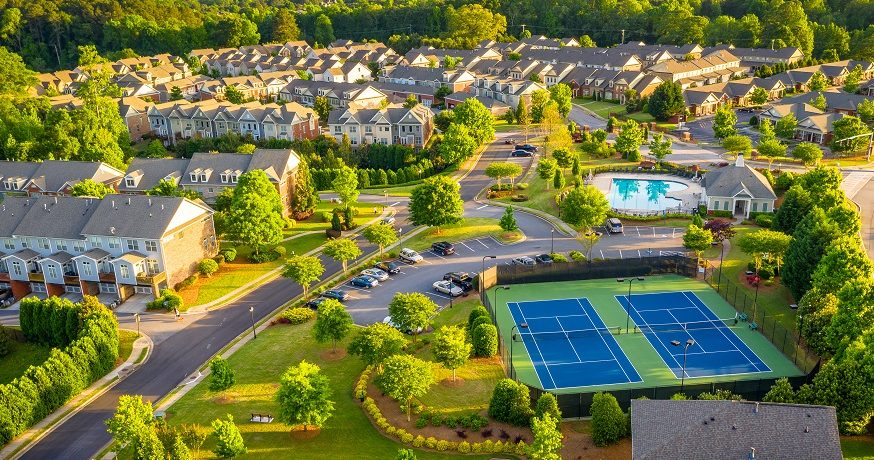
What is a Community Association Management?
Community association management is the professional administration of shared-governance residential communities including homeowners associations, condominium associations, and cooperative associations. It covers financial management, rules enforcement, vendor coordination, maintenance oversight, and resident communications on behalf of an elected board. The goal is to protect property values, maintain common areas, and keep the community operating within its governing documents and applicable state law.
Nearly 80 million Americans now live in community association-governed housing, and approximately 377,000 community associations operate across the US as of 2026, according to the Foundation for Community Association Research. That scale makes community association management one of the largest segments of residential real estate administration in the country.
Yet for many residents, what a community association actually does remains unclear. Monthly dues go out, but the work that produces maintained common areas, enforced standards, paid bills, and organized governance tends to be invisible until something goes wrong. This guide explains what community association management is, what community association managers do, and how associations are structured and governed.
Foundation for Community Association Research — Community Association Fact Book
Community Association Management vs. Property Management: What Is the Difference?
The terms are often used interchangeably, but they describe different functions. Property management focuses on the relationship between a landlord and individual tenants. It covers leasing, rent collection, tenant screening, and maintenance for privately owned rental units.
Community association management is different. It serves a membership organization where the residents are the owners, represented by an elected board. The CAM manager works for the board and the association, not for individual landlords. There is no landlord-tenant relationship. The authority comes from the governing documents and applicable state law, not a lease.
Types of Community Associations
Community association management covers several distinct association types. Each has a different legal structure, scope of common elements, and applicable statute.
Homeowners Associations (HOAs)
The most common type. HOAs govern planned communities of single-family homes, townhomes, or mixed-use neighborhoods. Membership is typically mandatory for all property owners. The association owns and maintains common areas: entrances, landscaping, pools, clubhouses, and roads. Governed by state HOA statutes and the association's CC&Rs.
Condominium Associations
Govern multifamily buildings where individual owners hold title to their units but share ownership of the building structure and common areas. The scope of common-element responsibility is typically broader than HOAs, covering the building exterior, roof, elevators, and shared systems. Governed by state condominium acts, which are usually separate from HOA statutes.
Cooperative Associations
Residents own shares in a corporation that owns the property, rather than holding title to individual units. Cooperatives are common in New York City and some other urban markets. Management is more complex because the corporate ownership structure creates different financial and governance obligations than either HOAs or condominiums.
Prospective residents typically go through a board approval process before a share transfer is finalized, and a proprietary lease, rather than a deed, governs each resident's rights and obligations. Because the corporation holds the underlying mortgage on the building, individual shareholders carry a degree of collective financial exposure that HOA and condominium owners, who hold title directly, do not.
Community Development Districts (CDDs)
Government-established special purpose districts, primarily used in Florida under the state's Uniform Community Development District Act of 1980 (Florida Statutes Chapter 190), that issue bonds to finance infrastructure development. CDDs operate alongside HOAs rather than replacing them and have their own elected or appointed boards with taxing authority.
Property owners in a CDD typically see two separate charges on their tax bill: a capital assessment that repays the bonds issued to build roads, water management systems, and other infrastructure, and a separate operations and maintenance assessment that funds ongoing upkeep of that infrastructure. Both are billed alongside county and other local taxes, and both are distinct from any HOA dues charged by an overlapping homeowners association covering the same property.
What Does a Community Association Manager Do?
A community association manager, often called a CAM, is the professional hired by an association's board to handle day-to-day operations. The board sets policy and direction. The CAM executes it. Here is what that work looks like in practice across the core functional areas.
Financial Management
The financial function is the foundation of every association's operations. CAM responsibilities here include:
• Assessment billing and collections: Generating invoices for monthly or annual dues, tracking payment status, following up on delinquencies, and coordinating with legal counsel when liens or collections actions are needed.
• Accounts payable: Processing vendor invoices, verifying work completion, and ensuring bills are paid on time from the correct association accounts.
• Financial reporting: Preparing monthly income and expense reports for board review. Many states now require specific financial reporting formats depending on association size and revenue.
• Budget preparation: Working with the board to build the annual operating budget and reserve fund contribution schedule.
• Reserve fund management: Tracking reserve fund balances, coordinating reserve studies, and ensuring capital reserve contributions match the association's long-term funding needs.
• Tax filings: Coordinating annual tax return preparation for the association as a nonprofit corporation.
For a detailed guide to HOA financial management and accounting, see accounting for homeowners associations and HOA financial management.
Governance and Administration
Community association management supports the board in meeting its governance obligations. This includes:
• Meeting preparation and minutes: Organizing board and annual meeting agendas, preparing materials, recording minutes, and distributing them to members.
• Governing document administration: Maintaining the CC&Rs, bylaws, and rules; tracking amendments; and ensuring board decisions align with the governing documents.
• Record keeping: Maintaining organized records of contracts, correspondence, financial documents, meeting minutes, and homeowner files. Many states have specific records retention requirements.
• Insurance coordination: Managing the association's property and liability insurance policies, filing claims, and ensuring coverage remains adequate.
• Legal liaison: Coordinating with the association's legal counsel on disputes, collection actions, and governing document interpretation.
Rules Enforcement and Violations
Consistent enforcement of the governing documents is one of the most visible and sensitive parts of CAM work. The process typically involves:
• Conducting regular community inspections to identify violations
• Sending written violation notices with a defined cure period
• Coordinating hearings for homeowners who contest fines
• Tracking violation histories and fine balances
• Escalating unresolved violations to the board or legal counsel
Selective or inconsistent enforcement is one of the most common sources of legal challenges against associations. A CAM who documents every enforcement action and applies rules uniformly across all homeowners protects both the association and the board.
For a framework on drafting and applying community rules consistently, see the HOA rules and regulations guide.
Maintenance and Vendor Management
Common area maintenance is a core deliverable of every community association. CAM responsibilities include:
• Vendor procurement: Soliciting bids, evaluating proposals, and making recommendations to the board for landscaping, cleaning, pool maintenance, security, and other recurring services.
• Contract management: Reviewing service contracts, tracking renewal dates, and monitoring vendor performance against contract terms.
• Work order management: Receiving and tracking maintenance requests, dispatching vendors, and confirming completion.
• Preventive maintenance scheduling: Building a calendar of recurring maintenance tasks across all common area assets to extend their useful life and reduce emergency repair costs.
• Capital project coordination: Managing larger projects like roof replacements, resurfacing, or irrigation system upgrades from bid solicitation through completion.
Resident Communication
Community association managers are often the primary point of contact between the board and the residents. Communication responsibilities include:
• Responding to homeowner inquiries and complaints in a timely way
• Publishing newsletters, meeting notices, and community updates
• Managing the community website or homeowner portal
• Distributing violation notices and collection correspondence
• Coordinating community events and resident engagement initiatives
Clear, consistent communication reduces the volume of disputes and complaints a board has to handle reactively. Communities where residents feel informed tend to have higher meeting participation and lower delinquency rates.
Self-Managed vs. Professionally Managed Associations
The choice usually comes down to complexity more than size alone. A 20-unit HOA with a landscaping contract and modest dues can often run well with volunteer board members and no professional manager. A 300-unit condominium with elevators, a pool, and a multimillion-dollar reserve fund is a different calculation entirely: the compliance workload and financial exposure typically outgrow what a volunteer board can safely handle without professional or credentialed support.
For a detailed look at the trade-offs, see HOA self-management vs. professional management.
Are Community Association Managers Licensed or Certified?
Whether a community association manager needs a license depends entirely on the state. A handful of states regulate the profession directly. Most rely on voluntary industry certification instead, which means the same job title can mean very different things depending on where the community sits.
State Licensing Requirements
- Florida: requires a state license for anyone who receives compensation to manage an association with more than 10 units or a budget of $100,000 or more. Applicants complete 16 hours of prelicensure education, pass a state exam administered through the Department of Business and Professional Regulation, and renew the license every two years. A 2025 law (HB 913) added new recordkeeping and online licensure-account requirements for CAMs and management firms, effective July 1, 2025.
- California: does not require a state license to work as a CAM. State law (Business and Professions Code Sections 11500 to 11504) instead regulates who may use the title "certified" common interest development manager. Earning that title requires 30 hours of coursework from an approved provider. A manager who has not completed that coursework can still practice, but cannot advertise as certified under the statute.
- Most other states: have no CAM-specific licensing statute at all. Boards in those states generally rely on national certification to screen for baseline competency, since state law provides no floor.
National Certifications
- CMCA (Certified Manager of Community Associations): the most common entry-level credential, administered by the Community Association Managers International Certification Board (CAMICB). Candidates qualify through a prerequisite course or two years of documented experience, then pass a 120-question exam. CAMICB reports it has certified more than 25,000 CMCAs.
- AMS and PCAM: the Community Associations Institute (CAI) offers two credentials above the CMCA. The Association Management Specialist (AMS) generally requires the CMCA plus two years of experience and additional coursework. The Professional Community Association Manager (PCAM) is CAI's most advanced designation, requiring five years of experience, advanced coursework, and a case study demonstrating applied management judgment.
CAI reports that more than 90% of community association board members prefer to hire a credentialed manager, even in states where no license is required.
Why This Matters for Boards
In a state with no licensing statute, "community association manager" is not a protected title. Anyone can use it. Certification is the only signal a board has that a candidate has been tested on budgeting, governance, and legal compliance before being handed the community's finances.
State Licensing Snapshot
The Scale of Community Association Management in 2026
The industry has grown substantially and continues to expand. Key figures from the Foundation for Community Association Research and Buildium's 2025 Community Association Management Industry Report:
• Approximately 377,000 community associations operate in the US as of 2026, up from 373,000 at end of 2025
• Roughly 3,000 to 4,000 new associations form every year
• Nearly 80 million Americans, about one third of all US housing stock, now live in HOA-governed communities
• 66% of newly completed homes are in community associations, according to FCAR
• Portfolio growth was the top priority for 92% of community association management companies in 2025, per Buildium's 2025 Community Association Management Industry Report, as cited by AvidXchange
• Electronic payments (76%) and accounting software (74%) were the most widely adopted tools among CAM companies in 2025, per the same report
Source: Foundation for Community Association Research — Community Association Fact Book. Industry growth data also covered in the State of HOA and Community Association Management 2026. Portfolio and technology adoption figures: AvidXchange 2026 community association management trends (citing Buildium 2025 CAM Industry Report).
The growth trend is structural. Most new residential construction, particularly at the mid-to-upper market segment, is built into planned communities with shared governance. That means the demand for community association management will continue expanding alongside new housing supply.
What Makes a Community Association Well-Managed?
Residents notice the difference between a well-run association and a poorly run one. The marks of effective community association management come down to five things:
• Financial clarity: Budgets are realistic, reserve funds are adequately funded, financial reports are published on schedule, and assessment increases are explained and justified.
• Consistent enforcement: Rules are applied the same way to every homeowner. Enforcement actions are documented, properly noticed, and grounded in the governing documents.
• Responsive maintenance: Common area issues are addressed promptly. Vendors are held to contract standards. Major capital projects are planned and funded rather than handled as emergencies.
• Clear communication: Residents know when meetings are happening, what decisions were made, and how to reach the manager with concerns. Information is not withheld or delayed.
• Governance discipline: The board operates within the governing documents. Decisions are made in properly noticed meetings. Minutes are recorded and accessible to members.
Associations that do these five things consistently tend to have lower delinquency rates, fewer disputes, and higher resident satisfaction scores.
For a deeper look at governance standards and board responsibilities, see HOA board member responsibilities and rules. For the most common management challenges and how to address them, see HOA management challenges.
Managing Your Community Association
Community association management involves financial reporting, vendor coordination, enforcement, resident communications, and board governance support across a single operational platform. Purpose-built tools help CAM managers and self-managed boards handle the administrative workload without manual overhead.
Explore HOA management features and pricing, or visit ManageCasa.com to learn more.
Frequently Asked Questions
What is a community association manager?
A community association manager (CAM) helps HOA and condominium boards manage daily operations, including finances, maintenance, vendor coordination, rule enforcement, and homeowner communication.
What is the difference between an HOA and a community association?
An HOA is one type of community association. Community associations also include condominium associations, cooperatives, and other shared-interest communities governed by resident-owned organizations.
Do community association managers need to be licensed?
Licensing requirements vary by state. Florida requires a state license for compensated managers handling more than 10 units or a $100,000+ budget. Most other states have no CAM-specific license and rely on voluntary national certifications like the CMCA instead.
How many community associations are there in the US?
There are approximately 377,000 community associations in the United States, serving nearly 80 million residents and representing a significant portion of the nation's housing stock.
What is the difference between community association management and property management?
Community association management serves HOA and condo boards overseeing shared community assets. Property management serves rental property owners and focuses on leases, tenants, and rent collection.

Expert in Property Management and SaaS
Peter Koch is an expert in property management and SaaS, focused on building top digital tools for property managers and growing technology-driven startups. He specializes in enhancing property management operations through smart software solutions that streamline accounting, automate workflows, and improve community communication. Peter writes about HOA management technology, proptech innovation, and scalable SaaS strategies designed to help modern property professionals operate more efficiently.