




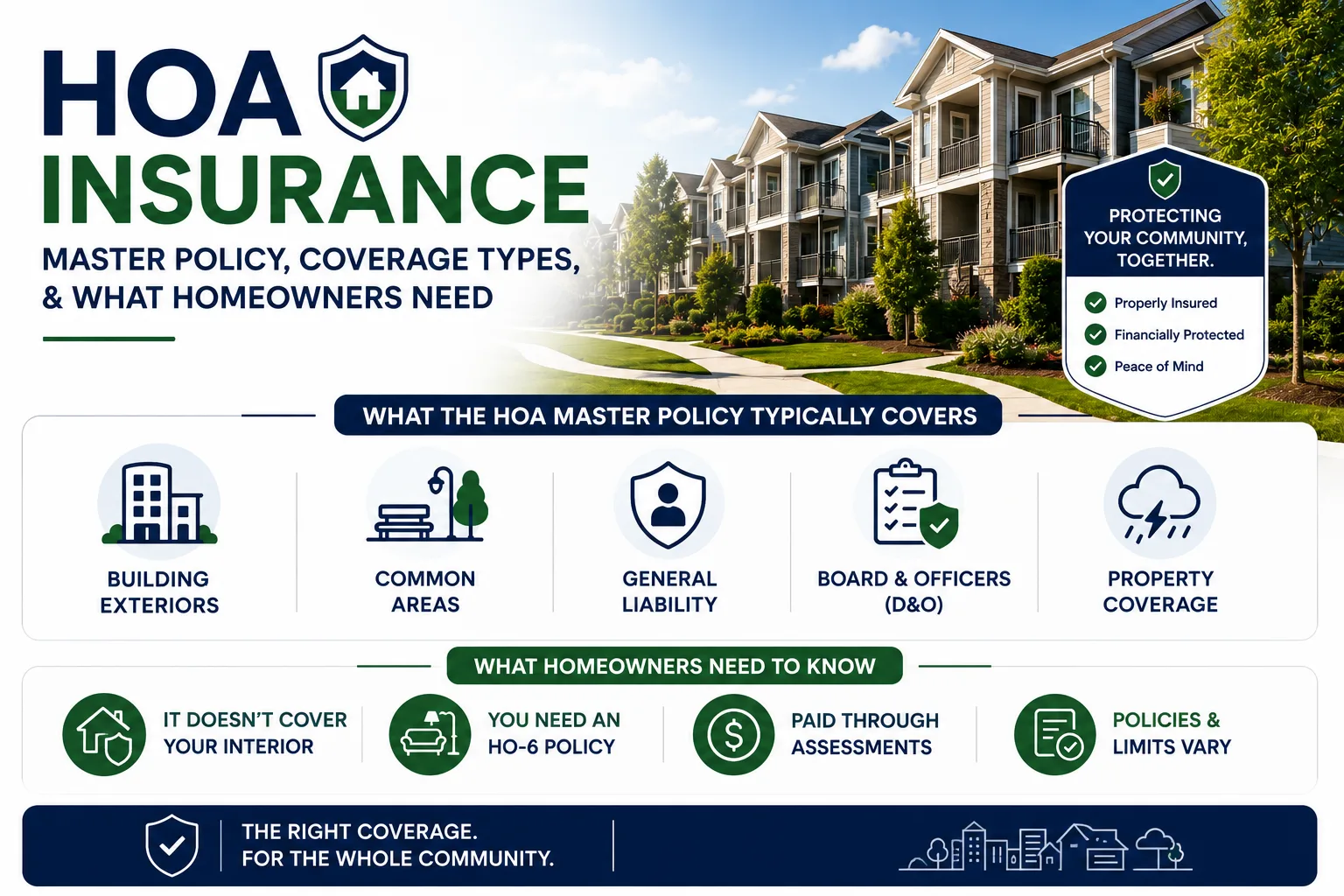
What is HOA Insurance?
HOA insurance is a set of policies purchased by the homeowners association to protect shared property, common areas, and the association itself. The foundation is the master insurance policy, which covers building exteriors, common elements, and general liability. Individual owners are not covered by the master policy for interior damage, personal property, or personal liability and need a separate HO-6 or homeowners policy to fill that gap.
A lot goes wrong with HOA insurance because people assume the association's policy covers more than it does. The board assumes the master policy handles everything. Homeowners assume they have no responsibility. Neither assumption holds up when a major loss hits.
HOA insurance operates as a two-tier system. The association carries policies that protect the buildings, common areas, and the board. Individual owners carry personal policies that protect everything the association's coverage does not reach. When those two layers are not aligned, the gap between them becomes a financial problem for someone.
This guide explains how HOA insurance works, what each policy type covers, how the three master policy structures determine owner responsibility, what individual owners need, and where the most common coverage gaps appear.
What HOA Insurance Covers and What It Does Not
HOA insurance protects the association as an entity, not individual homeowners. The coverage is paid for through regular assessments and exists to protect shared property and the association's liability exposure.
What the HOA's insurance typically covers:
• Building exteriors, roofs, hallways, stairwells, elevators, and parking structures
• Common amenities including pools, clubhouses, fitness centers, and landscaping
• Bodily injury and property damage claims arising from common areas
• Board members' personal liability for decisions made in their governance role
• Association funds against theft, fraud, or embezzlement
What the HOA's insurance does not cover:
• The interior of individual units, including walls, flooring, fixtures, and appliances
• Owners' personal property or belongings
• Owners' personal liability for incidents inside their units
• Losses that exceed the master policy's limits or fall below its deductible
• Damage from excluded perils such as floods, earthquakes, or earth movement (unless separately endorsed)
Source note
A common and costly misconception among condo and townhome owners is assuming the master policy covers everything inside the building. That gap between assumption and reality is one of the leading sources of post-claim disputes and surprise out-of-pocket costs, which is why boards should proactively explain coverage boundaries to homeowners rather than waiting for a claim to surface the confusion.
The Three Master Policy Types
The most consequential decision in HOA insurance is which master policy structure the association uses. The structure determines exactly where the association's coverage ends and individual owner responsibility begins. All three types cover common areas; they differ in how far into the units the coverage extends.
Bare Walls-In (Walls-Out)
The master policy covers the building structure up to the unfinished interior face of the unit walls. Owners are responsible for everything inside: drywall, flooring, cabinets, fixtures, and all improvements. This model places the most responsibility on individual owners and is common in older associations with modest common areas.
Single Entity
The master policy covers original builder-grade finishes inside the unit as they were installed at the time of construction: typically drywall, basic fixtures, and original flooring. Owners are responsible for personal property, any improvements above builder grade, loss of use, and personal liability. This is the most common structure in condominium associations.
All-In
The master policy covers nearly everything inside the unit including fixtures and in some cases appliances, depending on the policy and the CC&Rs. Owners are still responsible for personal property, improvements they installed above the original finishes, and personal liability. This model offers the broadest coverage for owners but typically results in higher association premiums.
Critical check before buying into an HOA
The CC&Rs determine which master policy model the association uses. Always request the master policy declarations page and read the 'Insurance' section of the CC&Rs before closing. Assuming the wrong model is one of the most common and expensive mistakes new HOA buyers make.
The Four Core HOA Insurance Policies
Most well-run associations carry at least four distinct policy types. Each one protects a different layer of the community's exposure.
1. Master Property Insurance
The largest expense in most HOA insurance budgets, the master property policy covers the physical structures the association is responsible for maintaining. Coverage is typically written on a replacement cost basis, meaning the insurer pays what it costs to rebuild, not what the property is worth on the market.
Boards should review insured values annually. Construction costs have risen sharply in recent years, and a policy valued three to five years ago may be significantly underinsured. An underinsured property means a major loss generates a shortfall that falls on homeowners through special assessments.
Strong HOA reserve funds reduce how often the association needs to lean on insurance and special assessments in the first place, since a well-funded reserve can absorb smaller losses without triggering a claim or a deductible-driven assessment.
According to a survey cited by Access Management Group, average HOA master insurance premiums increased 90.4% over a recent two-year period and insurance consumed more than 34% of a typical association's operating budget. Source: Minnesota HOA Insurance Survey Results, cited by Access Management Group.
2. General Liability Insurance
General liability covers the association's exposure when someone is injured in a common area or alleges property damage from HOA operations or maintenance. Typical claim scenarios include a slip on a wet pool deck, a trip on broken pavement, or a falling tree limb in a common space.
California sets statutory minimums for general liability: $2 million for associations with 100 or fewer separate interests, and $3 million for associations with more than 100 separate interests, under the Davis-Stirling Common Interest Development Act. Most other states leave the coverage amount to the governing documents and lender requirements, with $1 million to $5 million the typical market range depending on community size and amenities.
3. Directors and Officers (D&O) Insurance
Board members serve as volunteers and can be personally sued for decisions they make in their governance role. D&O insurance pays legal defense costs and settlements up to policy limits. California Civil Code Section 5800 provides personal liability protection to board members only when the association carries proper D&O coverage. Without it, board members' personal assets are exposed.
Typical D&O limits range from $1 million to $5 million depending on association size. The growing complexity of HOA governance, including enforcement decisions, special assessment disputes, and election challenges, has made D&O coverage one of the most frequently triggered policies in the HOA insurance stack.
Common situations D&O covers: selective enforcement claims, failure to maintain common areas, election procedure disputes, and alleged violations of homeowner rights.
For more on the duties D&O coverage protects against, see the guide on responsibilities and rules for HOA board members, and for the enforcement process that most often triggers these claims, see HOA violations and enforcement.
4. Fidelity Bond (Crime Coverage)
A fidelity bond protects the association if someone with access to its funds steals or misuses them, whether an employee, board member, or management company employee. Without it, embezzlement or fraud losses come directly out of the association's operating or reserve accounts.
California requires fidelity coverage equal to or exceeding the sum of the association's reserve funds plus three months of regular assessments, and mandates that the policy include computer fraud and funds transfer fraud protections under the Davis-Stirling Act. Source: California Civil Code Section 5806.
A general industry benchmark, noted by Coverage Criteria and other HOA insurance resources, is that the bond should cover at least three months of assessments plus the full reserve fund balance. Boards should confirm whether their management company's handling of association funds is covered under the same bond or requires a separate endorsement.
Additional Coverage Types
Beyond the four core policies, associations frequently carry supplemental coverage depending on location, community type, and risk profile.
What Individual Homeowners Need
The master policy is not a substitute for individual owner insurance. Every homeowner in an HOA, whether in a townhouse, condominium, or single-family community, needs their own policy to cover what the association's coverage does not reach.
HO-6 Policy (Condo and Townhome Owners)
An HO-6 policy is personal insurance designed specifically for condo and townhome owners. It covers the interior of the unit, personal property, personal liability, and loss of use if the unit becomes uninhabitable after a covered loss. The right amount of interior coverage depends on which master policy structure the association uses: bare walls-in policies require owners to insure all interior finishes, while single entity or all-in policies reduce that obligation.
Loss Assessment Coverage
Loss assessment coverage is one of the most frequently overlooked and most important endorsements an HOA owner can carry. It covers the owner's share of a special assessment levied by the HOA when a covered loss exceeds the master policy's limits or when the board issues an assessment to cover a large deductible.
Standard HO-6 policies often include only $1,000 in loss assessment coverage by default. Given that HOA master policy deductibles can run into five or six figures in hurricane or earthquake zones, $1,000 of coverage is functionally useless. Owners should review the association's master policy deductible and set their loss assessment coverage at or above that threshold. Most insurers allow loss assessment limits of $25,000 to $100,000 for a modest additional premium.
Fannie Mae caps the maximum allowable master policy deductible at 5% of the total coverage amount for any single occurrence. Source: Fannie Mae Selling Guide B7-3-03. Owners buying into a community should confirm the master policy deductible before choosing their loss assessment limit.
HOA Insurance Deductibles: Who Pays What
HOA master policy deductibles typically range from a few thousand dollars to tens of thousands. In communities exposed to hurricanes or earthquakes, deductibles can be expressed as a percentage of the insured value and can run into six figures for a major event.
Who pays the deductible when a claim is filed depends entirely on the CC&Rs:
• Some governing documents assign the deductible to the unit owner whose property triggered the claim
• Others spread the deductible across all homeowners through the operating budget
• Some CC&Rs are silent on the question, which creates disputes at the worst possible time
Boards that have not addressed deductible responsibility in their governing documents should put it on the agenda before a loss forces the conversation. The Colorado Division of Insurance, which publishes one of the most thorough public toolkits on HOA insurance, recommends that boards and owners review deductible responsibility annually as part of the insurance review cycle.
Insurance premiums and deductible exposure should factor directly into the annual HOA budget planning process. Boards that track insurance costs alongside reserve contributions as part of broader HOA financial management are better positioned to absorb a premium increase or a deductible-driven assessment without disrupting the operating budget.
State Insurance Requirements
HOA insurance requirements come from three sources: state law, the association's CC&Rs and bylaws, and lender guidelines from Fannie Mae, Freddie Mac, or the FHA. The most comprehensive statutory requirements are currently in California.
California
California's Davis-Stirling Common Interest Development Act sets mandatory minimum coverage levels under Civil Code Section 5805 and related provisions:
• General liability: $2 million minimum (associations with 100 or fewer units); $3 million (over 100 units)
• D&O: $500,000 minimum (100 or fewer units); $1 million (over 100 units)
• Fidelity bond: must equal reserve funds plus three months of regular assessments, with computer fraud and funds transfer fraud protections
California also requires an Annual Budget Report disclosing insurance coverage to all homeowners under Civil Code Section 5300. Any HOA whose units must qualify for FHA or Fannie Mae financing faces additional coverage requirements tied to those programs. For broader California HOA law obligations, see the
Florida
Florida HOA insurance requirements differ between HOAs under Chapter 720 and condominium associations under Chapter 718. Condominium associations face more prescriptive requirements including mandatory reserve funding and structural inspection timelines following the post-Surfside legislation. HOAs under Chapter 720 are generally governed by their own documents and lender guidelines rather than statutory coverage minimums, though underfunded reserves remain the most common driver of surprise special assessments. See the Florida HOA Laws 2026 guide for detail on current statutory requirements.
Other States
Most states outside California and Florida set HOA insurance requirements through the association's own governing documents and lender guidelines rather than through prescriptive statutes. Boards in those states should review their CC&Rs and consult their insurance agent and legal counsel to confirm coverage meets both document requirements and lender standards for any community where units are financed.
Common HOA Insurance Coverage Gaps and How to Avoid Them
Related HOA Guides
Further reading from the ManageCasa HOA cluster:
• HOA Reserve Funds: Funding Levels, Studies and State Rules
• HOA Budget Planning: 6 Essential Tips for 2026
• Responsibilities and Rules for HOA Board Members
• California HOA Law Changes 2026
Protect Your Community with the Right Tools
Insurance decisions get harder when records are scattered and financial data is hard to pull together at renewal time. ManageCasa gives HOA boards centralised financial reporting, reserve fund tracking, and document management so boards can go into every insurance review with accurate, current numbers.
See how ManageCasa supports HOA financial management and board governance: managecasa.com/hoa-management-software
Explore plans and pricing: managecasa.com/pricing
Learn more about property management with ManageCasa.
Frequently Asked Questions
What is HOA insurance?
HOA insurance is coverage purchased by the homeowners association to protect shared property, common areas, amenities, and the association itself. The core policy is the HOA master policy, which helps cover community-owned assets and liability claims. Individual homeowners still need personal insurance to protect their unit, belongings, and personal liability.
What does an HOA master insurance policy cover?
An HOA master insurance policy typically covers common areas, building exteriors, roofs, shared amenities, and liability claims involving association-owned property. Coverage varies by community and policy type, but it generally does not protect homeowners' personal belongings, interior improvements, or individual liability exposures.
Do I need my own insurance if I live in an HOA?
Yes. HOA insurance protects the association, not your personal property or liability. Homeowners should maintain an HO-6 or similar policy to cover belongings, interior improvements, personal liability, additional living expenses, and potential gaps between the HOA master policy and individual responsibilities.
What is loss assessment coverage and why does it matter?
Loss assessment coverage helps pay your share of certain HOA special assessments that may result from covered insurance claims. It can be valuable when damages exceed the association's policy limits or deductible. Without adequate coverage, homeowners may be responsible for significant out-of-pocket costs following major community losses.
What is D&O insurance for an HOA?
Directors and Officers (D&O) insurance protects HOA board members from personal financial liability arising from decisions made while serving the association. It can help cover legal defense costs, settlements, and claims related to governance, rule enforcement, elections, budgeting, or other board responsibilities performed in good faith.

Content Writer
Patrick Bohan is a content strategist focused on property management technology, HOA operations, and real estate. A Cornell graduate, he began his career at UBS covering housing markets, homeownership policy, and financial regulation — experience that now informs his research-driven approach to proptech content. Today he bridges the gap between software teams and the practitioners who use them, producing practical resources on community associations, rental operations, and accounting workflows for property managers.