




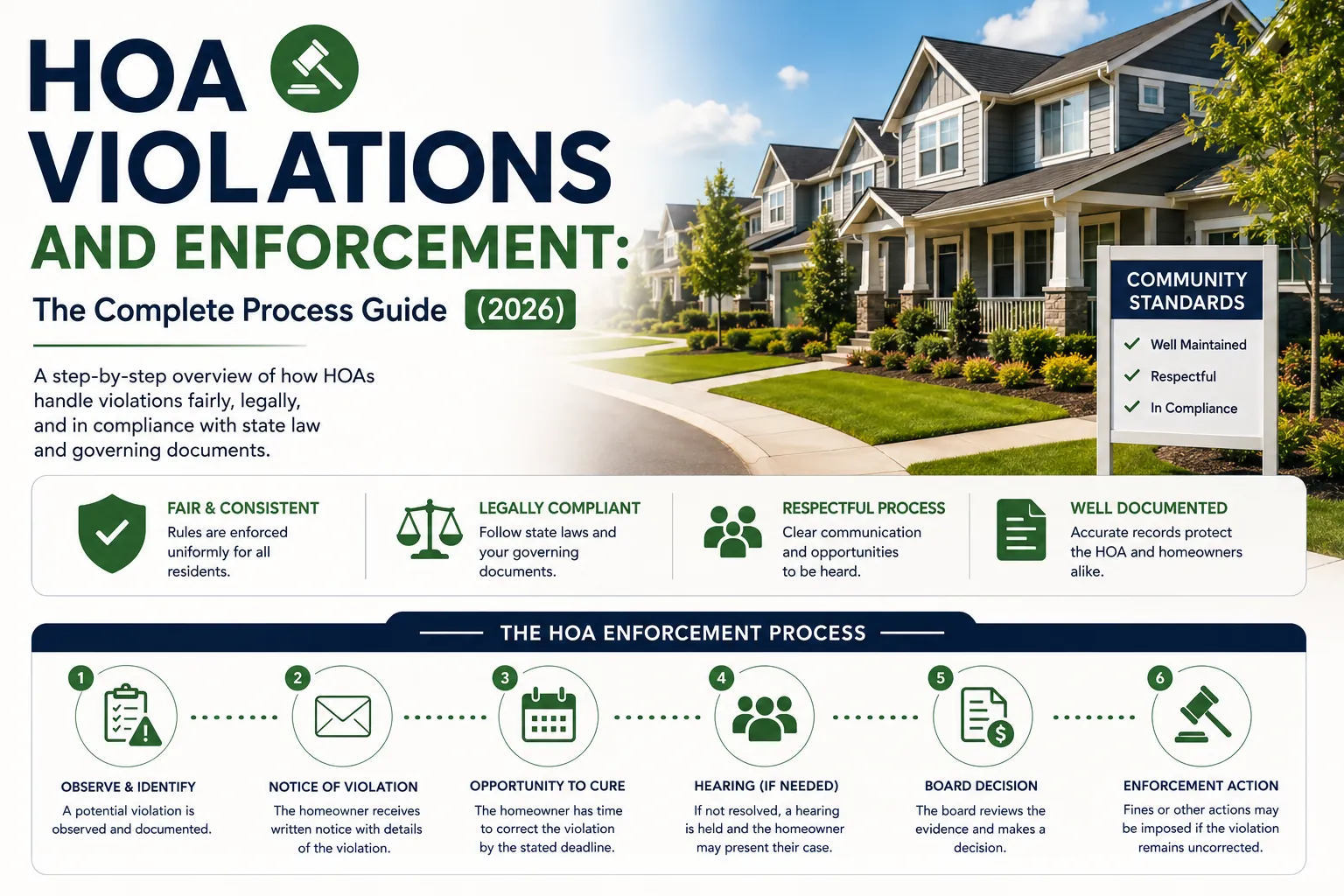
HOA violations and enforcement refer to the process by which a homeowners association identifies a breach of its rules or covenants and applies consequences. Most associations follow a set sequence: written notice, a cure period, a hearing if the issue is not resolved, then a fine or other discipline. State law and the association's governing documents both control how this process must work.
Every HOA board eventually has to send a violation notice. The trash cans were left out too long, a fence went up without approval, a tenant is parking a commercial truck in the driveway. How the board handles what happens next determines whether the issue gets resolved quietly or turns into a dispute that drags on for months and ends up in front of a judge.
Enforcement is one of the most legally exposed areas of HOA governance. Boards have real authority to cite violations, levy fines, and in some cases place liens on a property. But that authority comes with procedural strings attached, and skipping a step or treating one homeowner differently from another can unravel an otherwise valid enforcement action.
This guide walks through what counts as a violation, the standard process from notice through resolution, where state law sets hard requirements, what selective enforcement means and why it matters, and what boards can do to keep their enforcement program defensible.
What Counts as an HOA Violation
An HOA violation is any action, or failure to act, that breaches the association's governing documents, typically the Covenants, Conditions, and Restrictions (CC&Rs), the bylaws, or board-adopted rules and regulations. Violations generally fall into a handful of recurring categories.
• Property maintenance: unmowed lawns, peeling paint, deferred exterior repairs
• Architectural and aesthetic rules: unapproved fences, paint colors, structural changes, or landscaping
• Parking and vehicles: commercial vehicles, boats or RVs in driveways, street parking violations
• Noise and nuisance complaints: excessive noise, unauthorized short-term rentals, pet policy violations
• Use restrictions: business use of a residence, occupancy limits, signage rules
Most of these are minor and resolve after a single notice. The process matters most when a homeowner disputes the violation, refuses to cure it, or argues the board is applying the rule unevenly.
The HOA Violation and Enforcement Process
While the exact steps vary by state and by the association's own governing documents, the enforcement process generally follows the same sequence.
1. The violation is identified
Violations are typically identified through routine property inspections, complaints from other residents, or reports submitted to the management company. Most associations allow residents to report violations, sometimes anonymously, though board members are still expected to verify the violation against the governing documents before acting.
2. Written notice is sent
The board or its management company sends a written notice describing the violation, citing the specific provision violated, and explaining what the homeowner needs to do to correct it. State law frequently sets a minimum number of days the notice must precede any hearing.
In Florida, Florida Statutes Chapter 720, Section 720.305 requires at least 14 days’ written notice before a fining hearing, and the notice must describe the violation and the hearing's date and location.
In California, Civil Code Section 5855 requires at least 10 days’ written notice before a disciplinary hearing, extended to 15 days if the discipline includes a suspension of membership privileges.
In Texas, Property Code Section 209.006 requires the notice to state the violation, the proposed fine amount, and that the owner has 30 days to request a hearing before the board.
3. The cure period
Most governing documents and several state statutes give the homeowner a window to correct the violation before any fine attaches. Curing the violation during this period, mowing the lawn, removing the unapproved structure, moving the vehicle, typically ends the matter with no further penalty. Where curing the violation will take longer than the notice period allows, some states permit the homeowner to instead provide a written commitment to cure.
4. The hearing
If the violation isn't cured, the homeowner is generally entitled to a hearing before the board imposes discipline. This is a due process requirement, not a courtesy. Due process in this context means two things: the homeowner received adequate notice, and the homeowner had a genuine opportunity to respond before a decision was made.
California courts addressed this directly in Ironwood Owners Association IX v. Solomon, holding that an association must show it followed its own standards and procedures, that those procedures were fair and reasonable, and that the resulting decision was made in good faith rather than arbitrarily.
Hearings are usually held by the board itself or a designated committee, often in executive session. The homeowner has the right to attend, to address the board, and in most states to receive a written decision afterward.
5. The fine or other discipline
If the board decides discipline is warranted, the result is most often a monetary fine, though some associations also have authority to suspend amenity access or voting privileges. Several states cap how large a single fine can be.
Florida limits HOA fines to $100 per violation, or $1,000 in aggregate for a continuing violation, under Chapter 720.305, and requires that any fine become due no sooner than 30 days after the hearing notice was sent.
6. Escalation: liens and legal action
Unpaid fines, in states and governing documents that allow it, can eventually be converted into an assessment lien against the property, similar to how unpaid dues are handled. Litigation is typically the last resort given the cost involved, but courts can order a homeowner to cure a violation and, in some states such as Texas, award ongoing civil damages of up to $200 per day the violation remains uncorrected once a court order is in place.
Selective Enforcement: What It Is and Why It Matters
Selective enforcement happens when an association enforces a rule against one homeowner while knowingly letting another homeowner's comparable violation slide. It is one of the most common defenses homeowners raise when contesting a fine, and one of the most common ways a board's enforcement action gets thrown out.
The legal logic is straightforward: covenants have to be enforced uniformly to remain enforceable. If a board lets a violation go unaddressed for long enough, or enforces it inconsistently across the community, it risks losing the ability to enforce that rule at all.
Florida courts established this principle in Chattel Shipping and Investment, Inc. v. Brickell Place Condominium Association, Inc., a 1985 decision from Florida's Third District Court of Appeal. The case also clarified that an association can revive enforcement of a rule it previously let slide, but only by giving owners clear, prospective written notice that enforcement will resume going forward.
Boards that want to avoid selective enforcement exposure generally rely on a few practical habits:
• Document every violation and every enforcement decision, including decisions not to pursue a fine
• Apply the same notice, cure period, and hearing process to every comparable violation
• Communicate enforcement policy changes to all owners in writing before applying them
• Avoid letting enforcement decisions depend on board members' personal relationships in the community
Can a Homeowner Sue Over HOA Enforcement?
Yes. Homeowners can sue over HOA enforcement in two main scenarios: disputing a fine on procedural or selective-enforcement grounds, or suing the association for failing to enforce a rule against a neighbor at all.
Procedural challenges argue the board didn't follow its own notice, hearing, or due process requirements. Selective enforcement challenges argue the rule wasn't applied consistently. Non-enforcement claims, where a homeowner sues because the board isn't enforcing a rule against someone else, are harder to win, since boards generally have discretion over how aggressively to pursue minor violations, but they can succeed if the homeowner can show the board's inaction amounts to a breach of its fiduciary duty to the community.
Before litigation, most governing documents and several states require or strongly encourage mediation or arbitration, which resolves the large majority of these disputes without a courtroom.
State Enforcement Requirements at a Glance
These three states illustrate how much enforcement procedure can vary. Always confirm current requirements against the statute and the association's own governing documents before acting.
Best Practices for Boards Running an Enforcement Program
• Adopt a written enforcement policy and distribute it to every owner, not just new residents
• Use a consistent fine schedule so similar violations receive similar consequences
• Keep enforcement records, photos, dates, and notices, organized and easy to retrieve if a decision is ever challenged
• Give every cited homeowner a genuine opportunity to be heard, even for minor violations
• Review enforcement policy annually with the association's attorney, since state requirements change
For the broader governance context behind these decisions, see the guide on responsibilities and rules for HOA board members. For the specific rules that tend to generate the most pushback in the first place, see the guide on unenforceable HOA rules and the 15 most disliked.
Related HOA Guides
Further reading from the ManageCasa HOA cluster:
● HOA Rules and Regulations Guide
● Responsibilities and Rules for HOA Board Members
● Unenforceable HOA Rules and the 15 Most Disliked (2026)
● HOA Self-Management vs. Property Management: Key Pros and Cons
Run a Defensible Enforcement Program
Consistent documentation is the single biggest factor in whether an enforcement decision holds up if it's ever challenged. ManageCasa gives HOA boards centralized violation tracking, automated notice generation, and a documented audit trail for every step of the enforcement process.
See how ManageCasa supports HOA enforcement and compliance management: managecasa.com/hoa-management-software
Explore plans and pricing: managecasa.com/pricing
Learn more about property management with ManageCasa.
Frequently Asked Questions
What is the standard process for an HOA violation?
Most HOA violation processes begin with a written notice describing the issue and providing time to correct it. If the violation remains unresolved, the homeowner may be invited to a hearing before the board. After reviewing the facts, the board can impose fines, suspend privileges, or take other actions permitted by governing documents.
How much notice does an HOA have to give before a hearing?
The required notice period varies by state and community governing documents, but many HOAs provide between 10 and 30 days' notice before a disciplinary hearing. The notice typically includes the alleged violation, hearing date, and instructions for presenting evidence or responding to the claim.
Can an HOA enforce rules selectively?
No. HOAs are generally expected to enforce rules consistently and fairly across all homeowners. Selective enforcement can expose the association to legal challenges and undermine its authority. Boards should document violations, follow established procedures, and apply rules uniformly to avoid claims of unfair treatment.
Can I sue my HOA for selective enforcement?
Yes. Homeowners may pursue legal action if they believe an HOA is enforcing rules against them while ignoring similar violations by others. Successful claims often require evidence showing unequal treatment, such as photographs, correspondence, violation records, or documentation demonstrating that comparable violations were not addressed.
What happens if an HOA doesn't enforce its own rules?
When an HOA repeatedly ignores violations, it may weaken its ability to enforce those rules in the future. Courts can view long-term non-enforcement as evidence that a rule has been waived. Associations seeking to resume enforcement should provide clear notice and apply the rule consistently moving forward.

Content Writer
Patrick Bohan is a content strategist focused on property management technology, HOA operations, and real estate. A Cornell graduate, he began his career at UBS covering housing markets, homeownership policy, and financial regulation — experience that now informs his research-driven approach to proptech content. Today he bridges the gap between software teams and the practitioners who use them, producing practical resources on community associations, rental operations, and accounting workflows for property managers.