




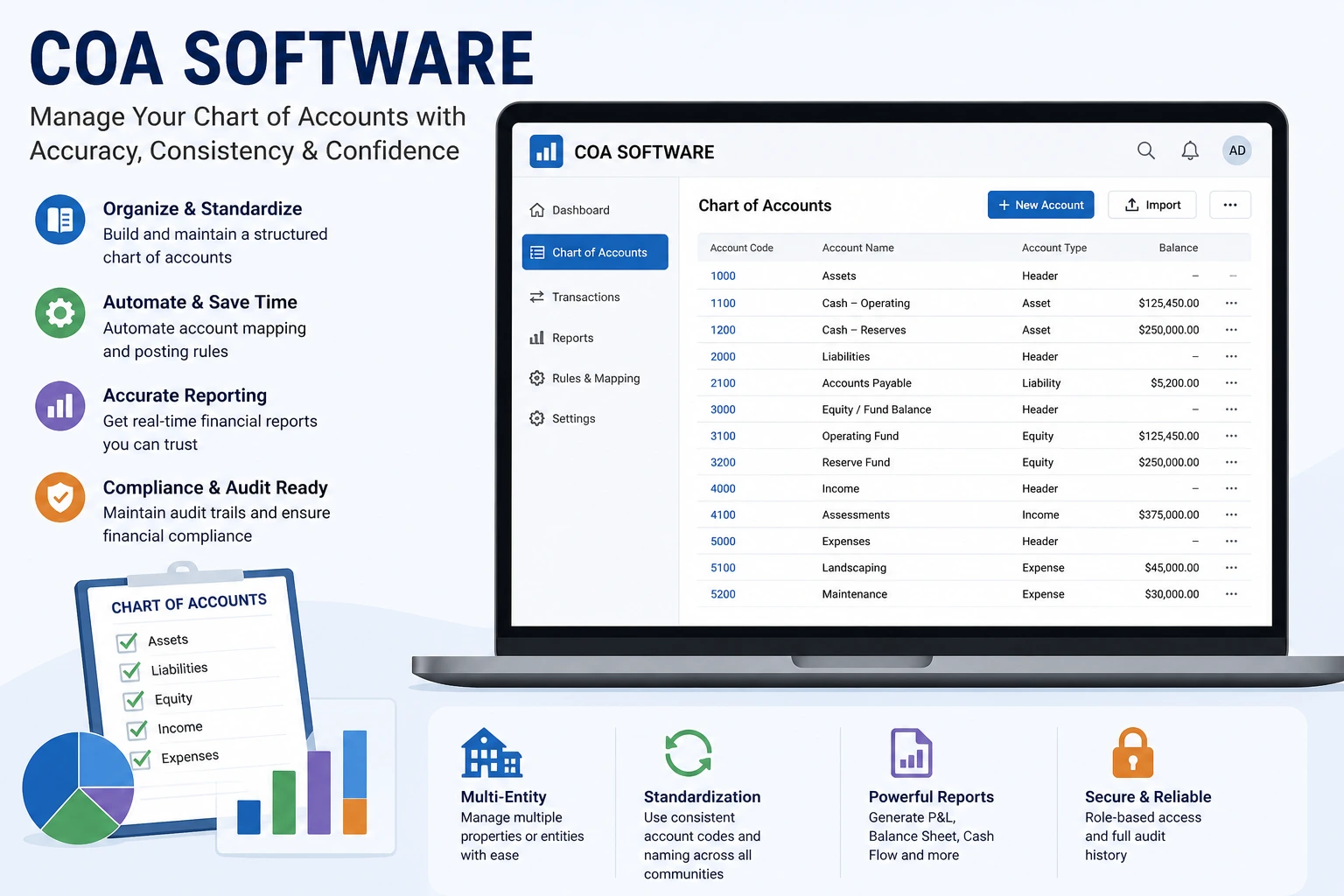
What is condo association management software?
Condo association management software is a platform designed to handle the financial, operational, and communications functions of a condominium owners association (COA). Core capabilities include assessment billing, accounting, reserve fund tracking, maintenance management, violation enforcement, owner portals, and board governance tools. It differs from standard HOA software in that it must support the shared building ownership and structural reserve requirements specific to condominium communities.
If you manage a condominium association or sit on a condo board, the phrase "COA software" covers a wide range of platforms with meaningfully different capabilities. According to CAI Foundation industry data, nearly 80 million Americans now live in community associations, with condominiums representing a significant and growing share of that population. Knowing what condo association software actually does, and how it differs from general HOA tools, is increasingly important for boards that want to manage their communities effectively.
COA Software vs HOA Software: What Is the Difference?
The key distinction
HOA software manages communities of separately owned homes sharing common areas. Condo association management software manages communities where owners share ownership of the building structure itself, creating more complex maintenance obligations, reserve requirements, and legal compliance needs specific to condominium statutes.
In a standard homeowners association, each owner holds the land and structure outright. In a condominium association, owners share legal ownership of the building envelope, roof, corridors, elevators, and mechanical systems with every other unit owner. That shared building ownership creates a different operational profile. G2's community association management category notes that condo software must deal with the fact that not all residents will own their units, adding complexity that HOA-only platforms often do not handle well.
Condo association software needs to handle building system maintenance scheduling, structural reserve fund calculations tied to component lifecycles, compliance with condo-specific statutes, shared utility billing, and visitor management systems that reflect the vertical shared-access nature of condominium living.
For the financial management dimension of this, the HOA Accounting Complete Guide covers accrual accounting, reserve fund tracking, and board-ready financial reporting in depth. The HOA Financial Management guide provides the broader operational context.
What Does Condo Association Management Software Do?
1. Financial management and accounting
Assessment billing, dues collection, accounts payable, general ledger, bank reconciliation, and financial reporting are the financial core of any COA platform. Condominium associations face stricter financial reporting requirements than standard HOAs in most states. For a full breakdown of HOA and COA accounting requirements and methods, see the HOA Accounting Complete Guide.
2. Reserve fund tracking
Reserve fund management is where many condo boards run into trouble. Good condo association software keeps the reserve fund balance separate from operating funds at all times and tracks contributions against reserve study projections. States including Florida and Nevada now mandate specific reserve funding levels for condominium associations. For the full picture on reserve funds, see the HOA Reserve Funds guide.
3. Maintenance and work order management
Maintenance requests from residents, scheduled preventive maintenance for common systems, and coordination with vendors are all operational functions that condo association software manages. In a condominium building, shared building systems affect multiple residents simultaneously, and maintenance needs to be tracked, prioritized, and documented for both operational and legal reasons.
4. Violation and compliance management
Condominium associations enforce community rules on noise, parking, common area use, and unit modifications. COA software tracks violation reports, generates notice letters at appropriate intervals, logs compliance or escalation, and produces records for hearings. Documented, consistent enforcement is important both for fairness and for legal defensibility.
5. Owner and resident portals
Owners and residents expect online access to their accounts: dues balances, payment history, maintenance request status, meeting documents, and community announcements. A resident portal is now a standard expectation in condo association software. Mobile access through a native iOS and Android app or a fully mobile-optimized interface is similarly expected. The condominium management app market has grown significantly as residents default to mobile for all service interactions.
6. Board governance and document management
Meeting management, electronic voting, document storage, and board communication are governance functions that condo association software should support. For compliance obligations around elections, meeting notices, and reserve disclosures, the New HOA Laws in Florida and California HOA Law Changes 2026 articles cover the current state-specific requirements in the two largest COA markets.
What to Look for in Condo Association Software: Evaluation Checklist
Sizing the Decision by Community Type
If your community is professionally managed, the Role of a Professional HOA Manager guide covers what managers look for in a platform and how the software selection decision differs from self-managed boards.
How Condo Association Software Is Priced
Condo association software follows two main pricing models. For a full breakdown including annual audit and reserve study costs, the HOA Accounting guide's cost section covers total annual accounting cost for associations of different sizes.
• Per-unit pricing: typically $0.50 to $2.00 per unit per month. Scales proportionally with community size. Common for mid-size and large associations.
• Flat-rate pricing: typically $39 to $250 per month. Favors very small communities but becomes expensive per unit as the community grows.
ManageCasa for Condo Associations
ManageCasa supports condo and HOA boards of all sizes, from small self-managed communities to large professionally managed portfolios. Assessment billing, full accrual accounting, reserve fund tracking, owner portals, violation management, and eVoting are all included on one platform built for community associations.
Explore the platform at managecasa.com/hoa-management-software or review plans at managecasa.com/pricing.
Frequently Asked Questions
What is condo association management software?
Condo association management software is a platform that handles financial, operational, and communications functions for condominium owners associations, including assessment billing, accrual accounting, reserve fund tracking, maintenance management, violation enforcement, owner portals, and board governance tools, built specifically for the shared building ownership model of condominium communities.
What is the difference between COA software and HOA software?
COA software handles the added complexity of shared building ownership that condominium associations carry but standard HOAs do not, including structural reserve fund tracking, building system maintenance scheduling, and compliance with condo-specific state statutes such as Florida Statute 718. Most modern platforms serve both HOAs and COAs, but depth of COA support varies significantly between providers.
What features should condo association management software include?
At minimum, condo association software should include accrual basis accounting, separate reserve fund tracking, assessment billing and online payments, a mobile-accessible resident portal, work order and maintenance management, violation tracking, electronic voting, and document storage. State-specific compliance tools are important for associations in Florida, California, Nevada, and other states with strict reserve and disclosure requirements.
How much does condo association software cost?
Condo association software pricing ranges from $0.50 to $2.00 per unit per month for per-unit models, or $39 to $250 per month for flat-rate platforms. Total annual cost for a mid-size COA with professional services typically runs $6,000 to $18,000 including platform fees, audit coordination, and reserve study updates.
Do COA boards need a reserve study?
Yes, in most states. Condominium associations face stricter reserve study and funding requirements than standard HOAs. Florida, Nevada, California, Maryland, and Washington all have mandates for condominium reserve studies and adequate funding. Even where not legally required, a reserve study is considered essential financial practice for any condo board managing significant shared infrastructure.

Sales Leader
Noah Gerboff is a strategic sales leader with deep experience in SaaS, real estate, and lending. He specializes in market-driven insights, sales optimization, and helping organizations scale through data-informed strategies.