




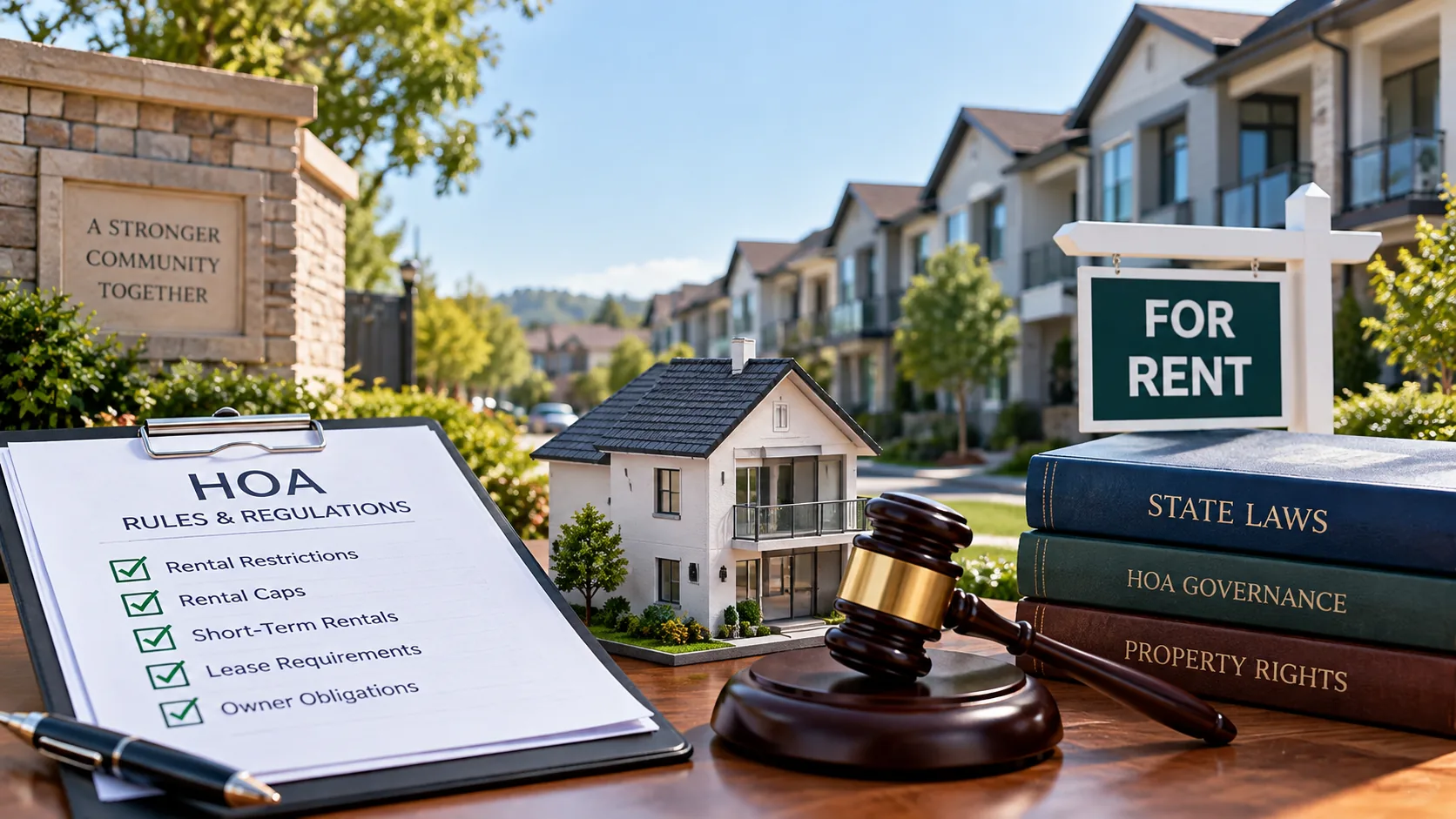
An HOA rental restriction is a rule in an association's governing documents that limits how, when, or how many homes owners can rent out. The two most common tools are rental caps, which limit what percentage of homes may be rented at once, and lease restrictions, such as minimum lease terms. State law sets firm limits on both.
Note:
Rental restriction law varies significantly by state and changes frequently. This guide reflects California, Florida, and Texas law as of September 2026, and federal agency guidance current as of the same date. It does not constitute legal advice. Confirm current requirements with a licensed attorney in your state before adopting, amending, or enforcing any rental restriction.
More than 74 million Americans live in HOA-governed communities across roughly 377,000 associations nationwide, according to the Foundation for Community Association Research. A meaningful share of those communities restrict rentals in some way, and the rules governing what a board can and cannot do have shifted substantially over the past five years in several large states. For board members deciding whether to adopt a rental cap, and for owners trying to figure out whether a new restriction applies to them, the details matter more than the general idea.
This guide covers why associations restrict rentals, the two main tools boards use, how California, Florida, and Texas law treat rental restrictions differently, short-term rental rules, and a 2026 financing change that affects how some boards think about investor-owned units. For the broader governance context, see HOA board member responsibilities and rules.
Why HOAs Restrict Rentals
Boards typically point to three reasons when they adopt or defend a rental restriction:
- Property character and stability: owner-occupants tend to have longer tenures and a direct financial stake in maintaining the property, which boards often cite when justifying a cap.
- Financing eligibility: mortgage lenders and agencies apply owner-occupancy thresholds when deciding whether a condo project qualifies for conventional financing, covered in detail below.
- Insurance and risk: some master insurance policies price differently, or apply different underwriting scrutiny, to buildings with a high concentration of non-owner-occupied units.
None of these reasons gives a board unlimited authority. Every state discussed below allows some form of rental restriction, but each also draws a line the board cannot cross.
Rental Caps vs. Lease Restrictions: The Two Main Tools
Associations generally use one or both of two mechanisms to manage rentals:
A rental cap and a lease restriction are not mutually exclusive. An association can, for example, cap total rentals at 25 percent of homes and separately require every lease to run at least 30 days.
State Rental Restriction Laws: California, Florida, and Texas
The single biggest point of confusion for both boards and owners is timing: when a new restriction is adopted, does it apply to owners who already rent out their homes? The answer depends entirely on the state.
California: Civil Code Sections 4740 and 4741
California's Davis-Stirling Act sets some of the strongest owner protections in the country. Under Civil Code Section 4741, an association cannot adopt or enforce a rule that prohibits, effectively prohibits, or unreasonably restricts renting out a home. A rental cap cannot be set lower than 25 percent of the separate interests in the community, though a board may set it higher.
• Grandfathering: under Civil Code 4740, a rental restriction adopted after an owner takes title does not apply to that owner. Only owners who buy after the restriction is recorded are bound by it.
• Short-term rentals are a separate carve-out: Section 4741(c) still allows an association to prohibit rentals of 30 days or less, regardless of the 25 percent cap or grandfathering.
• Compliance deadline: boards were required to remove any noncompliant rental restriction from their governing documents by July 1, 2022. A willful violation exposes the association to actual damages plus a civil penalty of up to $1,000.
For the full current California HOA legal framework, see California HOA laws: rules, statutes and 2026 changes.
Florida: Statute 720.306(1)(h)
Florida takes a narrower approach than California. Under Chapter 720 of the Florida Statutes, Section 720.306(1)(h), a rental-restricting amendment adopted after July 1, 2021, applies only to an owner who acquires title after the amendment's effective date, or who consents to it. Florida does not set a minimum rental-cap percentage the way California does.
• The one exception that reaches existing owners: an association may adopt restrictions on lease terms shorter than six months, or on renting a parcel more than three times per calendar year, and those restrictions apply to every owner regardless of when they bought.
• Restrictions recorded before July 1, 2021 remain binding on all owners, regardless of their nature.
Florida also regulates community association management professionally, distinct from this rental question; see how to get your Florida community association manager or CAM license for that separate topic.
Texas: Property Code Chapter 209
Texas does not provide the automatic, statute-based grandfathering that California and Florida do. Whether a new restriction reaches an existing renting owner generally depends on the association's declaration and how the amendment was adopted. Texas law focuses instead on limiting how an HOA screens tenants. Under Texas Property Code Section 209.016, an association generally cannot require that a lease applicant be submitted to and approved by the HOA, and cannot demand a tenant's credit report or rental application. The HOA may request basic occupant contact information and the lease term.
This is a meaningfully different limitation than California's or Florida's: Texas restricts the HOA's role in tenant screening rather than setting a percentage floor on rentals. For the full Texas HOA legal framework, see Texas HOA law: homeowner rights and association rules. Landlords handling their own tenant screening, separate from the HOA's role, can reference how to screen tenants: adverse action and legal compliance.
Side-by-Side Comparison
Tracking Rental Caps and Approvals
Enforcing a rental cap consistently requires knowing, in real time, how many homes are currently rented and where a community stands against its cap. ManageCasa's board oversight and governance tools (managecasa.com/capabilities/management) let boards log rental status per unit, manage a rental waitlist, and keep the documentation a grandfathering claim depends on, such as an owner's date of title, in one place.
Short-Term Rentals and Airbnb Restrictions
Short-term and vacation rentals sit in their own category in every state covered here. Even where general rental caps are limited or grandfathering protects existing owners, associations generally retain more room to restrict rentals under 30 days.
- California: Civil Code 4741(c) allows a board to prohibit transient or short-term rentals of 30 days or less, independent of the 25 percent cap and independent of grandfathering.
- Florida: the carve-out in 720.306(1)(h) for lease terms under six months, and for renting more than three times a year, applies to every owner, including those who bought before the restriction was adopted.
- Texas: short-term rental restrictions are enforced through the declaration like any other CC&R provision, and typically require a membership vote to adopt or amend, often a supermajority.
Boards considering a new short-term rental restriction should confirm the specific mechanics in their state, since "short-term" is defined differently and the retroactivity rules differ from the rules governing general rental caps.
Financing Considerations: The 2026 Fannie Mae Change
A March 2026 change to agency condo lending rules is relevant context for boards weighing whether to loosen a rental cap. In Lender Letter LL-2026-03, effective March 18, 2026, Fannie Mae retired the rule that made an established condo project ineligible for conventional investor financing once more than 50 percent of its units were non-owner-occupied. That specific investor-concentration limit no longer applies to established projects reviewed under Fannie Mae's Full Review process.
Two things this change does not do:
- It does not apply to single-family HOAs; it is a condo-project financing rule that affects associations whose units are individually financed through Fannie Mae or Freddie Mac.
- It does not remove every investor-related limit. A separate rule still caps any single entity's ownership at 20 percent of units in a project of 21 or more units, and new or newly converted projects still face separate presale requirements.
In practice, many condominium associations are expected to keep their existing rental restrictions in place regardless of this financing change, since the restrictions also serve the community-character and insurance reasons discussed earlier, not financing eligibility alone.
Enforcing a Rental Restriction Fairly
A rental restriction that is otherwise legal can still become unenforceable if it is applied inconsistently. Courts in multiple states have found that a rule enforced against some owners but not others cannot be enforced against the owner challenging it, regardless of the rule's underlying validity.
- Apply the same verification process, cap counting method, and waitlist procedure to every owner.
- Document each owner's date of title before applying grandfathering, since that date determines whether an older or newer restriction governs their unit.
- Give written notice before treating a rental as noncompliant, consistent with the association's standard enforcement process.
For the general enforcement framework HOAs must follow, see the HOA rules and regulations guide.
Managing Rental Rules in Your Community
Keeping rental caps, lease terms, and grandfathering documentation organized is one of the more detail-heavy parts of HOA governance. Explore ManageCasa's HOA management features and pricing), or visit ManageCasa to learn more.
Related Guides
- HOA Board Member Responsibilities and Rules
- HOA Rules and Regulations Guide
- California HOA Laws: Rules, Statutes and 2026 Changes
- Texas HOA Law: Homeowner Rights and Association Rules
- How to Screen Tenants: Adverse Action and Legal Compliance
Frequently Asked Questions
Can an HOA restrict rentals?
Yes, but the extent of that authority varies by state. California requires that any cap allow at least 25 percent of homes to be rented, Florida limits new restrictions to owners who buy after the restriction is adopted, and Texas focuses its limits on how the HOA screens tenants rather than on a cap percentage.
What is an HOA rental cap?
An HOA rental cap is a limit on the percentage of homes in a community that may be rented out at the same time. Once the cap is reached, owners who want to rent are typically placed on a waitlist until a rented unit becomes owner-occupied again or another slot opens.
If I already rent out my home, can a new HOA rule stop me?
In California and Florida, generally no. Both states protect owners who were already renting, or who owned before a restriction was adopted, from having that new restriction applied to them retroactively. In Texas, whether a new restriction reaches you depends on your association's declaration, since state law does not provide the same automatic grandfathering.
Can an HOA restrict short-term rentals like Airbnb?
Yes, generally. Even in states like California that limit general rental caps, associations typically retain broader authority to prohibit or restrict short-term rentals, commonly defined as stays of 30 days or less, regardless of the community's overall rental cap or grandfathering rules.
Does a California HOA rental cap have to allow at least 25 percent of homes to be rented?
Yes. Under Civil Code Section 4741, a California association cannot adopt or enforce a rental cap lower than 25 percent of the separate interests in the community, though it may set a higher percentage if the board and membership choose to.

Content Writer
Patrick Bohan is a content strategist focused on property management technology, HOA operations, and real estate. A Cornell graduate, he began his career at UBS covering housing markets, homeownership policy, and financial regulation experience that now informs his research driven approach to proptech content. Today he bridges the gap between software teams and the practitioners who use them, producing practical resources on community associations, rental operations, and accounting workflows for property managers.