


What is California AB 2050?
AB 2050 is a California law, signed September 29, 2026, that turns reserve studies into a funding obligation for homeowners associations. Starting January 1, 2032, boards must contribute at least the 30-year minimum their study identifies, and associations projected to run out of reserves must set aside at least 15% of the annual budget.
Legal note
This article summarizes AB 2050 (Chapter 796, Statutes of 2026) as signed. It isn't legal advice. The funding rules don't apply until January 1, 2032, and boards should review their reserve study, governing documents and budget plans with association counsel and a qualified reserve specialist.
For years, California HOA law has told boards to study their reserves without requiring them to fund them. On September 29, 2026, Governor Newsom signed AB 2050, and that changes. Starting in 2032, the number in your reserve study becomes a funding floor, and associations headed for a shortfall will have to move money into reserves every year.
The headlines have focused on higher dues. For boards, the bigger story is the runway: the rules apply in 2032, so the next few budget cycles decide whether your association eases into compliance or meets it with a sudden increase or a special assessment. Here's what the law actually says and how to plan for it.
What AB 2050 Changes About California HOA Reserves
AB 2050 amends the Davis-Stirling Act by rewriting the reserve study section and adding a new funding section. The full text is in the chaptered bill.
Current law: the study is required, the funding isn't
Under Civil Code 5550, boards must have a reserve study with an on-site visual inspection of major components at least once every three years and review it every year. The study lists components with less than 30 years of remaining life, estimates their replacement costs and includes a funding plan. What the law hasn't done is require the board to follow that plan. Those California HOA reserve requirements stay in place until January 1, 2032.
The 30-year minimum contribution level
From 2032, every HOA reserve study in California must also identify "the minimum reserve contribution level to prevent the projected association reserve account balance from falling below zero over the following 30 years." The new Section 5552 then requires the association to "fund the reserve account on an annual basis in at least the minimum reserve contribution level."
In plain terms: whatever your reserve specialist calculates as the yearly amount needed to stay above zero for three decades, that becomes the least you can put in.
The 15% gross budget rule
The law adds a second trigger for associations that are already behind. If the reserve balance is projected to fall below zero at any point in the next 30 years, the association "shall transfer a minimum of 15 percent of its gross annual budget to its reserve account each year until its reserve account balance is no longer projected to fall below zero."
That 15% figure lines up with lender expectations too. The Senate Judiciary Committee analysis notes that Fannie Mae and Freddie Mac expect associations to budget at least 10% for reserves, with that expected to rise to 15% by 2027. Our guide to Fannie Mae's reserve rule covers what that means for mortgage eligibility.
When AB 2050 Takes Effect: Timeline for Boards
The bill becomes law on January 1, 2027, but its funding rules are written to become operative on January 1, 2032. Until then, the existing reserve study rules continue unchanged.
One technical note: parts of AB 2050 were drafted to merge with SB 1238, another HOA bill. Those merged sections only take effect if both bills became law, and the Governor vetoed SB 1238. AB 2050's own version of the reserve study section is the one that applies.
Reserve Funding Special Assessments Under AB 2050
What if the budget can't cover the minimum? The law answers directly: "the association shall levy a reserve funding special assessment subject to the same provisions as a standard special assessment in Section 5605." That ties AB 2050 to California HOA special assessment rules that already exist.
The 5% and 20% limits without a member vote
Civil Code 5605(b) limits what a board can do on its own. Without approval from a majority of a quorum of members, the board can't:
• Raise regular assessments more than 20% above the prior fiscal year, or
• Impose special assessments that total more than 5% of the association's budgeted gross expenses for the year.
AB 2050 doesn't change either limit, and it doesn't spell out what happens if members vote down a reserve funding assessment above 5%. That's a question for association counsel, and one more reason to close any gap through the regular budget well before 2032. For the general rules on notices and homeowner rights, see our guide to HOA special assessment rules.
The once-every-nine-years limit
The law also caps how often this tool can be used: "An association shall not levy a reserve funding special assessment more than once every nine years." In practice, a reserve funding special assessment is a one-time catch-up, not a recurring line item. Ongoing shortfalls have to be solved through regular dues.
Worked Example: How the 15% Rule Plays Out
Here's a simplified, hypothetical association to show how the pieces fit. The figures are illustrative only, not drawn from a real community.
In this example, the board could cover the gap with a regular dues increase of 5% of the budget, well inside the 20% limit. Phasing that in over several years before 2032 makes each step smaller. If the reserve study's 30-year minimum came out higher than 15%, that higher figure would apply instead.
What AB 2050 Means for Homeowners and Buyers
California has about 51,700 common interest developments housing an estimated 14.5 million residents, according to Foundation for Community Association Research figures cited in the Senate analysis. For owners in underfunded associations, dues are likely to rise before 2032. For buyers, a community's reserve study and funding plan become more important to review before closing.
The bill had organized backing and organized opposition. It was sponsored by the Community Associations Institute's California Legislative Action Committee and supported by the California Association of Community Managers. The Center for California Homeowner Association Law, the Consumer Federation of California and Housing and Economic Rights Advocates opposed it, according to the same analysis. Supporters point to deferred maintenance and mortgage eligibility. Opponents point to cost pressure on owners.
Rising dues are easier to accept when owners understand why. Our guide on communicating HOA fee increases covers how to explain a reserve-driven increase.
How to Prepare Your Association Before 2032
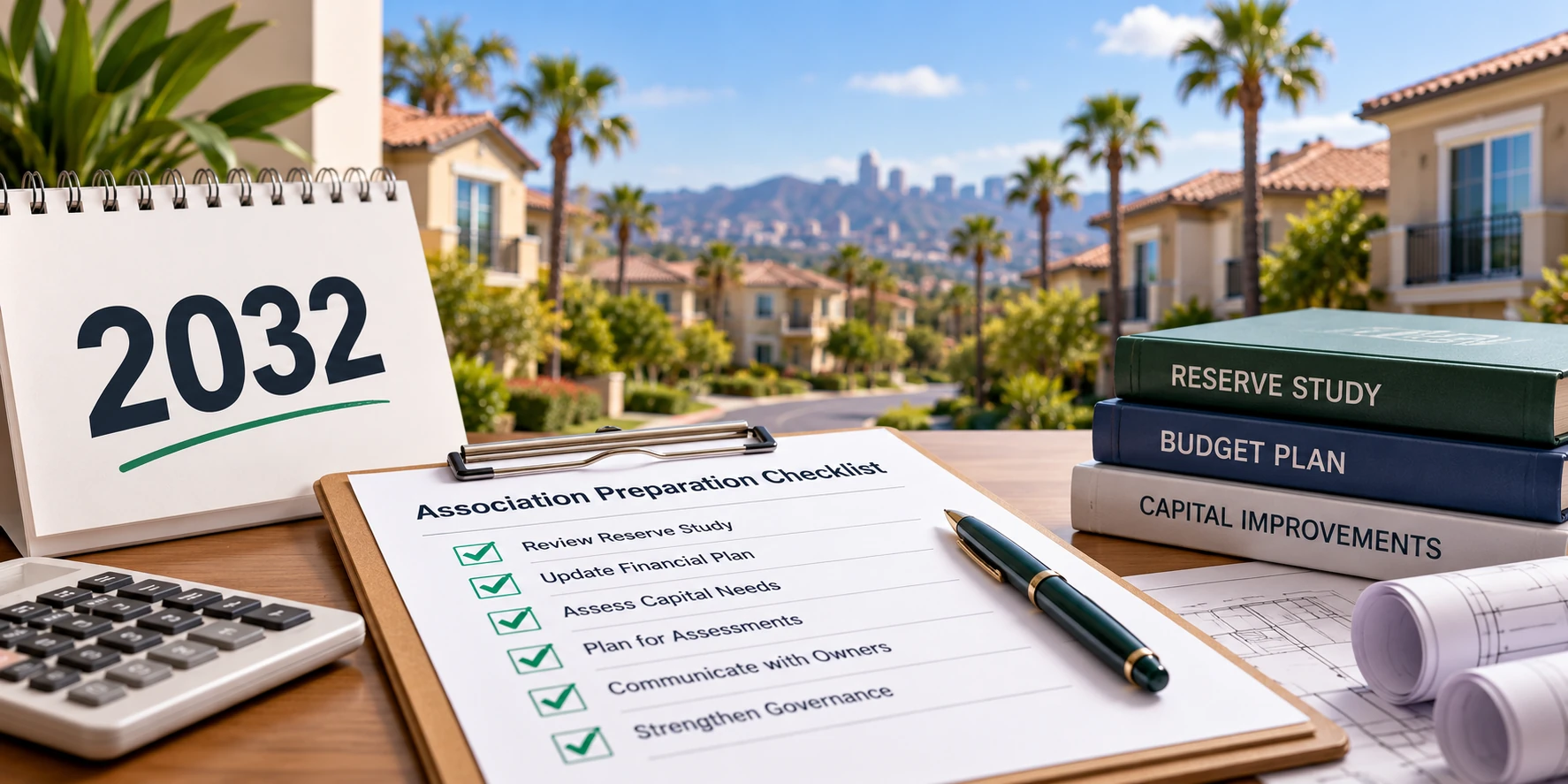
Boards that start now have roughly five budget cycles to get ready. A practical sequence:
- Commission an updated reserve study. Ask your specialist to model the 30-year projection now, even though the requirement starts in 2032. The California DRE reserve study guide is a useful primer for board members.
- Find your gap. Compare current contributions to both the 30-year minimum and 15% of your gross annual budget.
- Phase increases in. Spread the change across the 2027 to 2031 budgets instead of absorbing it all in 2032.
- Keep the special assessment in reserve. With the nine-year limit, treat it as a last resort.
- Document everything. Record funding decisions in board minutes and the annual budget report so owners and lenders can see the plan.
For a broader look at reserve levels and accounting, see our guide to how much an HOA should keep in reserves, and our HOA budgeting guide for building the numbers into next year's budget. Sound reserve planning is a core part of good property management for any association.
How ManageCasa supports reserve planning
ManageCasa's financial tools track operating funds, reserves and special accounts on separate ledgers, and let boards compare budgeted amounts against actual activity. For AB 2050, that makes it easier to see each year whether reserve transfers are on pace with the plan in your reserve study.
Frequently Asked Questions
What is AB 2050 in California?
AB 2050 is a 2026 California law that requires HOAs to fund their reserves, starting January 1, 2032. Associations must contribute at least the 30-year minimum in their reserve study. If reserves are projected to dip below zero, they must transfer at least 15% of the annual budget, or levy a special assessment.
When does AB 2050 take effect?
The law is on the books January 1, 2027, but its funding rules don't apply until January 1, 2032. Until then, the existing Davis-Stirling reserve study rules stay in place. That leaves boards about five budget cycles to update their studies and phase in higher contributions before the requirements apply.
How often should an HOA do a reserve study in California?
California requires a reserve study with an on-site visual inspection at least once every three years, plus an annual review of the study. AB 2050 keeps that schedule. From 2032, the study must also show the minimum yearly contribution that keeps reserves from falling below zero over the next 30 years.
How much can HOA fees increase in California?
Without a member vote, a California HOA board can raise regular assessments by up to 20% over the prior year. Special assessments are capped at 5% of budgeted gross expenses per year unless members approve more. AB 2050's new reserve funding special assessments follow those same Civil Code 5605 rules.
Can a California HOA levy a special assessment without a vote?
Yes, but only up to 5% of the association's budgeted gross expenses for the fiscal year. Anything larger needs approval from a majority of a quorum of members under Civil Code 5605. Under AB 2050, a reserve funding special assessment also can't be levied more than once every nine years.
Related California HOA Guides
• California HOA laws: rules, statutes and 2026 changes
• HOA reserve funds: funding levels, studies and state rules
• HOA reserve study and Fannie Mae's 15% rule
• HOA special assessments: rules and homeowner rights
Plan reserves with confidence
Getting ready for AB 2050 starts with clean books and a clear budget. ManageCasa gives California boards fund accounting, budgeting and owner communication in one place.
See how the HOA platform works or compare plans on the pricing page.

Content Writer
Patrick Bohan is a content strategist focused on property management technology, HOA operations, and real estate. A Cornell graduate, he began his career at UBS covering housing markets, homeownership policy, and financial regulation experience that now informs his research driven approach to proptech content. Today he bridges the gap between software teams and the practitioners who use them, producing practical resources on community associations, rental operations, and accounting workflows for property managers.