




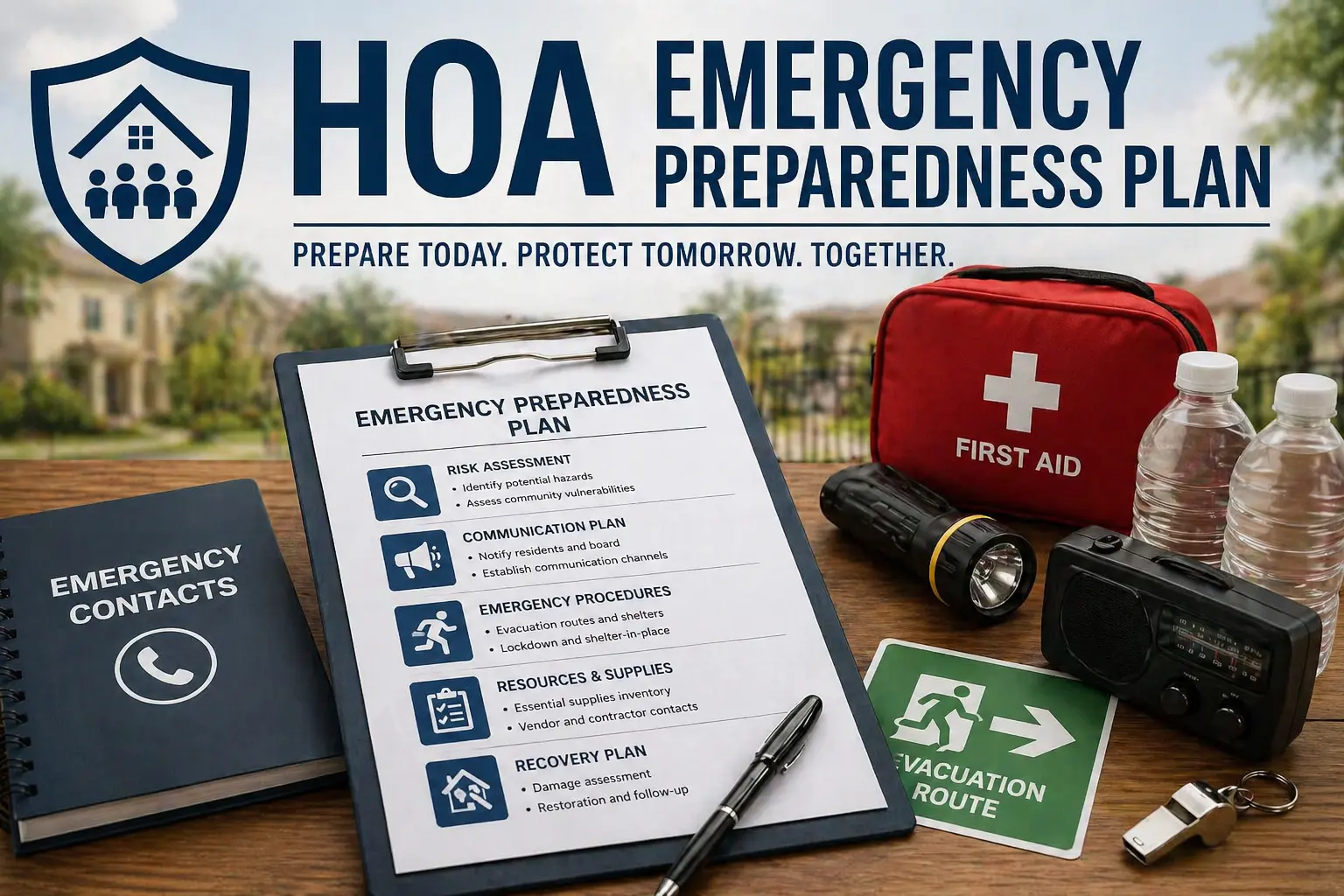
What is an HOA emergency preparedness plan?
An HOA emergency preparedness plan is a documented framework that defines how a homeowners association will respond to natural disasters, infrastructure failures, and other community emergencies. It covers risk assessment, emergency response team structure, evacuation procedures, resident communication, and supply readiness, giving every resident and board member a clear role before a crisis occurs.
Emergencies are not predictable. What is predictable is whether a community is ready when one arrives. An HOA without a preparedness plan leaves its board scrambling for authority it does not have, its residents without guidance they need, and its common areas exposed to damage that proper preparation could have reduced.
This guide walks through every component of a complete HOA emergency preparedness plan: how to assess risk, how to form and train an emergency response team, how to build a communication system that actually reaches residents, and how to document everything in a way that holds up when it matters most. If your board is also building out its broader governance foundations, the guide on HOA best practices covers the operational frameworks that emergency planning sits within.
Why Every HOA Needs a Formal Emergency Plan
A well-run community association has protocols for everything from architectural reviews to vendor payments. Emergency response deserves the same rigor, not because disaster is inevitable, but because the absence of a plan guarantees a poor response when one occurs.
Communities with documented emergency plans respond faster, communicate more clearly, and suffer less secondary damage than those without one. Board members who know their roles in advance make better decisions under pressure. Residents who know where to go and who to contact before an emergency are less likely to create additional problems during one.
There is also a liability dimension. Many state HOA statutes and governing documents create obligations for boards to protect common areas and maintain basic safety infrastructure. A board that has done nothing to plan for foreseeable emergencies may face legal exposure if that inaction contributes to harm. The specific board obligations in this area are part of the broader fiduciary framework covered in the HOA board member responsibilities guide.
Building Your HOA Emergency Preparedness Plan: Six Steps
Recover & Thrive: Your HOA’s Emergency Action Plan
.webp)
In emergencies, a well-structured action plan is essential for your HOA to survive, recover, and thrive. Below, we discuss various natural disasters and the most appropriate action plans.
Earthquakes
Risk Assessment: Identify buildings and structures most vulnerable to seismic activity.
Rescue Action Plan
- Pre-Earthquake: Secure heavy furniture and appliances and conduct regular structural assessments.
- During Earthquake: Instruct residents to “Drop, Cover, and Hold On” under sturdy furniture.
- Post-Earthquake: Check for injuries, evacuate if necessary, inspect for gas leaks and structural damage, and communicate with local authorities for assistance.
Hurricanes
Risk Assessment: Determine flood-prone areas and identify safe buildings.
Rescue Action Plan
- Pre-Hurricane: Install storm shutters, trim trees, and secure outdoor objects.
- During Hurricane: Instruct residents to stay indoors, away from windows, and in the safest part of their home.
- Post-Hurricane: Conduct safety checks, clear debris, assist injured residents, and coordinate with emergency services for rescue operations and supplies.
Floods
Risk Assessment: Map flood zones and ensure proper drainage systems.
Rescue Action Plan
- Pre-Flood: Build sandbag barriers, move valuables to higher ground, and prepare emergency kits.
- During Flood: Instruct residents to move to higher ground immediately and avoid driving or walking through floodwaters.
- Post-Flood: Check for waterborne hazards, purify drinking water, assist in necessary evacuation, and coordinate with local authorities for relief efforts.
Wildfires
Risk Assessment: Identify areas prone to wildfires and ensure proper vegetation management.
Rescue Action Plan
- Pre-Wildfire: Clear dry brush and debris, creating defensible space around properties.
- During Wildfire: Instruct residents to evacuate immediately if ordered and use fire-resistant materials for sheltering in place.
- Post-Wildfire: Check for hot spots, assist with evacuations and medical aid, and coordinate with fire departments for ongoing firefighting efforts.
- Health Emergencies
Pandemics
Risk Assessment: Monitor global and local health advisories and identify vulnerable populations.
Rescue Action Plan
- Pre-Pandemic: Promote vaccination, ensure availability of hygiene supplies, and establish communication protocols.
- During Pandemic: Enforce social distancing, distribute personal protective equipment (PPE), and provide regular health updates.
- Post-Pandemic: Assist with medical care, support mental health resources, and ensure thorough sanitation of common areas.
Infectious Disease Outbreaks
Risk Assessment: Identify potential sources of outbreaks and monitor health trends.
Rescue Action Plan
- Pre-Outbreak: Educate residents on hygiene practices and stockpile necessary medical supplies.
- During Outbreak: Isolate affected individuals, provide medical assistance, and communicate transparently.
- Post-Outbreak: Conduct health screenings, support recovery, and implement preventive measures for future outbreaks.
- Man-Made Disasters
Fires
Risk Assessment: Identify fire hazards and ensure compliance with fire safety codes.
Rescue Action Plan
- Pre-Fire: Install smoke detectors, conduct regular fire drills, and maintain fire extinguishers.
- During Fire: Instruct residents to evacuate immediately, use fire escape routes, and follow the fire emergency protocol.
- Post-Fire: Assess for structural damage, provide first aid, assist displaced residents, and coordinate with fire services for recovery.
Chemical Spills
Risk Assessment: Identify potential sources of hazardous materials and ensure proper storage and handling.
Rescue Action Plan
- Pre-Spill: Conduct safety training and ensure proper labeling and storage of chemicals.
- During Spill: Evacuate affected areas, provide protective gear, and contact hazardous materials (HAZMAT) teams.
- Post-Spill: Decontaminate the area, provide medical evaluations, and ensure the safe return of residents.
Power Outages
Risk Assessment: Identify critical electrical systems and ensure backup power sources.
Rescue Action Plan
- Pre-Outage: Install backup generators and educate residents on power outage procedures.
- During Outage: Distribute flashlights and batteries, provide emergency lighting, and ensure open communication.
- Post-Outage: Assess electrical systems for damage, restore power safely, and address any immediate needs of residents.
Acts of Terrorism & Violence
Risk Assessment: Identify potential targets and maintain a high level of security awareness.
Rescue Action Plan:
- Pre-Terrorism: Conduct regular security drills, install surveillance systems, and establish emergency protocols.
- During Terrorism: Follow lockdown procedures, communicate with law enforcement, and evacuate if necessary.
- Post-Terrorism: Provide medical and psychological support, assess security breaches, and coordinate with authorities for ongoing safety.
Emergency Communication: The Most Critical Component
Of all the elements in an HOA emergency preparedness plan, communication is the one that most often fails during an actual event. Common failure points include contact lists that have not been updated in years, alert systems that rely on a single channel that goes down during the emergency, and no clear protocol for who sends messages or how often.
A robust HOA community safety communication plan uses at least three independent channels, designates a specific person as communications lead, and establishes a cadence of updates so residents know when to expect information.
Residents with Special Needs
Every HOA emergency plan should include a specific protocol for residents who will need assistance during an evacuation or shelter-in-place situation: elderly residents who cannot self-evacuate, residents with mobility limitations, residents with medical equipment that requires power, and residents with young children. The practical approach is to invite residents to voluntarily register with the association if they anticipate needing evacuation assistance.
Coordinating with Local Emergency Services
An HOA emergency preparedness plan does not operate in isolation from the broader emergency management system. Before an emergency occurs, board leadership should contact local fire, police, and emergency management agencies to understand how the community fits into local response plans and what protocols govern emergency access to gated or access-controlled communities.
HOA Emergency Preparedness Checklist
• HOA risk assessment completed and documented for your geographic area.
• Emergency response team formed with defined roles and a printed contact list.
• Resident contact database complete and updated within the last six months.
• Multi-channel alert system tested and confirmed operational.
• HOA evacuation plan routes mapped and distributed to all residents.
• Assembly points designated and clearly signed in common areas.
• Special needs registry maintained and reviewed annually.
• Common area emergency supply kits stocked and inventory checked annually.
• Written emergency plan distributed to all residents and new move-ins.
• Annual review and drill scheduled on the association calendar.
• Local emergency service contacts confirmed and relationships established before any emergency.
Centralise Your HOA Emergency Records with ManageCasa
ManageCasa gives HOA boards a centralised platform to store emergency plans, maintain resident contact databases, and manage communication across the community. When emergency information is organised and accessible, response times improve and the board is better positioned to act quickly.
Explore HOA platform features at managecasa.com/hoa-management-software
Frequently Asked Questions
What should an HOA emergency preparedness plan include?
An HOA emergency preparedness plan should include a community risk assessment, an emergency response team with defined roles, a multi-channel resident communication plan, mapped evacuation routes and assembly points, emergency supply protocols, and a special needs assistance protocol. The plan should also include contacts for local emergency services and a schedule for annual review and drills.
Who is responsible for HOA emergency preparedness?
The HOA board of directors is ultimately responsible for emergency preparedness planning in a homeowners association. Boards typically delegate day-to-day plan maintenance to a designated emergency response team of board members, volunteer residents, and sometimes the community's professional management company. Every board member carries a fiduciary duty to ensure the community has a reasonable emergency plan in place.
How often should an HOA emergency plan be updated?
An HOA emergency plan should be reviewed and updated at least once per year, with contact information verified at least twice annually. The plan should also be updated after any significant community change, such as major infrastructure work, shifts in community demographics, or a local emergency event that revealed gaps in the current plan.
Are HOAs legally required to have an emergency plan?
No federal law mandates HOA emergency preparedness plans, though state HOA statutes and governing documents in many jurisdictions create obligations for boards to protect common areas and maintain basic safety infrastructure. Even where not legally required, the absence of any emergency plan creates legal exposure for boards if that gap contributes to resident harm during a foreseeable emergency.
How do HOAs communicate with residents during emergencies?
Effective HOA emergency communication uses multiple independent channels so that no single point of failure can leave residents without information. Text alerts, email, a community app or portal, physical bulletin boards, and coordination with local emergency services all play a role. The key is designating a communications lead before an emergency and maintaining an up-to-date resident contact database year-round.

Expert in Property Management and SaaS
Peter Koch is an expert in property management and SaaS, focused on building top digital tools for property managers and growing technology-driven startups. He specializes in enhancing property management operations through smart software solutions that streamline accounting, automate workflows, and improve community communication. Peter writes about HOA management technology, proptech innovation, and scalable SaaS strategies designed to help modern property professionals operate more efficiently.