




Rental Management: What It Is, How It Works
If you have spent a Saturday morning fielding a maintenance call, chasing a late rent payment, and trying to decode a new landlord ordinance all at the same time, you already understand what rental management is really about. It is the operational layer that holds a rental property together, and for most owners, it is the part of real estate investing nobody fully warns you about before you dive in.
This guide covers everything you need to know about rental management in 2026 - what it is, how the rental property management process works from first day to last, what rental management services are included, what it costs, and when hiring a rental management company makes genuine financial sense.
Quick answer: Rental management is the professional administration of residential or commercial rental properties on behalf of owners. It covers the full rental property management process -- from tenant screening and lease management to rent collection, maintenance coordination, property inspections, and eviction handling.
What Is Rental Management?
Rental management is the ongoing operational oversight of a rental property from the moment it is listed to the day a tenant moves out. It covers every task required to keep a property occupied, legally compliant, physically maintained, and financially healthy.
The term is used interchangeably with "property management for rentals" and "rental and property management." Where differences exist between companies, they usually come down to property type rather than any meaningful difference in the work involved.
Property rental management explained in the simplest terms: someone other than the owner handles the day-to-day work of running the property. That might be an individual property manager, a full-service rental management company, or a technology platform. The goal is always the same - keep the property occupied with reliable tenants, protect the physical asset, and give the owner a consistent return without demanding their constant attention.
According to the Buildium and NARPM 2026 State of the Property Management Industry Report, there are over 304,000 property management businesses operating in the United States, with 238,000 of those focused exclusively on residential properties. That scale tells you something important: this is a mature, specialized industry with established service standards and measurable performance benchmarks.
2026 data point: AI adoption among property management companies grew from 20% to 58% in a single year, according to Buildium and NARPM's 2026 Industry Report. That is one of the fastest adoption rates ever recorded in the sector.
How Rental Management Works Step by Step
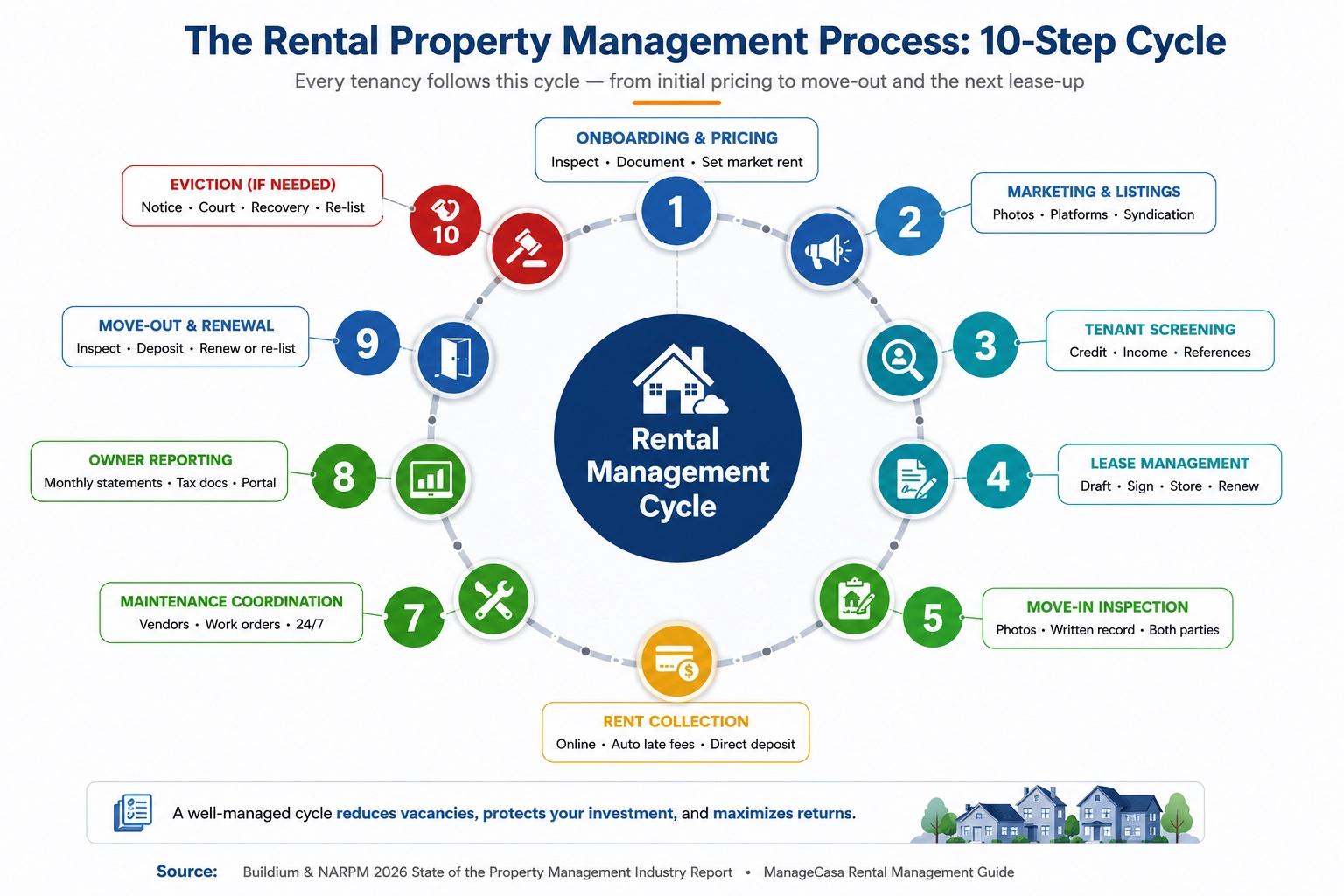
Understanding how rental management works helps owners set realistic expectations before signing a management agreement. The rental property management process follows a predictable cycle tied to each tenancy. Here is how it plays out in practice.
- Property onboarding and pricing - The manager inspects the property, documents its current condition, assesses any repairs needed before listing, and sets a market-rate rent using real-time local data. This baseline inspection protects the owner at move-out and ensures the asking rent is competitive from day one.
- Marketing and vacancy listing - Vacancies are listed on major rental platforms, syndicated to high-traffic sites, and marketed with professional photography. The goal is to attract a large pool of qualified applicants in the shortest time possible, keeping vacancy days to a minimum.
- Tenant screening - Applications are reviewed against documented criteria covering credit score, income verification (typically requiring income of at least 2.5x monthly rent), employment history, and prior landlord references. Consistent, written criteria reduce fair housing legal risk and produce better tenants over time.
- Lease management - A legally compliant lease is drafted, signed digitally, and stored. Key clauses cover rent amount, due dates, maintenance obligations, landlord entry notice requirements, and pet or subletting policies. Lease management also includes renewal tracking and serving required rent increase notices.
- Move-in property inspection - A detailed inspection is conducted and documented with photos and written reports before the tenant takes possession. This record protects both parties when the tenancy ends and a security deposit needs to be reconciled.
- Rent collection - Tenants pay through an online portal by ACH, credit card, or debit card. Automated payment reminders reduce late payments, and late fees are enforced consistently per the lease terms. Owners receive net income by direct deposit, typically within a few business days of collection.
- Maintenance coordination - Maintenance requests are submitted digitally, assessed for urgency, and dispatched to vetted vendors. Routine repairs, emergency calls, and seasonal maintenance are all tracked through the same system. Pre-negotiated vendor rates are one of the most financially significant advantages of professional management.
- Owner reporting - Owners receive monthly financial statements, year-end summaries for tax filing, and on-demand reporting through an owner portal. The quality of this reporting is one of the clearest indicators of how well a rental management company is actually running your property.
- Move-out and lease renewal - At lease end, a move-out inspection is conducted and compared against the move-in record. The security deposit is reconciled based on documented condition. If the tenant renews, the lease is updated and re-signed before expiry. If not, the vacancy cycle begins again.
- Eviction handling when needed - If a tenant fails to pay or violates the lease, the manager initiates the legal eviction process: proper written notice, court filing, representation at the hearing, and coordination of unit recovery. Mistakes in eviction procedure can invalidate the case entirely - one of the clearest reasons professional management pays for itself.
For a detailed breakdown of what a strong lease should include at each stage of this process, see Rental Agreements and Lease Terms Guide.
Key Services Included in Rental Management
Not every rental management company offers the same scope. Full-service providers cover all of the following. Leaner or lower-cost firms may handle only a subset, with owners responsible for filling the gaps. Always confirm in writing what is and is not included before signing.
Tenant screening
A structured tenant screening process covers background checks, credit reports, eviction history, income verification, and prior landlord references. Written, consistent criteria protect owners from fair housing violations and produce better outcomes over time. Rental fraud is also a growing concern: a 2024 RealPage survey of 402 multifamily professionals found that 75% reported an increase in rental fraud in the prior year, with fake identities and misrepresented income being the most common tactics.
Rent collection
Automated online rent collection is now the standard expectation in full-service rental management. Tenants pay digitally by ACH, credit card, or debit card. Late fees are applied automatically per the lease. Owners receive net income by direct deposit with full ledger visibility. Property management companies still relying on paper checks and manual tracking are operating with a significant operational disadvantage.
Lease management
Lease management covers drafting, execution, storage, and renewal of rental agreements. It also includes serving legally required notices for rent increases, landlord entry, and lease violations. Each of these carries specific timing and format requirements that vary by state and municipality, and getting them wrong creates legal exposure for the owner.
Maintenance coordination
Maintenance coordination is the most operationally intensive part of rental management for most properties. A well-run rental management company dispatches vetted vendors, tracks work orders from submission to completion, and handles after-hours emergencies through a documented process. According to the Buildium and NARPM 2026 Industry Report, contractor labor costs for HVAC, plumbing, and electrical work have risen 15 to 25 percent since 2022. Property managers with pre-negotiated vendor rates typically save owners 15 to 20 percent compared to what they would pay calling contractors independently.
Property inspections
Regular property inspections protect both the owner and the tenant. Move-in inspections establish the documented baseline. Mid-lease inspections catch deferred maintenance before it compounds. Move-out inspections provide the evidence needed to make fair, defensible security deposit decisions. Firms that skip the mid-lease inspection are often surprised by the condition of units at move-out.
Landlord responsibilities and legal compliance
Staying current on landlord responsibilities and tenant rights is one of the most complex and consequential parts of rental management. Local habitability standards, required disclosures, notice periods, rent control ordinances, and fair housing rules all carry legal consequences for non-compliance. Professional rental management companies track these obligations across their full portfolio and ensure owners stay on the right side of them.
Eviction handling
Eviction is a legal process with specific procedural requirements, not simply a decision to remove a non-paying tenant. Rental management companies handle every stage: serving notice with proper timing and format, filing with the appropriate court, representing the owner at hearings, and coordinating the physical recovery and re-leasing of the unit. A single procedural mistake can invalidate a case and require starting over.
Rental Management vs. Self-Management
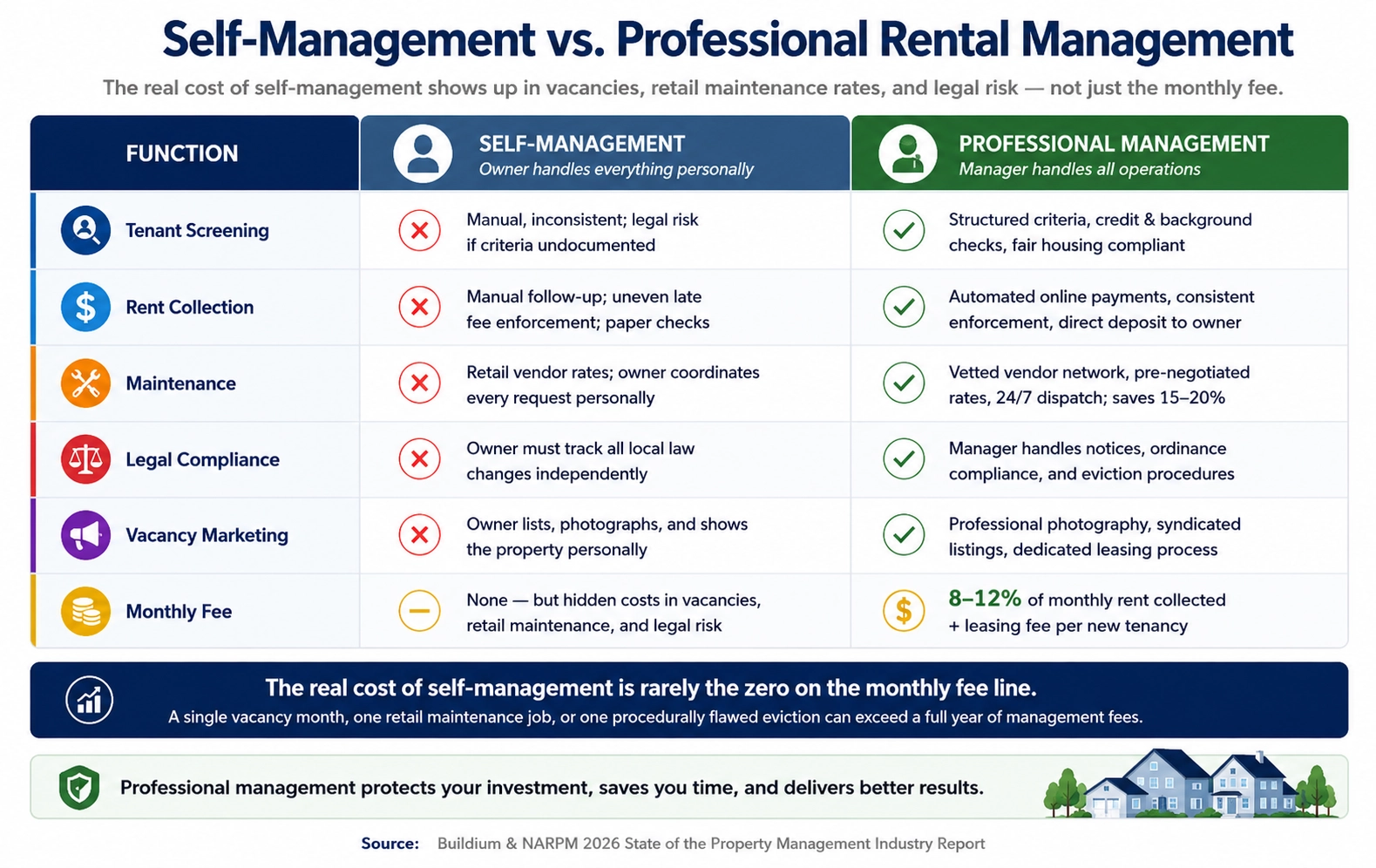
Self-managing a rental property works for some owners, particularly those with one or two properties in their local area and the time to handle tenant issues personally. But the financial case for professional management is often stronger than the headline fee comparison suggests. The real cost of self-management shows up in extended vacancies, maintenance paid at retail rates, and legal mistakes that could have been avoided.
Here is an honest side-by-side comparison of how the two approaches differ across the functions that matter most.
The math on self-management often looks more favorable than it actually is. A single month of extended vacancy, one maintenance job sourced at retail pricing, or one eviction handled incorrectly can exceed a full year of management fees. Those are tail risks that most self-managing owners do not fully account for until one of them materializes.
If you are still deciding, 22 Tips for First-Time Rental Property Owners walks through the full setup process and the point at which professional management tends to make the clearest financial sense.
Costs of Rental Management Services
Rental property management cost is the first thing most owners ask about, and the most commonly misunderstood. The monthly percentage is just one of several fees in a typical management agreement. Owners who negotiate only on that number often end up surprised by the total. Here is a full breakdown of every fee category you are likely to encounter, with verified 2026 ranges.
On a property renting for $2,000 per month, a 10% management fee costs $2,400 per year. Add one leasing fee of $1,000 to $2,000 per new tenancy and the total annual cost for a steady tenancy runs roughly $3,400 to $4,400. Set against the time, risk, and operational overhead of self-management - particularly the cost of a single vacancy month or maintenance emergency - most owners with more than one property find this a net positive on their returns.
Want to explore rental property management cost in detail? See how management fees compare to the true cost of self-managing your portfolio. Explore rental management software options.
Benefits of Hiring a Rental Management Company
The case for working with a rental management company is not primarily about convenience. For most rental owners with more than one property, or with any property outside their immediate area, it is a return-on-investment question. Here is where the value actually shows up in measurable terms.
Lower vacancy rates
Professional rental management companies have active marketing systems, professional photography, broad listing distribution across major rental platforms, and streamlined leasing workflows. They use current market data to price rentals accurately rather than relying on guesswork or outdated comps. The result is shorter vacancy periods, and since every vacant day is direct revenue loss, this advantage alone often justifies the management fee for owners who have experienced a slow lease-up.
Better tenant quality
Consistent, documented tenant screening produces better tenants over time. Property management companies with structured criteria and technology-enabled background checks catch problems that self-managing landlords frequently miss. Fewer problem tenants means fewer evictions, less property damage, and lower turnover -- all of which compound into meaningfully better returns across a portfolio.
Lower maintenance costs
Access to a vetted vendor network is one of the most financially underestimated benefits of professional management. Pre-negotiated labor rates and established vendor relationships save owners 15 to 20 percent on maintenance costs compared to retail pricing, according to the Buildium and NARPM 2026 Industry Report. For older properties or those with aging mechanical systems, this advantage grows considerably over time.
Legal protection
Landlord-tenant law is local, frequently updated, and unforgiving when violated. Professional rental management companies track ordinance changes, ensure leases include all required disclosures, serve notices with the correct timing and format, and handle evictions through the proper legal process. The cost of a single wrongful eviction lawsuit or fair housing complaint easily exceeds several years of management fees. See 7 Essential Tenant Rights and Rental Owner Obligations for a plain-language summary of what landlords are legally required to provide regardless of whether they self-manage.
Scalability without proportional overhead
Self-management does not scale. Each new property adds a proportional load of maintenance calls, rent follow-ups, lease renewals, and compliance tasks. A rental management company absorbs that load at a fixed percentage of collected rent. Owners who want to grow from two units to ten without building their own management operation need this structure to make growth sustainable.
Better technology
The best rental management companies today operate on modern property management software platforms that give owners real-time financial reporting, digital maintenance tracking, online lease execution, and tenant communication tools that most self-managers do not have access to independently. AI-powered tools for lease analysis, maintenance triage, and communication are now part of the standard operational stack at leading firms -- and the 2026 data shows 58% of property management companies are already using some form of AI in their daily operations.
Ready to hire a rental property manager? Get clear on what professional rental management delivers versus what it costs for your portfolio. See what rental management services cover.
Frequently Asked Questions
What is rental management and what does it include?
Rental management is the professional oversight of a residential or commercial rental property on behalf of the owner. It includes the full rental property management process: tenant screening, lease management, rent collection, maintenance coordination, property inspections, landlord compliance, and eviction handling when necessary. Full-service rental management services handle all of these functions under a single management agreement.
How does the rental property management process work?
The rental property management process follows a repeating cycle tied to each tenancy. It starts with property onboarding and market pricing, moves through marketing, tenant screening, lease signing, move-in inspection, rent collection, and ongoing maintenance coordination, and finishes with move-out inspection, security deposit reconciliation, and either a renewal or a new lease-up cycle.
What do rental management companies charge?
Most rental management companies charge a monthly management fee of 8% to 12% of collected rent, with a national average around 8.5 to 10%. They also charge a leasing fee of 50% to 100% of one month's rent when a new tenant is placed. Additional fees may apply for lease renewals ($100 to $300), maintenance coordination markups (10 to 20% of invoices), and eviction handling ($200 to $500 plus court costs). Always request a full written fee schedule before signing and compare total annual cost against your expected rental income.
How do I find rental management services near me?
Start with the NARPM directory for licensed property managers in your market. Cross-reference with Google Business listings and local reviews. Ask for references from other property owners in your area, verify licensing with your state real estate commission, and confirm the firm has direct hands-on experience with your specific property type before signing any agreement.
What is the difference between self-management and hiring a rental management company?
Self-management means the owner personally handles tenant screening, rent collection, maintenance coordination, lease management, and legal compliance. A rental management company takes over all of these functions for a percentage of monthly rent. The core trade-off is time, expertise, and legal risk against cost. For most owners with more than two properties, or with properties located outside their immediate area, professional management produces better financial outcomes when total costs including vacancy days, maintenance pricing, and legal risk are compared honestly.
The Bottom Line
Rental management is not a passive income shortcut or a service reserved for hands-off investors. It is the operational infrastructure that determines whether a rental property actually performs the way it is supposed to. For most owners managing more than a couple of units -- or any property that is not just down the street -- it is the difference between a real estate investment that works and one that consistently demands more time and creates more stress than it should.
The best rental management companies bring structured tenant screening, consistent rent collection, vetted vendor networks, legal compliance expertise, and transparent financial reporting to every property they manage. The result is lower vacancy, better tenants, lower maintenance costs, and protection from the legal missteps that most self-managers do not anticipate until they are already expensive.
Whether you are searching for rental management services near me for a first investment property or evaluating firms to take over a growing portfolio, the evaluation criteria are the same: local expertise, transparent fees, documented screening standards, and technology that keeps you informed without demanding your constant attention. Those are the factors that separate the best rental management company in your market from the rest, and they are worth taking the time to verify before you sign.

Expert in Property Management and SaaS
Peter Koch is an expert in property management and SaaS, focused on building top digital tools for property managers and growing technology-driven startups. He specializes in enhancing property management operations through smart software solutions that streamline accounting, automate workflows, and improve community communication. Peter writes about HOA management technology, proptech innovation, and scalable SaaS strategies designed to help modern property professionals operate more efficiently.