




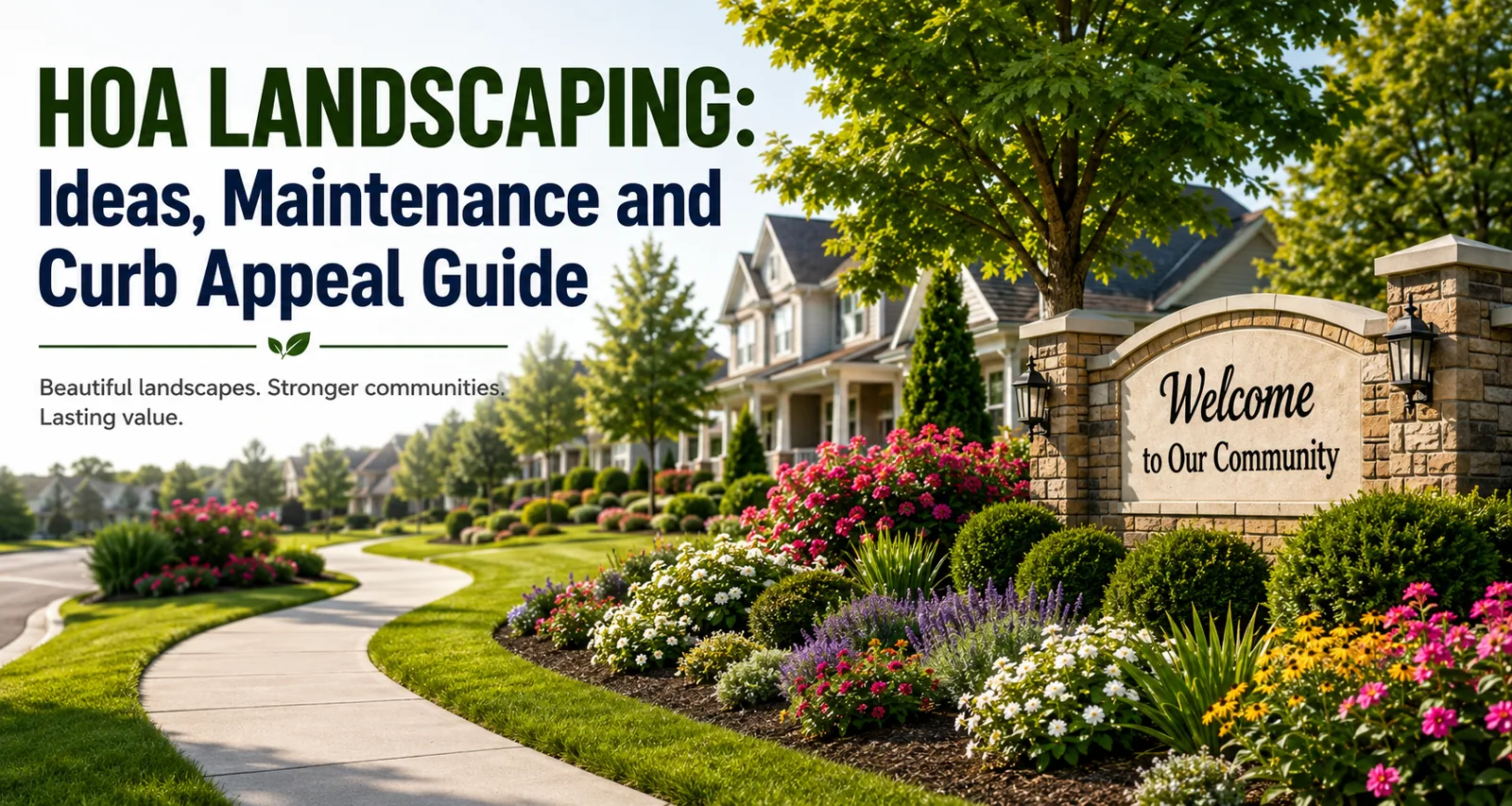
What is HOA landscaping?
HOA landscaping covers the planning, maintenance, and improvement of common areas in a homeowners association, including lawns, entrances, pathways, and shared green spaces. Well-managed HOA landscaping preserves curb appeal, supports property values, and keeps the community attractive for residents and prospective buyers year-round.
A well-landscaped HOA community does more than look good from the street. It shapes how residents feel about where they live, influences what buyers are willing to pay, and tells anyone driving through whether this is a community that takes care of itself. Boards that invest in thoughtful landscaping and common area maintenance tend to see the payoff in higher resident satisfaction, fewer complaints, and stronger long-term property values.
This guide covers the full scope of HOA landscaping: planning principles, cost-effective maintenance strategies, entrance and curb appeal improvements, vendor selection, and how to get residents genuinely engaged in keeping the community looking its best.
Why HOA Landscaping Matters for Property Values and Community Life
The connection between landscaping and property values is well-documented. According to the National Association of Realtors, homes in HOA communities are worth 5 to 6% more on average than comparable homes without an HOA, and curb appeal is one of the primary reasons buyers are willing to pay that premium. Landscaping accounts for a meaningful share of that premium.
Research published in Environment and Planning found that converting vacant urban lots into green spaces in Philadelphia increased adjacent home values by up to 30%. A separate USDA Forest Service study found that a 1% increase in tree canopy coverage in Tampa, Florida was associated with a home sale price increase of more than $9,000. These are city-scale findings, but the principle applies directly to HOA common areas: maintained green spaces and tree coverage add measurable value to every home in the community.
USDA Forest Service tree canopy study
Beyond property values, there is the resident experience. According to data from the Foundation for Community Association Research (FCAR), 86% of HOA residents rate their community experience as good or very good, and landscaping is the most common service included in HOA dues across U.S. associations. When landscaping is consistently maintained, residents notice. When it slips, it generates the most visible complaints a board can receive.
Community Association Fact Book (FCAR)
Planning Your HOA Landscaping Program

Here are the 6 steps to a successful HOA landscaping program.
Step 1: Assess Your Community Needs
• Walk the community and identify strengths, issues, and maintenance needs.
• Review resident feedback and board priorities.
• Consider site conditions, drainage, sun exposure, and plant health.
Goal: Understand your community's unique landscape needs.
For a comprehensive framework covering all common area maintenance tasks, the HOA maintenance checklist covers inspection schedules and priority categories boards commonly use.
Step 2: Set Standards and Objectives
• Define the level of service and appearance standards.
• Establish measurable objectives and expectations: frequency, response times, and quality.
• Document standards in governing documents and vendor contracts.
Goal: Create clear, enforceable standards and measurable goals.
For guidance on drafting enforceable standards, the HOA rules and regulations guide covers how to structure community standards so they are consistently applied.
Step 3: Develop Your Landscape Plan
• Plan for turf, plants, trees, irrigation, hardscape, and common areas.
• Include seasonal color, mulch, soil health, and water management.
• Plan for enhancements and long-term replacement needs.
Goal: Build a plan that is beautiful, sustainable, and budget-conscious.
Step 4: Budget Effectively
• Obtain cost estimates based on your plan and standards.
• Build a realistic annual budget and reserve for future improvements.
• Review and adjust annually as needed.
Goal: Align landscape expectations with a sustainable budget.
For a board-level breakdown of how to structure operating and reserve budgets, see the HOA budgeting complete guide. For reserve fund planning specific to landscaping capital projects, see HOA reserve funds.
Step 5: Select and Manage Your Vendor
• Solicit proposals with a detailed scope of services.
• Verify insurance, licensing, references, and HOA experience.
• Monitor performance regularly and enforce contract terms.
Goal: Partner with a reliable vendor and hold them accountable.
Step 6: Monitor, Communicate, and Improve
• Communicate with residents about projects and updates.
• Conduct regular inspections and document results.
• Review the program annually and pursue continuous improvement.
Goal: Maintain transparency and continuously improve your landscape program.
HOA Landscaping Ideas for Common Areas
HOA Entrance Landscaping: First Impressions Drive Perceived Value
The entrance to an HOA community is the single highest-impact landscaping location in the entire property. Every resident passes it daily. Every visitor and prospective buyer forms an immediate impression from it. Boards that invest in entrance landscaping consistently report that it has the highest visible return of any landscaping expenditure.
Effective HOA entrance landscaping combines several elements: a clearly maintained sign with clean sight lines, seasonal flowering plants or low-maintenance ornamental grasses, appropriate uplighting for visibility and ambiance, and hardscape features like decorative boulders or pavers that do not require ongoing replanting. The goal is an entrance that looks well-maintained even during low-maintenance seasons.
HOA entrance landscaping has seen search interest grow 200% over the past three months, which tracks with a broader trend of boards prioritizing visible curb appeal investments over less visible infrastructure.
Common Area Lawn Care and Maintenance
Consistent lawn care and mowing schedules form the baseline of any HOA landscaping program. Uneven mowing, scalped edges, or unaddressed brown patches are the first things residents notice and the first things prospective buyers photograph. A well-managed HOA lawn maintenance program specifies mowing frequency by season, edging requirements along sidewalks and curbs, and protocols for managing irrigation during drought conditions.
HOA lawn care and HOA lawn maintenance are both growing search terms, driven by boards actively looking for vendor guidance and residents looking to understand what their association covers. Boards that proactively publish their lawn care standards in community communications tend to see fewer "why isn't the lawn being mowed" calls.
Landscaping Green Spaces and Community Gardens
Common green spaces, beyond lawns and entrance medians, offer communities an opportunity to build something residents actually use. Community gardens, in particular, have become a meaningful engagement tool for HOAs in suburban and urban-adjacent communities. When residents can sign up for a dedicated plot, maintain it, and see their contribution in the shared space, their connection to the community deepens.
Shaded seating areas, benches along walking paths, and picnic spots with appropriate lighting also encourage residents to use common spaces rather than pass through them. Spaces that get used get cared for. Spaces that sit empty tend to generate complaints.
Drought-Tolerant and Sustainable HOA Landscaping
Eco-friendly landscaping choices are increasingly practical rather than just aspirational, particularly in states with water restrictions. Florida HOAs operating under the state's Florida-Friendly Landscaping principles, outlined in Florida Statute 373.185, are required to allow drought-tolerant native plants even when they do not match a community's traditional aesthetic standards.
Beyond compliance, drought-tolerant landscaping reduces irrigation costs, which can be a meaningful line item in HOA operating budgets in warmer climates. Native plants also require less fertilizer and fewer treatments, reducing both ongoing cost and maintenance complexity. The Community Associations Institute recommends that boards actively evaluate water usage across common areas and develop guidelines that encourage sustainable species choices, a standard outlined in CAI's sustainable landscaping policy.
CAI sustainable landscaping policy
For boards looking to reduce landscaping costs without reducing visual quality, the shift to drought-tolerant species is often the highest-return category of change available.
Walkways, Pathways, and Shared Hardscape
Walkways and shared pathways tend to fall into deferred maintenance until they become a liability issue. Cracked sidewalks, uneven pavers, and broken curbing are not just eyesores but slip-and-fall risks that expose the association to claims. A regular inspection cycle that identifies and remedies hazards before they become incidents is far cheaper than reactive repairs.
Improvements to pathways, including solar-powered lighting, clearly marked crossings, and benches at regular intervals along longer trails, make walkways more usable and more attractive. Communities with well-lit, well-maintained walking paths consistently report higher resident use of common outdoor spaces.
Community Beautification: Public Art and Entryway Features
Murals, sculptures, and decorative features are higher-commitment projects but can have outsized community identity impact. The key is ensuring any public art installation reflects a community-wide conversation rather than a single board member's preference. Residents who have input in what goes up are far more likely to take pride in it.
Entryway features like water elements, decorative stones, or curated seasonal plantings around signage are lower-cost alternatives that still create visual landmarks. A neighborhood whose entrance clearly announces that someone cares about it communicates quality to everyone who passes through.
HOA Landscape Maintenance: Standards, Vendors, and Common Mistakes

What an HOA Landscape Maintenance Program Should Cover
A complete HOA landscape maintenance program is more than a mowing contract. It should address: routine mowing, edging, and blowing; seasonal color rotations; irrigation system inspection and repair; fertilization and pest management; tree and shrub trimming; mulching and ground cover replacement; and drainage and erosion control. Boards that specify all of these in their vendor contracts avoid the "that's not in scope" conversation when problems arise.
For a full breakdown of what a board-level landscape maintenance program should include, scope by scope, see the HOA landscape maintenance guide.
Choosing an HOA Landscape Company or Maintenance Contractor
Selecting an HOA landscape maintenance company is one of the most consequential vendor decisions a board makes. Common mistakes include choosing the lowest bid without reviewing scope, renewing contracts year over year without rebidding, and failing to include performance standards and cure periods in the contract language.
When evaluating vendors, boards should request a detailed written scope of services, ask for references from communities of comparable size, verify licensing and insurance, and clarify how change orders and additional work are priced. An HOA landscape company with HOA-specific experience understands community standards, resident communication expectations, and the difference between a homeowner's individual preference and an enforceable guideline.
Search interest in HOA landscape company and HOA landscape maintenance company has both grown meaningfully over the past three months, suggesting more boards are actively sourcing vendors or reconsidering current contracts.
Common HOA Landscaping Maintenance Mistakes
Getting Residents Involved in Community Beautification
The most successful community beautification programs are ones residents feel connected to, not ones done to them. Boards that involve homeowners in planning, volunteer in execution, and credit them in communications consistently get better long-term results than boards that handle everything through vendors and post announcements after the fact.
Practical approaches that work:
• Beautification committees: A small resident committee with a board liaison can take ownership of specific projects, freeing the board from operational detail while keeping homeowners invested in outcomes.
• Seasonal cleanup events: Neighborhood cleanup days reduce contractor costs, improve areas that fall between standard maintenance scopes, and create social events that strengthen community connections.
• Community garden programs: Managed plot programs give residents an active stake in a specific common area. Well-run programs have waiting lists, which signals community health to prospective buyers.
• Before-and-after communication: Sharing visual updates of completed projects in newsletters or community communications reinforces the value of HOA assessments and maintains resident trust in board decision-making.
• Incentive programs: Recognizing volunteers publicly, hosting resident appreciation events tied to beautification milestones, or offering small HOA credit incentives for sustained participation all increase ongoing engagement.
Budget-Friendly Landscaping Strategies for HOA Boards
Landscaping does not have to be expensive to be effective. Several high-impact strategies work well at modest cost:
• Phase large projects: Break a comprehensive entrance redesign or pathway upgrade into phases across 2-3 budget years. Phased improvements are easier to fund and maintain momentum.
• Shift to lower-maintenance species: Replacing high-maintenance annual plantings with drought-tolerant perennials reduces both material and labor cost over a 3-5 year period.
• Leverage local business partnerships: Local nurseries, landscaping suppliers, and contractors may provide materials at reduced cost in exchange for community recognition or signage.
• Apply for grants: State and municipal programs frequently offer funding for tree planting, water conservation, and eco-friendly landscaping. Many boards are not aware these programs exist for private communities.
• Resident skill volunteers: Licensed residents with landscaping, design, or construction backgrounds often volunteer expertise when asked directly by the board rather than through a general call for help.
• Rebid vendor contracts: For communities with long-standing vendor relationships, a competitive rebid can reduce costs 15-25% without changing service quality.
Frequently Asked Questions
How much does HOA landscaping cost?
HOA landscaping costs vary by community size and services. Small communities may spend $1,500 to $4,000 monthly, while larger properties with complex landscaping often pay significantly more.
Can HOA residents be required to maintain their own lawn?
Yes. HOAs may require homeowners to maintain lawns according to community standards outlined in governing documents, including mowing, weed control, and landscaping appearance requirements.
How do you choose an HOA landscape maintenance company?
Choose an HOA landscaping company by comparing detailed bids, checking references, verifying insurance, and reviewing service standards, communication practices, and HOA-specific experience.
What are the best HOA landscaping ideas for curb appeal on a budget?
Budget-friendly HOA landscaping ideas include entrance improvements, drought-tolerant plants, regular mowing, edging, updated signage, and community cleanup events to improve curb appeal affordably.
Does better landscaping actually increase HOA property values?
Yes. Quality landscaping improves curb appeal, supports higher home values, attracts buyers, and contributes to stronger overall property value performance within HOA communities.

Content Writer
Dann is a real estate and property management content strategist specializing in HOA operations, financial management, and community governance. He works closely with industry professionals to produce accurate, practical guidance for property managers and HOA boards.