




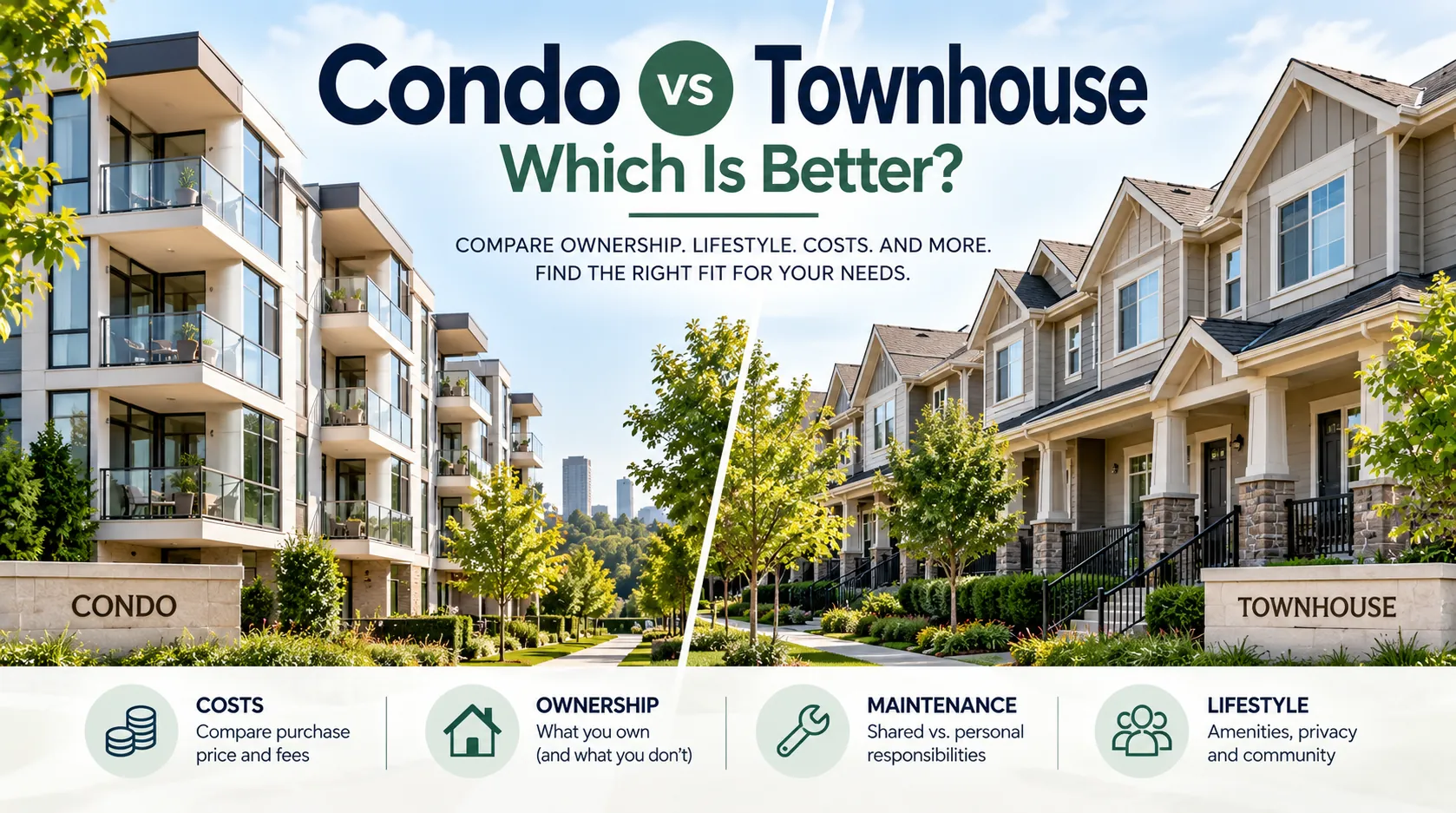
A condo is an owned unit in a shared building. A townhouse is an attached, multi-level home. The condo and townhouse difference mostly comes down to upkeep, control, space, and privacy. Condos often mean less day-to-day care and more shared services. Townhouses often mean more room, more privacy, and more work for the owner.
Choosing between them depends on how much space, privacy, maintenance, and community structure you want. A condo suits buyers or renters who want ease and shared perks. A townhouse fits people who want more room and a more home-like feel without the full cost of a detached house. This guide compares condo vs townhouse living side by side, with apartment context where it helps.
Which Is Better: A Condo or a Townhouse?
A condo is usually better if you want less day-to-day care, shared amenities, and a home that is easy to leave for trips. A townhouse is usually better if you want more private space, more than one level, a direct entry, and a stronger home feel. Neither option is always best. The right choice depends on your budget, your routine, how much upkeep you want, and how much you want to follow community rules.
For owners, boards, and managers, the choice also changes how the community is run. Condo communities often need more shared-area coordination. Townhouse communities may mix private-owner work with tasks the association handles.
The Quick Decision Summary
If you are comparing townhouse vs condo vs apartment options, start with your life, not the label. The same term can mean different things in different markets, buildings, and legal setups, but the trade-offs are usually clear.
Choose a Condo If You Value
- Less personal upkeep
- Shared perks such as lobbies, fitness rooms, pools, lounges, parking areas, or landscaped spaces where available
- A smaller home that is easier to clean and maintain
- A community where many building choices are handled together
- City living or high-density living, depending on local supply
Choose a Townhouse If You Value
- More separation from neighbors than a typical apartment-style condo
- A private entry and, in many cases, a garage, patio, small yard, or more than one floor
- A layout that feels closer to a single-family home
- More control over your immediate living space, based on community rules
- Room for work areas, storage, or bedrooms on separate levels
Choose an Apartment If You Value
- Renting instead of owning
- Flexibility to move without selling a property
- A landlord or property manager handling most maintenance
- Lower commitment than buying a condo or townhouse
- Managed housing without association ownership duties
Condo, Townhouse, and Apartment Basics
A condo is a form of ownership, not just a building style. When you own a condo, you usually own your unit and share the common areas through a condo association or HOA. These shared spaces may include hallways, roofs, elevators, amenities, landscaping, building systems, and outside parts, depending on the rules.
A townhouse is usually a multi-level home attached to one or more neighbors. Townhouses may be owned on their own, governed by an HOA, set up as condos in some markets, or rented like apartments. The word townhouse often describes the physical style, while the legal setup and upkeep depend on the community.
An apartment is most often a rental unit in a larger property owned by a landlord or investment group. Tenants do not build equity in the unit and usually do not vote on association matters. They also avoid many ownership duties. That is why townhouse vs condo vs apartment can be confusing: one term is about ownership, one is often about design, and one usually means a rental.
Ownership and Control Are Different
The biggest difference between a condo and a townhouse is often the balance between ownership and control. Condo ownership usually gives you control of the inside of your unit, while the association handles many shared parts. That can be convenient, but it can also mean approval is needed for some upgrades, rentals, pets, parking, or outside changes.
Townhouse ownership may offer more control, especially when the owner is responsible for more of the structure or yard. However, townhouse communities can still have HOA rules covering exterior colors, landscaping, parking, fencing, rentals, design changes, and common-area use. Before you choose either option, review the rules, the budget, the upkeep duties, the insurance rules, and the reserve plan.
Condo Ownership Often Means
- More shared decisions through a condo association
- More common-area care paid for by monthly fees
- Less direct duty for outside parts of the building
- More rules for shared spaces, noise, amenities, and building access
- A stronger need for clear communication between residents, board members, and managers
Townhouse Ownership Often Means
- More personal duty for the home's outside or structure, based on the papers
- More separation and a private entry than many condo units
- HOA oversight that may be lighter or focused on matching outside looks and shared grounds
- More need to know what you maintain and what the association maintains
- A life that may feel closer to owning a detached home, with fewer total duties
Which Option Is Cheaper to Run?
The cheaper option depends on the purchase price or rent, fees, insurance, utilities, upkeep, and what those fees cover. A condo may have higher monthly fees because more building systems and shared perks are managed together. But those fees may also pay for services a townhouse owner would pay for separately. A townhouse may have lower HOA fees in some communities, yet owners may pay more for repairs, utilities, yard care, or outside work.
When comparing condo vs townhouse costs, do not look only at the monthly payment. Ask what is included, what is not, and what future bills may look like.
- HOA fees: the amount, when they are due, what they cover, and whether the community has special assessments
- Maintenance duty: who handles roofs, siding, windows, doors, balconies, landscaping, driveways, garages, plumbing, and shared systems
- Insurance coverage: what the association master insurance policy covers and what you must insure yourself
- Utilities: heating, cooling, water, trash, internet, electricity, and shared utility setups
- Amenities: they can add value, but they also need funding, care, booking, and rules
- Long-term reserves: a well-run community should plan for major repairs; weak reserves can mean surprise costs
Privacy, Space, and Layout Shape Daily Life
Condos often share more walls, floors, ceilings, entries, hallways, elevators, and amenities. That can be a good fit if you like being close to services, neighbors, and shared conveniences. It can also mean more awareness of building rules, quiet hours, package areas, guest access, and shared parking.
Townhouses usually give more of a private-home feel. Many have separate entrances, a vertical layout, attached garages, patios, or small outdoor spaces. Shared walls are still common, but you may not have neighbors above or below you, which can make the home feel more private.
A Condo May Feel Better If You
- Travel often and want a low-maintenance home base
- Prefer elevators or single-level living, where available
- Like shared amenities and organized common areas
- Do not want to manage outside tasks yourself
- Are comfortable living close to neighbors
A Townhouse May Feel Better If You
- Want bedrooms and living spaces separated by floors
- Need more storage, workspace, or family space
- Prefer a private entrance over a shared hall
- Want some outdoor space without owning a detached house
- Are willing to take on more upkeep for more independence
Rules, Governance, and Community Management Matter
Both condos and townhouses can come with association rules. These rules protect the appearance, operations, finances, and comfort of the community, but they also limit what individual residents can do. The experience depends a lot on how well the association communicates and how clearly duties are written down.
In a condo community, governance may be more intense because more property is shared. Residents may need coordination around elevators, security, building access, amenities, maintenance schedules, package rooms, waste areas, parking, and noise policies. If communication is poor, small issues can become frustrating fast because many residents rely on the same systems.
In a townhouse community, governance may focus more on outside standards, landscaping, parking, private yards, roofs, roads, shared perks, and design consistency. The community may feel less centralized than a condo building, but residents still need clear rules and responsive management. A missed repair request, a vague fee notice, or uneven enforcement can hurt trust in the association.
Which Is Easier to Maintain?
A condo is usually easier for the resident to maintain because the association handles more shared and outside work. A townhouse may need more owner work, but it can also give you more control over how your home is cared for. The key is to read the rules instead of assuming every condo or townhouse works the same way.
Maintenance differences usually show up in three areas: inside upkeep, outside upkeep, and shared-area upkeep.
Interior Maintenance
- Condo owners usually handle their own inside repairs, fixtures, appliances, floors, and finishes
- Townhouse owners also handle interiors, often across more square footage or more than one level
- Apartment renters usually report problems to a landlord or manager, based on the lease
Exterior Maintenance
- Condo associations often handle many outside parts, though the duty can vary
- Townhouse owners may handle some outside features, such as doors, windows, patios, decks, or small yards
- Apartment renters are generally not responsible for major outside care
Shared-Area Maintenance
- Condo communities may have more shared systems, perks, hallways, elevators, and common spaces
- Townhouse communities may have shared landscaping, roads, gates, play areas, or drainage systems
- Apartment communities are managed by the property owner or the management company
The easier option is the one whose upkeep matches your expectations. If you dislike arranging repairs, a condo or apartment may feel simpler. If you want more freedom and do not mind extra work, a townhouse may feel better.
Condo vs Apartment vs Townhouse for Renters
Renters often compare condo vs apartment vs townhouse options because all three can be rented. The experience can be very different even when the monthly rent is close. An apartment is usually managed as part of a rental property. A rented condo or townhouse may be owned by a private landlord and sit inside an association community.
A rented condo may give you access to amenities and a more owner-occupied feel, but you may need to follow both the lease and the association rules. A rented townhouse may offer more space, a private entrance, or a garage, but it may also involve yard care or community rules. A traditional apartment may offer more standard leases, easier maintenance, and on-site management, but less unique layout or finish.
If you are asking what is the difference between apartment and condo, the main answer is ownership. For renters, compare who handles repair requests, whether association rules apply, what parking, storage, pets, guests, and amenities are allowed, whether utilities are included or billed separately, and how renewals, deposits, repairs, and communication work.
Resale and Long-Term Fit Deserve Attention
Think beyond the first year. A condo can appeal to buyers who want convenience, location, and amenities, but resale can depend on building condition, association finances, rules, fees, and market demand. A townhouse can appeal to buyers who want more space and a more residential feel, but long-term costs and upkeep still matter.
The best choice is usually the one that fits both your current life and your next stage. A condo may be ideal now if you want simplicity, but a townhouse may fit better if you expect to need more space. On the other hand, a townhouse may feel too maintenance-heavy if your main goal is travel, convenience, or low upkeep.
Before you decide, review the association budget and reserve data, community rules and design standards, upkeep history and upcoming projects, rental limits if you may rent later, parking, storage, pets, noise, and amenity rules, insurance duties, and any planned fee increases or assessments shared during the sale or lease review.
The Final Recommendation
Choose a condo if your top goal is convenience, shared amenities, and less outside upkeep. Choose a townhouse if you want more room, more privacy, and a layout that feels closer to a traditional home. Choose an apartment if flexibility, renting, and low ownership duty matter more than equity or long-term control.
The best answer is not just condo vs townhouse. It is whether the home, rules, costs, and community setup fit the way you actually live. Well-run communities make either choice easier because residents know where to find help, how to ask for it, and what duty belongs to whom.
Whether you live in a condo, a townhouse, or manage one of these communities, staying organized makes life easier for everyone involved. ManageCasa helps boards and property teams handle communication, maintenance, and payments in one place. See how the HOA management platform supports condo and townhouse associations, explore the rental management platform if you're renting out a condo or townhouse, or check current plans and pricing to find the right fit.
Frequently Asked Questions
Is a townhouse a condo?
Not usually. A townhouse is a physical style, an attached, multi-level home, while a condo is a form of ownership. A townhouse can be structured as a condo in some markets, but most townhouses involve individual ownership of the structure itself, with an HOA managing shared areas rather than the building.
What's the difference between a condo and a townhouse?
The main difference is ownership and maintenance scope. Condo owners own their unit's interior while an association maintains the exterior and common areas. Townhouse owners typically own more of the structure itself, including some exterior elements, and take on more direct maintenance responsibility in exchange for more control.
Which is cheaper, a condo or a townhouse?
It depends on the market and what the fees cover. Condos often carry higher monthly association fees because more building systems and amenities are managed collectively, but a townhouse owner may pay more out of pocket for exterior repairs the association would otherwise handle in a condo.
What's the difference between an apartment, a condo, and a townhouse?
Ownership is the key distinction. An apartment is rented from a landlord, a condo is an individually owned unit with shared common areas, and a townhouse is an individually owned, multi-level home attached to neighboring units. All three can be available as rentals, but only condos and townhouses build equity for the owner.
Do townhouses come with HOA fees?
Many do, though not all. Townhouse communities are frequently governed by an HOA that collects fees for shared landscaping, roads, or amenities, but the fees are often lower than condo association fees since townhouse owners typically maintain more of their own structure directly.

Content Writer
Dann is a real estate and property management content strategist specializing in HOA operations, financial management, and community governance. He works closely with industry professionals to produce accurate, practical guidance for property managers and HOA boards.