


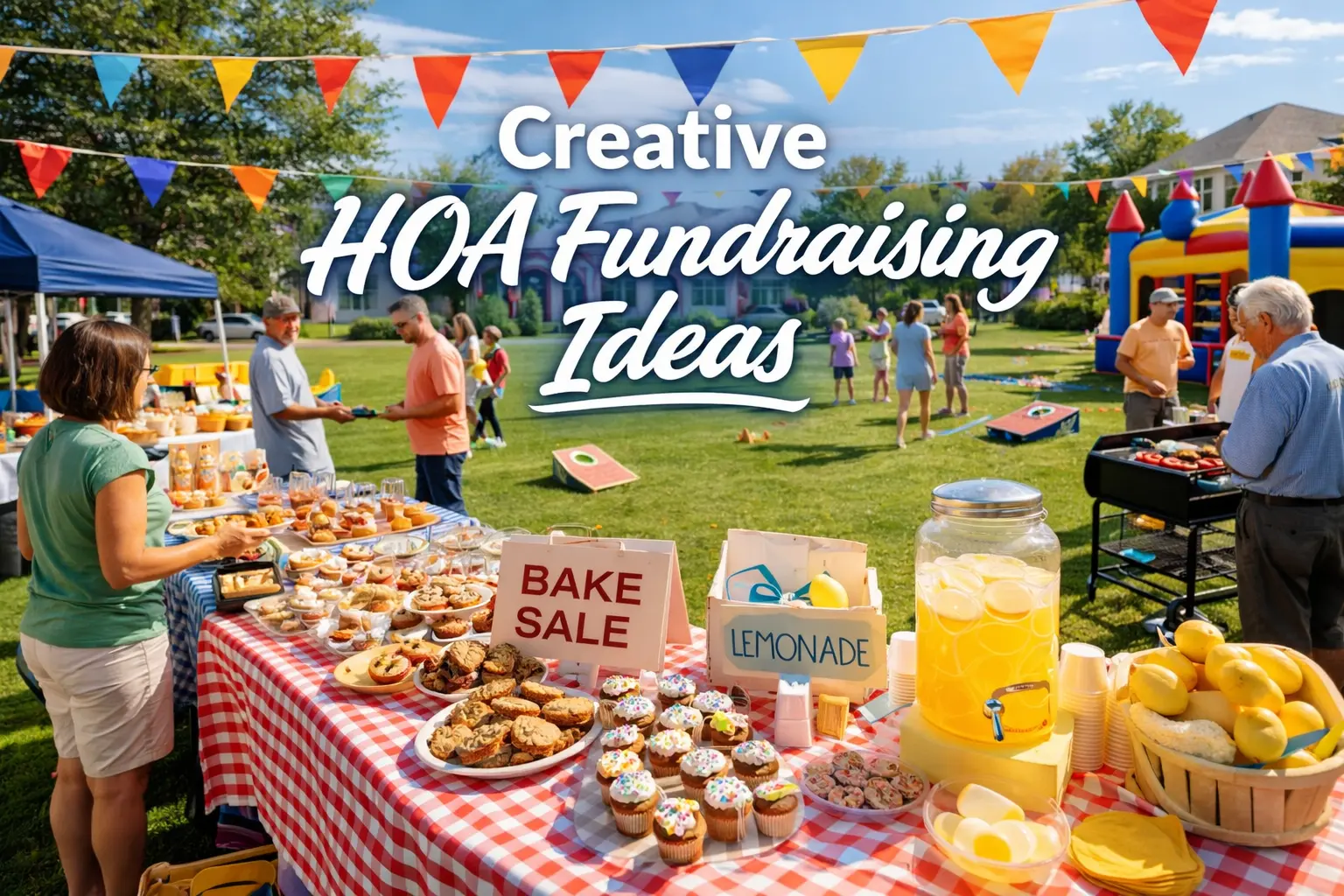
What is HOA fundraising?
HOA fundraising is the process by which a homeowners association raises supplemental funds through community events, sales, sponsorships, or social activities, separate from regular assessments. It serves two purposes: generating revenue for amenities, improvements, or special projects, and strengthening community engagement by bringing residents together around a shared goal.
Most HOA boards raise money the same way every year: they increase assessments. It works, but it is not the only tool available, and it is rarely the one that builds goodwill. A well-run fundraising event can cover costs that would otherwise land on the annual budget, and do it while giving residents a reason to actually show up to something. That combination, revenue plus engagement, is what separates a good HOA social event from one that just costs the association money to run.
The practical reality is that HOA fundraising does not need to be elaborate or expensive to be effective. A community garage sale, a food truck night with a small vendor fee, or a sponsorship arrangement with a local business can raise meaningful amounts without asking the board to become event planners. The ten ideas in this article range from low-effort and low-cost to more involved, so boards at any capacity level have options that fit.
Before planning any fundraising event, boards should confirm that their governing documents permit the association to raise and retain funds from non-assessment sources, and that any event complies with local permitting requirements. For an overview of how fundraising fits into broader HOA financial management, including how supplemental funds interact with the operating and reserve budget, that context is worth having before you start.
Why HOA Fundraising Is Worth Doing
The case for HOA fundraising is not just financial. Associations that run regular community events and social activities consistently report stronger owner satisfaction and lower rates of dispute and delinquency. When residents feel connected to their community, they are more likely to follow the rules, pay on time, and volunteer for committees. Fundraising events create that connection without requiring the board to become a social coordinator full-time.
On the revenue side, even modest fundraising totals can fund meaningful improvements. A community garage sale that raises $1,500 might cover the cost of new playground equipment, a landscaping upgrade to a common entry feature, or a portion of an amenity repair. None of those things need to come from a special assessment if the board builds a habit of supplemental fundraising year over year.
Governing document check: Before running any fundraising activity, confirm that your declaration and bylaws permit the association to solicit funds, enter arrangements with sponsors, or run commercial-style events on common property. Some declarations restrict how funds can be raised or how non-assessment revenue can be used. Review with qualified HOA counsel if the documents are ambiguous.
10 HOA Fundraising Ideas That Work
These ideas are ordered roughly from lowest effort to highest, so boards can match the approach to their available volunteer capacity and community size.
1. Community Garage Sale
A community-wide garage sale is the most consistently effective HOA fundraising event because the residents do the work. The association organizes a single weekend date, advertises the event to drive external foot traffic, and charges each participating household a small table or registration fee, typically $15 to $30. A community of 80 households with 40 participants at $20 each raises $800 with minimal board effort. Some associations add a baked goods table or refreshment stand run by the social committee to increase revenue further.
The key to a successful HOA community garage sale is external advertising. Post the event on local Facebook groups, Next door, and community boards at least two weeks in advance. The more non-resident foot traffic the sale draws, the more participating households earn and the more likely they are to participate again next year.
2. Food Truck Night with Vendor Fee
Food truck events have become a reliable format for HOA social events because they require almost no logistics from the board. The association arranges for one or more food trucks to park in a common area on an agreed evening, charges each truck a modest vendor fee for access to the community's foot traffic, and promotes the event to residents. Vendor fees of $100 to $200 per truck are common. A two-truck event can net $200 to $400 while giving residents a genuinely enjoyable evening at no cost to themselves.
Boards should check local permitting requirements for temporary food vendor events and confirm that the common area can accommodate vehicles of that size. Once the format is established it tends to repeat well, with the same vendors often returning season to season.
3. Seasonal Decorating Contest with Entry Fee
Decorating contests for Halloween, winter holidays, or spring are natural HOA community events that residents often enjoy regardless of any fundraising component. Adding a modest entry fee, typically $5 to $15 per household, turns the event into a light fundraiser. Judging can be done by a small volunteer committee or by resident vote via a simple online poll. Prizes do not need to be expensive; local business sponsorships (a gift card from a nearby restaurant or home improvement store) keep costs near zero while adding perceived value.
This format works well for the HOA social committee because planning is light, participation is voluntary, and the event creates visible neighborhood energy that non-participants also enjoy.
4. Local Business Sponsorships
Many local businesses, particularly real estate agents, insurance brokers, landscaping companies, and home service providers, actively seek opportunities to advertise to concentrated homeowner audiences. An HOA with 100 or more households represents a meaningful marketing opportunity. Boards can offer sponsorship tiers in exchange for logo placement in the community newsletter, signage at events, or a featured mention in the owner portal.
Sponsorship arrangements need to be structured carefully. The agreement should be in writing, specify exactly what the sponsor receives, and avoid any language that implies the association endorses the sponsor's services. A simple one-page agreement reviewed by HOA counsel is sufficient. Annual sponsorship packages of $250 to $1,000 are realistic for mid-size communities depending on the market and the sponsor's business type.
5. Skill-Share Workshop Series
Residents with professional skills in areas like home maintenance, gardening, cooking, or finance often enjoy sharing them in a low-key community setting. The HOA social committee can organize a monthly or seasonal workshop series, charge a small attendance fee ($10 to $20 per session), and use a community room or covered common area as the venue. Costs are minimal because the presenter is a community member volunteering their time.
Workshop topics that tend to draw well include: seasonal home maintenance, basic plumbing repairs, container gardening, and personal finance fundamentals. Events like these also identify community members with expertise and initiative, which is often where future board and committee volunteers come from.
6. Community Movie Night
An outdoor movie night is a reliable HOA event for adults and families, low-cost to run and consistently well-attended in communities with usable common green space. The association rents or borrows a projector and screen, obtains a public performance license for the screening (required for commercial films shown outside a private home), and charges a small admission or sells concessions. A modest concession stand selling popcorn, drinks, and snacks at a small markup can net $200 to $500 depending on attendance.
Public performance licensing: Showing a commercial film at a community event requires a public performance license, even on private HOA property. Licences are available through providers such as Swank Motion Pictures and Criterion Pictures. License fees typically range from $75 to $300 per screening depending on the film and audience size. Do not skip this step — unlicensed public screenings carry copyright liability.
7. Themed Potluck Dinner with Raffle
A themed potluck dinner, where residents bring a dish aligned to a cuisine or season theme, costs the association almost nothing in food and creates a strong social event with a natural fundraising mechanism: a raffle. Raffle tickets sold at $5 to $10 each with prizes donated by local businesses or contributed by residents can raise $300 to $800 at a mid-size community event. The ticket sales are the fundraising vehicle; the potluck is the draw.
Boards running raffles should confirm that their state does not classify small-scale charitable raffles as regulated gambling. Most states have exemptions for nonprofit or membership organization events below a revenue threshold, but the specific rules vary. A quick check with HOA counsel before the first event avoids a compliance issue later.
8. Dog Walk-a-Thon or Charity Walk
A community walk-a-thon asks participating residents to collect small pledges from friends and family in exchange for completing a set distance. The HOA provides the route (typically a loop of the community), light refreshments at the finish, and a fun atmosphere. Pledge-based events work particularly well in communities with high owner-occupancy and active owner engagement because participants are motivated to solicit outside the community for pledges.
For associations that want to direct proceeds to a specific cause rather than the general fund, a charity tie-in, partnering with a local animal shelter for a dog walk or a local food bank for a community fitness event, can increase participation and press coverage while the HOA retains a portion of proceeds for a specific improvement.
9. Art Fair or Artisan Market
Communities with outdoor common areas and a reasonable population of artisan or small-business residents can run a one-day artisan market as both a community event and a fundraiser. Booth fees from resident and non-resident vendors of $30 to $75 each, combined with a small admission charge or food concession, can generate meaningful revenue. A 20-vendor market at $50 per booth raises $1,000 in booth fees alone before any other revenue is counted.
Artisan markets also draw foot traffic from outside the community, which increases awareness of the neighborhood and can have indirect benefits for property values and community reputation. The logistical requirements are higher than a garage sale, so this works best for communities with an active social committee and at least a few weeks of planning runway.
10. HOA Social Committee Membership Drive
A membership drive for a formal HOA social committee, where residents pay a small annual fee ($20 to $50) to join and receive first notice of and priority access to community events, builds a recurring revenue base while creating a committed group of community volunteers. The committee funds its own small events from membership dues, reducing the call on the general operating budget for social activities.
A social committee structure also distributes the planning work away from the board, which is one of the most consistent pain points in HOA management challenges. When residents own the social programming, the board can focus on governance without also being expected to run every community event.
Planning a Successful HOA Fundraising Event
The difference between a fundraising event that raises meaningful money and one that just breaks even is almost always in the planning, specifically in how clearly the goal is set before any event decisions are made.
After the event, a brief summary of funds raised and what they will be used for, sent to all owners, does more for owner confidence in the board than almost any other communication. It closes the loop and demonstrates that the board handles money transparently.
Common HOA Fundraising Mistakes to Avoid
A few patterns tend to undermine HOA fundraising efforts consistently, and most of them are avoidable with a small amount of upfront planning.
Running Events That Cost More Than They Raise
Every fundraising event has costs: supplies, venue setup, permits, prizes, food. Boards that do not build a realistic cost model before committing to an event format sometimes find that the event breaks even at best. Before confirming any event, calculate the minimum participation needed to cover costs and hit the target, and decide whether that participation level is realistic for your community.
Failing to Communicate the Purpose
Residents are more likely to participate in and donate to events when they understand what the money is for. An event billed as a fundraiser for new playground equipment draws better than one described simply as a community social event with a raffle. Be specific about the goal in all promotional materials.
Over-Relying on the Board to Run Everything
Boards that take on all planning and execution for HOA community events burn out quickly and produce fewer events over time. The most sustainable HOA social activities are run by a volunteer committee with a clear mandate and modest budget authority. The board sets the policy and approves the budget; the committee runs the event.
Skipping the Legal and Permitting Check
A public performance license for a movie night, a food vendor permit for a food truck event, or a raffle compliance check for a state with gambling regulations are not bureaucratic formalities. They are the board's responsibility. Skipping them creates liability for the association and, in some cases, for individual board members.
Running events and managing community communications in one place? See how purpose-built tools support owner communications, event coordination, and financial tracking: managecasa.com/capabilities/management.
Frequently Asked Questions
What are the most effective HOA fundraising ideas?
Effective HOA fundraising ideas include community garage sales, food truck nights, sponsorships from local businesses, movie nights, and seasonal events that encourage resident participation and community engagement.
Can an HOA legally raise money through fundraising?
Most HOAs can legally raise money through fundraising if their governing documents permit non-assessment revenue. Boards should review bylaws and consult legal counsel before organizing fundraising activities.
Do HOA fundraising events require permits?
Yes. Some HOA fundraising events require permits for food vendors, amplified music, or public gatherings. Boards should check local municipal requirements before hosting community events.
How do you get residents to participate in HOA social events?
Resident participation improves when events are fun, affordable, well-promoted, and provide social value. Personalized communication and advance notice usually increase attendance and engagement.
What should an HOA do with money raised through fundraising?
HOAs should allocate fundraising proceeds toward clearly communicated community projects, amenities, or beautification efforts. Funds should be tracked separately and disclosed in financial reports to homeowners.

Content Writer
Dann is a real estate and property management content strategist specializing in HOA operations, financial management, and community governance. He works closely with industry professionals to produce accurate, practical guidance for property managers and HOA boards.