




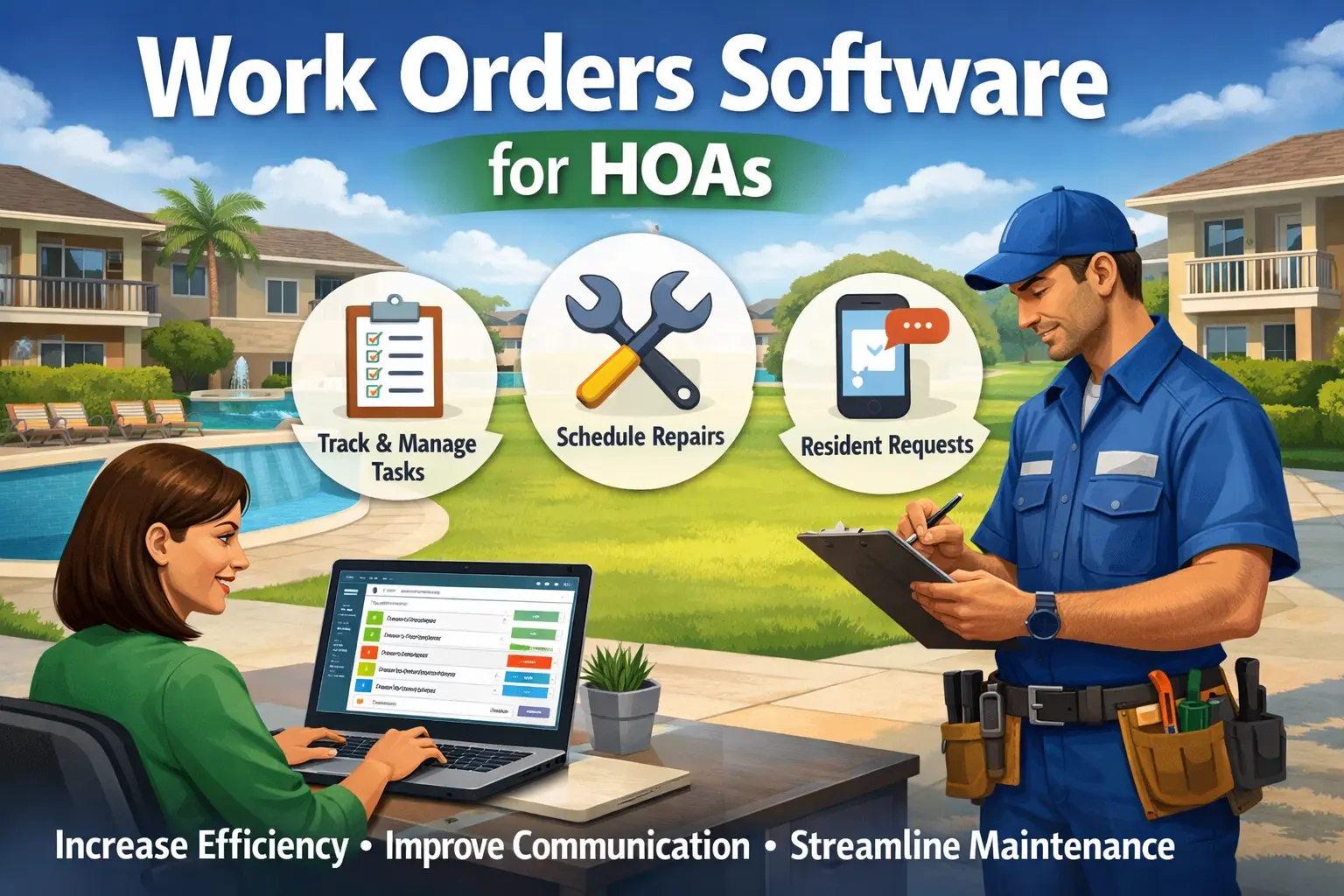
What is HOA work order software?
HOA work order software is a platform that manages the full lifecycle of maintenance requests in a homeowners association, from resident submission through vendor assignment, status tracking, resident notifications, and completion documentation. It replaces spreadsheets and email threads with a structured workflow where every request is logged, assigned, and tracked automatically, giving boards real-time visibility and vendors clear accountability.
If you manage an HOA, you already know how fast a maintenance problem becomes a resident complaint. A pool pump fails on a Friday afternoon. A resident submits a request through whatever channel they happen to use. Nobody confirms receipt. The vendor never gets the call. By Monday, that resident is emailing the board, and two other residents have noticed the same problem and done the same.
Most associations end up in this situation because they are running maintenance on spreadsheets, email threads, and informal phone calls. It works until it does not, and when it stops working, it stops loudly.
The right HOA work order software fixes the underlying structure. Requests come in through one place. Vendors are assigned through the same system and held to a documented timeline. Residents get automatic updates without anyone having to make a follow-up call. Boards can pull a real report on open, overdue, and completed work without asking anyone. This guide covers what that looks like in practice, what separates genuine work order platforms from glorified ticketing tools, and what to look for when you are ready to evaluate options.
Why Spreadsheets Fail for HOA Maintenance Tracking
Spreadsheets are not the problem in themselves. They are just the wrong tool for tracking maintenance across a community with dozens of units, multiple vendors, and residents who expect timely communication. The failure is structural, not a matter of effort.
Requests arrive through too many channels
Email. Phone. Text to a board member's personal number. Someone mentioning it at the pool. When requests come in through five different channels with no single intake point, there is no reliable way to ensure every one gets logged, prioritized, and acted on. Things get missed, not because anyone is negligent, but because no system exists to catch them.
Vendors have no formal accountability
Calling a vendor and asking them to handle something creates zero documentation. If they show up late, do the job incorrectly, or do not show up at all, the only record is a memory of the phone call. Good HOA maintenance tracking formalizes every assignment: the vendor receives a notification, acknowledges the job, and updates status in the system. That record exists regardless of who remembers what.
Residents go dark after submitting
A resident who submits a maintenance request and hears nothing for two weeks does not assume the board is handling it. They assume nothing is being done. That assumption, not the maintenance problem itself, is what generates the call volume, the board meeting agenda items, and the frustration that is hard to walk back. Automatic status updates change this dynamic entirely.
Boards cannot get a straight answer on workload
"How many open maintenance requests do we have right now?" On a shared spreadsheet, answering that question takes 10 minutes and depends on when the file was last updated. With proper HOA maintenance tracking software, that answer is three seconds and a dashboard.
Work Order Software vs. Basic Ticketing Tools: The Difference That Matters
Not everything marketed as work order software actually addresses the structural problem. Some platforms are glorified inboxes. A request comes in, gets logged, and sits in a queue, leaving the manager to chase it the same way they chased emails. The label is not what matters. The workflow is.
Basic ticketing tools handle intake only. There is no structured assignment process, no vendor accountability layer, no automatic resident notifications, and no connection to the rest of community operations. For a very small community with a single person handling everything, this might be adequate. For an HOA managing multiple vendors across common areas, amenities, and unit-specific repairs, it breaks down quickly.
The best work order software for maintenance treats every request as the start of a connected workflow: submission, triage, assignment, vendor updates, resident notifications, completion, and documentation. Managers make decisions. The system handles the logistics. That is the practical difference between a real maintenance management platform and a ticketing inbox with a different name.
What Good HOA Work Order Software Actually Does
There is a wide range in what platforms call work order management. The best maintenance work order software builds a complete workflow around every request, from the moment a resident submits it to the moment a vendor closes it out. Here is what that looks like in practice.
Residents submit through one portal, not your phone
Every request enters the system through one place. Residents submit from a phone or computer, attach a photo, describe the issue, and they are done. The submission is timestamped, linked to the correct unit or common area, and immediately visible to the manager. No missed texts. No "I thought someone else was handling it."
Vendors receive a real assignment, not a phone call
Once the manager reviews the request and creates a work order, the vendor receives a notification with job details and any photos attached. The vendor acknowledges the assignment, updates status as work progresses, and marks the job complete, all within the system. The manager is no longer the relay point between the resident and the vendor. Everything is documented from assignment to completion without manual information transfer.
Residents get updates automatically
Every status change on the work order triggers a notification to the resident: assigned, scheduled, completed. They know what is happening without calling the office. This is consistently one of the most impactful changes communities report when they move from informal processes to structured software, because it eliminates most of the follow-up call volume.
Everything is documented with timestamps
When a vendor marks a job complete, the system logs the timestamp, their notes, and any photos they uploaded. The manager reviews and closes the ticket. Every action from submission to close is in a timestamped audit trail. For HOA maintenance records, this documentation matters when disputes arise about whether something was reported or addressed, and it matters for insurance claims.
Boards get real reporting, not verbal updates
Open work orders. Average resolution time. Overdue items. Cost by vendor or category. Managers can pull any of this in seconds. Boards see clean summaries at meetings rather than verbal updates that nobody can verify. In states with specific recordkeeping requirements, having structured maintenance documentation rather than scattered emails makes compliance significantly easier.
Reactive Maintenance Is Only Half the Job
Most HOAs focus on reactive work orders because those come with complaints attached. However, the maintenance work order software that actually protects communities long-term handles preventive maintenance too.
Scheduled inspections that do not get forgotten
Elevator certifications. Fire suppression checks. Roof inspections. Pool equipment service. These happen on fixed schedules, and if that schedule lives in someone's head or a separate calendar, it is only a matter of time before something gets missed. Good HOA maintenance management software generates recurring work orders automatically on set timelines. The vendor is assigned, the job is tracked, and completion is documented, same as any reactive request. If an annual inspection goes past its due date without being closed, it surfaces on the board's open items report. For a deeper look at what inspections should be scheduled and when, see the HOA maintenance checklist.
Asset history that informs capital decisions
Every pool, every fitness machine, every irrigation zone, every parking lot light has a service history. When that history lives in a structured work order system, managers can see how many times a piece of equipment has been repaired and make an informed decision about replacement. When it lives in a spreadsheet or in someone's memory, that decision gets made on gut feel. Over time, the difference in capital planning quality is significant.
Key point: The communities that use preventive maintenance scheduling well tend to have fewer emergency work orders, lower average repair costs, and more predictable annual budgets. The software pays for itself in avoided emergency vendor rates alone.
How It Works in Practice: Real Scenarios
Pool equipment failure on a Friday afternoon
A resident submits a request through the homeowner portal with a photo of the pump. The manager sees it, creates the work order, and assigns it to the equipment vendor with a documented response window. The vendor receives the assignment, confirms, and shows up Saturday morning. The resident receives a notification when the job is complete. The board sees the work order resolved before Monday, with a full timestamp record.
Irrigation problem spotted during a site walk
A manager notices dry patches along the fence line and submits a request with a photo directly from their phone. It becomes a work order, gets assigned to the landscaping contractor, and is repaired mid-week. The repair is dated, documented, and linked to the irrigation system's service record for future reference.
Water line break on a Saturday night
A resident reports through the portal. The manager gets a push notification, flags the issue as urgent, and assigns the emergency plumbing vendor. The board is notified that an emergency work order is open. The timeline from report to vendor assignment is documented in real time without anyone having to manually log anything.
Annual fire suppression inspection
A recurring work order generates automatically ahead of the inspection due date. The vendor is assigned, the inspection happens, and the vendor uploads the certificate and marks it complete. The board's report shows it closed on time. No one had to remember it was coming. This is what the preventive side of HOA maintenance management looks like when the system is working.
What to Look for in HOA Work Order Software
Not every platform earns the label. Here is what actually separates effective maintenance work order software from a nicer spreadsheet.
Evaluating Your Options
HOA work order software is typically available as a standalone maintenance tool or as a module within a broader HOA operations platform. Both can work, but the integrated approach tends to perform better for most communities because maintenance data connects directly to vendor payments, homeowner accounts, and board reporting without requiring manual export or duplicate entry.
When comparing platforms, look at how vendors are credentialed and whether they can update work orders independently, how residents submit and receive notifications, whether recurring work orders are supported natively, and how the platform handles the connection between completed work orders and vendor invoices. The HOA self-management guide covers how good software changes what is actually feasible for a volunteer board, if you are still deciding whether outside management makes sense.
Note on Florida recordkeeping: Under HB 1203, HOAs face increased documentation requirements. Structured maintenance records in a work order system, rather than scattered emails and spreadsheets, make compliance significantly more manageable. See the HB 1203 guide for specifics: Florida house Bill 1203: What you need to know and how to comply
HOA Work Order Management: Quick Reference Checklist
• Use a single resident submission channel. Close all informal channels once the portal is live.
• Require photos at submission. A photo at intake prevents disputes about what the problem was.
• Give vendors direct system access. Remove the manager as a relay point between vendor and platform.
• Set documented response windows on every work order. Without a deadline, overdue items are invisible.
• Schedule all recurring inspections in the system. Nothing should rely on someone's calendar or memory.
• Build asset service histories. Log every repair against the relevant piece of equipment, not just the location.
• Review open and overdue items at every board meeting. Make it a standing agenda item.
• Confirm vendor invoices match work orders before payment. The match is the control.
ManageCasa includes work order management as part of its HOA operations platform
The full workflow is covered: resident submission through the homeowner portal, manager review and vendor assignment, vendor app access, automatic resident notifications, completion documentation, and board-level reporting. Work orders connect directly to vendor billing and HOA accounting, so operations and finance work from the same data. For communities managing both HOA and rental portfolios, ManageCasa handles work orders across both property types from a single account. Learn more at managecasa.com/capabilities/management
Frequently Asked Questions
What is HOA work order software?
HOA work order software manages the full lifecycle of maintenance requests, from resident submission through vendor assignment, progress tracking, automatic notifications, and completion documentation. It replaces spreadsheets and informal email threads with a structured workflow where every request is logged, assigned, and tracked in one place.
How do HOAs track maintenance requests without dedicated software?
Most HOAs without dedicated software rely on email, phone calls, shared spreadsheets, and informal communication. This approach breaks down as request volume grows: requests are missed, vendors have no formal accountability, residents have no visibility into status, and boards have no reliable data on how maintenance is being handled.
What is the difference between work order software and a ticketing tool?
Ticketing tools handle intake only. Work order software manages the full workflow: intake, triage, vendor assignment, status updates, resident notifications, completion documentation, and reporting. The practical difference is that managers make decisions and the system handles the logistics, rather than managers manually relaying information at every step.
Can small HOAs benefit from work order software?
Yes. Most modern HOA platforms price on a per-unit basis, so small communities pay proportionally less than large ones. The operational benefits apply regardless of community size: fewer missed requests, better vendor accountability, and less time spent on follow-up calls. Self-managed HOAs with volunteer boards often see the most significant time savings.
Does work order software help with HOA compliance?
Yes. A structured work order system creates a timestamped audit trail of every maintenance request, assignment, and resolution. This documentation is valuable in homeowner disputes, vendor disagreements, and insurance claims. In Florida, HB 1203 has increased recordkeeping obligations for HOAs, and having maintenance activity in a structured system makes compliance significantly more manageable than scattered emails.

Expert in Property Management and SaaS
Peter Koch is an expert in property management and SaaS, focused on building top digital tools for property managers and growing technology-driven startups. He specializes in enhancing property management operations through smart software solutions that streamline accounting, automate workflows, and improve community communication. Peter writes about HOA management technology, proptech innovation, and scalable SaaS strategies designed to help modern property professionals operate more efficiently.