




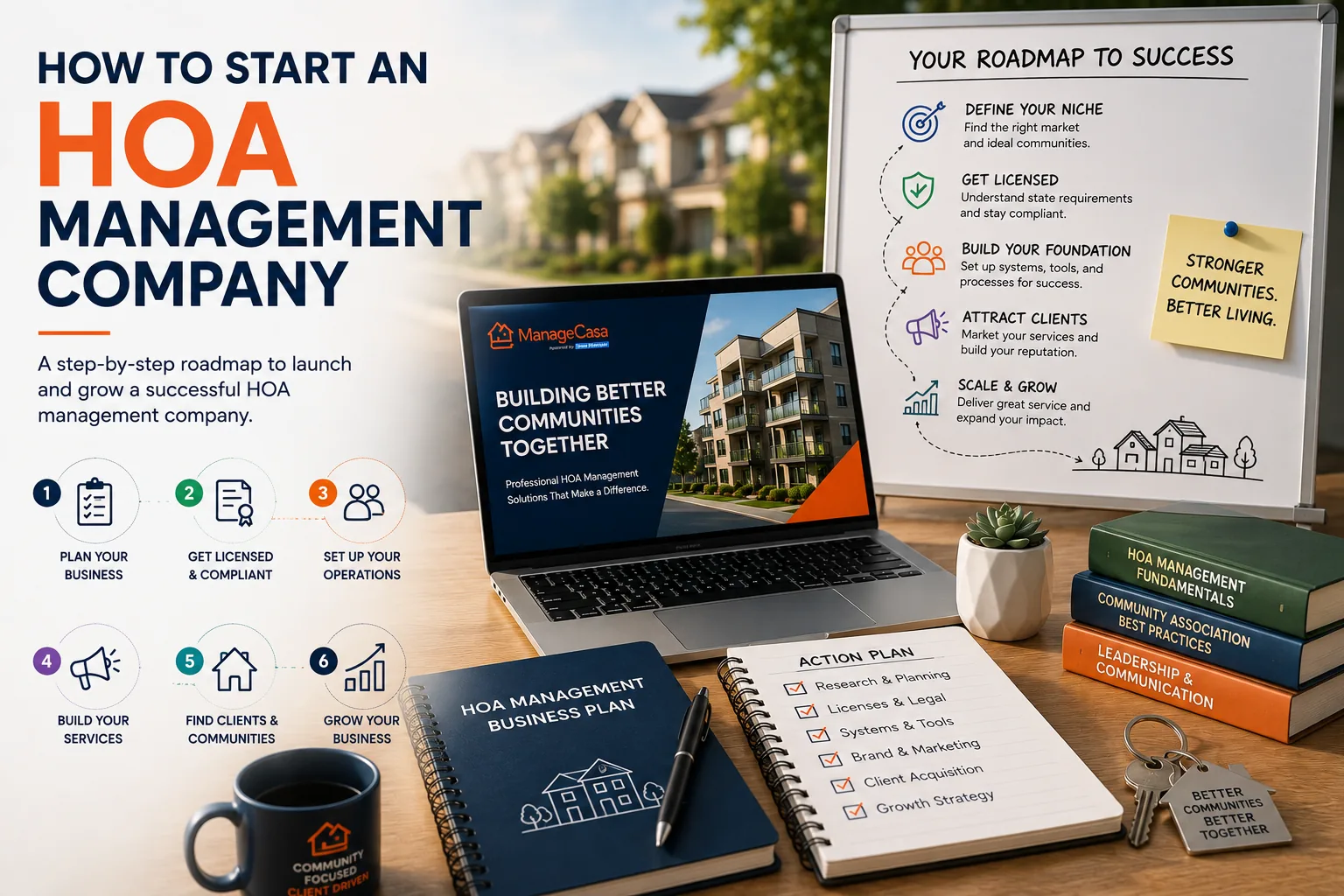
A community association management company provides HOA, condo, and co-op boards with professional oversight of finances, maintenance, compliance, and resident communication for a fee. Starting one typically requires meeting your state's licensing rules (seven states mandate a manager license), forming a business entity, securing insurance and bonding, and setting up compliant trust accounting before you can legally manage associations for compensation.
Community association management is a different business than rental property management, even though the two get lumped together constantly. You're not placing tenants or chasing rent from individual owners. You're serving a board of volunteers, managing shared assets like pools and clubhouses, enforcing covenants that residents sometimes resent, and handling budgets that get scrutinized at annual meetings. The regulatory requirements, the fee structure, and the day-to-day work all diverge from rental management in ways that matter before you start.
This guide walks through the eight steps to start a community association management company: licensing, business formation, insurance, trust accounting, pricing, operations, and landing your first client. If you're deciding between this path and starting a rental-focused business instead, our guide to starting a property management company covers the rental side in depth and explains where the two paths diverge. And if you're weighing starting your own company against simply hiring an existing HOA management company for your own association, that guide covers the hiring side of the same industry.
This article is for general informational purposes and is not legal or financial advice.
Licensing requirements, business formation rules, and insurance obligations vary by state and change through legislation. Consult a licensed attorney and your state's regulatory board before forming a company or beginning community association management activities.
The 8 Steps
Step 1: Understand What the Job Actually Is
Before you register a business, spend time understanding what community association managers actually do day to day: collecting and processing assessments, maintaining reserve funds, coordinating vendors for landscaping and repairs, enforcing architectural and covenant rules, preparing financials for board review, and running or supporting board meetings. Some of that work is administrative, some is financial, and a meaningful part of it is managing conflict between neighbors and enforcing rules people don't always like.
Community association managers are also fiduciaries. In Florida, for example, state regulators explicitly treat CAMs and board members as fiduciaries with a legal duty to the association, not just service providers. That standard shapes everything else in this guide, from licensing to insurance.
Step 2: Check Your State's Licensing Requirements
Licensing is the first real fork in the road, and it varies more than most new operators expect. As of mid-2025, seven states require a license to practice as a community association manager: Alaska, Connecticut, Florida, Georgia, Illinois, Nevada, and Virginia. California runs a voluntary licensure program rather than a mandatory one. In the other states, there's no state-specific CAM license, though most professional managers still pursue a national credential because clients and employers expect it.
Requirements differ significantly by state. Florida requires anyone managing an association with more than 10 units or a budget over $100,000, for compensation, to hold a CAM license through the Department of Business and Professional Regulation: a 16-hour pre-licensing course, a state exam through Pearson VUE, fingerprinting and a background check, and a total cost typically between $485 and $675. Illinois requires 20 hours of pre-license education, a passing exam score, and a $300 application fee. Nevada requires at least 60 hours of instruction, a minimum 12 months of related experience, and a passing score of at least 75% on the state exam.
If you plan to operate in one of the seven licensing states, confirm the current requirements directly with that state's regulatory board before you build a business plan around it. Requirements change: Florida added extra continuing education hours for HOA-focused managers in 2024, and legislative sessions regularly introduce licensing bills in other states.
Step 3: Get the CMCA Credential (Even Where It's Not Required)
The Certified Manager of Community Associations (CMCA) is the closest thing the industry has to a national standard. It's administered by the Community Association Managers International Certification Board (CAMICB), an independent nonprofit established by the Community Associations Institute, and it's accredited by the National Commission for Certifying Agencies and ANSI under ISO Standard 17024.
To qualify for the exam, you need one of three paths: complete an approved prerequisite course such as CAI's M-100, show at least two years of experience as a community association manager for a one-time waiver of the course requirement, or hold a qualifying state license or credential such as a Florida CAM license. The exam itself is 2.5 hours, 120 multiple-choice questions, delivered through Pearson VUE, with a total first-year cost around $360. Recertification happens every two years and requires 16 hours of continuing education plus an annual service fee.
It's worth the cost even in states with no license requirement. According to the Foundation for Community Association Research's compensation survey, CMCA-certified managers earn roughly 20% more on average than managers without the credential, and most established management companies expect it of the managers they hire or promote.
Step 4: Choose a Business Structure and Register Your Company
Most new community association management companies form as an LLC or S-corp to separate personal and business liability, then obtain an EIN from the IRS for tax purposes and business banking. Beyond the standard business formation steps, check whether your state requires a separate business or firm-level license in addition to your individual manager credential. Florida, for example, requires a separate CAM firm license for companies managing qualifying associations, on top of the individual manager's license.
This is also the point to consult a licensed attorney familiar with community association law in your state. Rules around trust accounting, fiduciary duty, and manager licensing are state-specific and change through legislation regularly, so generic business formation advice isn't enough on its own for this industry.
Step 5: Secure Insurance and Bonding
Community association management carries real fiduciary and financial risk, and most management contracts and state regulations require specific coverage before you can operate. At minimum, expect to need errors and omissions (E&O) insurance to cover claims of negligence or mistakes in your management duties, general liability insurance, and a fidelity bond that protects the association's funds against employee theft or embezzlement, which is often required by lenders, insurers, or the association's governing documents before a management contract can be signed.
Get quotes early in the process. Coverage requirements and costs vary by portfolio size and the states you operate in, and some insurers specialize in community association management risk specifically, so it's worth shopping beyond a generalist small-business insurance broker.
Step 6: Set Up Trust Accounting and Financial Systems
Association funds are not your company's operating funds, and mixing them is one of the fastest ways to lose a license, a client, or both. You'll need a trust or client funds accounting system that keeps each association's money separate, produces the financial statements boards expect at meetings, and creates a clean audit trail. This is also where a lot of new management companies underestimate the workload: reserve fund tracking, assessment collection, delinquency management, and budget preparation all run through this system continuously, not just at year-end.
This is a good point to evaluate software rather than trying to run trust accounting through spreadsheets and a generic accounting tool. Purpose-built community association software handles fund separation, owner and board reporting, and compliance documentation in ways that generic small-business accounting software isn't built for.
Step 7: Decide How You'll Price Your Services
Most community association management companies price on a per-door (per-unit) basis, a flat monthly fee, or a percentage of the association's collected assessments, and some blend a base fee with add-on charges for specific services. Per-door pricing is the most common model industry-wide, and typical rates run roughly $10 to $30 per unit per month for standard service, climbing higher in high-cost markets or for complex properties with elevators, pools, or extensive amenities. Percentage-based pricing, where it's used, generally falls in the 5% to 12% range of collected assessments.
Larger communities usually get a lower per-door rate since administrative costs scale, while smaller associations often pay toward the higher end of the range or a minimum flat fee, since a very small account can be unprofitable at a low per-door rate. Decide your pricing model and minimum account size before you start pitching clients, not after you've already underpriced your first contract.
Step 8: Build Your Systems and Land Your First Client
Before you take on your first association, have your core systems running: trust accounting, a homeowner and board communication channel, violation and architectural request tracking, and document storage for governing documents and meeting minutes. The HOA software buyer's guide covers what to look for across platforms if you're evaluating options for a new company.
Your first client is usually the hardest to land, since boards are naturally cautious about hiring a management company with no track record. Many new operators start by managing a smaller association, sometimes one they already have a personal connection to through a board seat or a referral, and use that first contract to build references before pursuing larger, more competitive accounts. Be direct about being new in early sales conversations; boards generally respond better to honesty about experience level paired with a clear system for how you'll run their community than to an inflated pitch.
How Community Association Management Companies Price Their Services
A quick reference for the pricing models covered in Step 7, compiled from named industry sources as of August 2026.
Setting up a new community association management company?
ManageCasa gives new and growing management companies built-in trust accounting, board and homeowner portals, and compliance-ready reporting from day one. See current plans and pricing, or explore the full HOA management toolset.
Frequently Asked Questions
What is community association management?
Community association management is the professional oversight of an HOA, condo, or co-op association's finances, maintenance, compliance, and communication on behalf of its board, typically provided for a fee by a licensed or certified manager or management company. It covers budgeting, assessment collection, vendor coordination, covenant enforcement, and board meeting support.
What is a community association manager?
A community association manager, often called a CAM, is a professional who runs the day-to-day operations of an HOA or condo association on behalf of its board, handling finances, maintenance coordination, rule enforcement, and resident communication. In seven states, this work legally requires a state license.
What does a community association management company do?
A community association management company handles an HOA or condo board's financial management, assessment collection, vendor and maintenance coordination, covenant and architectural review enforcement, board meeting support, and resident communication, typically under a annual or multi-year management contract.
What is a CAM license?
A CAM license is a state-issued credential required to legally manage a community association for compensation in seven states: Alaska, Connecticut, Florida, Georgia, Illinois, Nevada, and Virginia. Requirements vary by state but generally include pre-licensing education, a state exam, and a background check.
Is a CAM license worth it?
In the seven states that require it, a CAM license isn't optional if you want to legally manage associations for pay. In states without a mandatory license, the comparable national credential, the CMCA, is still widely valued by boards and employers and is associated with meaningfully higher average compensation.

Expert in Property Management and SaaS
Peter Koch is an expert in property management and SaaS, focused on building top digital tools for property managers and growing technology-driven startups. He specializes in enhancing property management operations through smart software solutions that streamline accounting, automate workflows, and improve community communication. Peter writes about HOA management technology, proptech innovation, and scalable SaaS strategies designed to help modern property professionals operate more efficiently.