



Quick answer: An HOA social committee can run community clubssmoothly by defining who may join, labeling optional club fees separately fromassessments, naming a coordinator, and keeping one accurate participant list.Start with a single pilot club, document how registration, communication andrenewals work, and keep club administration apart from the association's coreaccounting and governance.
A gardeninggroup, walking club or recurring craft workshop usually starts with a fewneighbors and an email thread. As more people join, the questions get practicalfast. Who has registered? What does the fee cover? Who tells new residents howto join? And what happens when the volunteer who started it all steps down?
The goal is aprogram residents understand and volunteers can hand over, without creating asecond, competing system for running the HOA.
Note: This article is general information, not legal, tax or accountingadvice. Check your governing documents and state law, and confirm clubarrangements with the association's attorney, accountant or tax adviser.
Where clubs fit: the board, the social committee and volunteers
Most clubs start informally, but once money or shared facilities are involved, someone has to answer for them. In many associations that is the social committee: a small group of volunteers the board appoints to plan events and resident activities. Your bylaws normally say how committees are formed and how much authority the board can hand them, so read those first.
A simple structure works for most communities:
• The board approves each program and keeps final say over spending and facility use.
• The social committee proposes clubs, recruits coordinators and reports back to the board.
• Each club coordinator runs day-to-day activity within the terms the board approved.
Put that on one page as a committee charter, so nobody has to guess later who can approve a new club, a fee change or a refund. If your association has no social committee yet, a board liaison can play the same role for one pilot club. For the wider picture, see how committees fit into HOA board governance.
1. Define the program before choosing software
An optional membership program gives eligible participants a defined set of activities or benefits for a stated period. It might be free, charge an annual club fee, or collect payments for individual events. Joining should be a clear choice, with its own registration process and a plain explanation of what participation includes.
Write a short program description covering its purpose, intended participants, activities, coordinator and funding. Say whether registration is for an individual or a household. Then explain how the program relates to the HOA: who approves it, who handles questions and who can make spending decisions.
Questions about governing documents, eligibility, shared facilities, insurance and charging authority belong to the board and its advisers, and they should be settled before launch. A software setting can't decide what the association is allowed to do.
2. Make participation and charges easy to understand
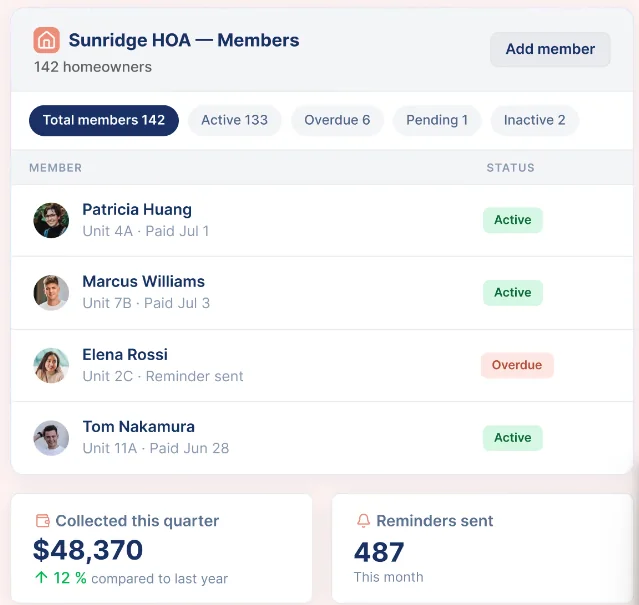
Avoid using "dues" as the label for every payment. A resident should be able to tell at a glance whether a charge is an association assessment, an optional annual club membership or a ticket to one activity.
For each optional charge, explain the amount, the period it covers, the benefits, the payment schedule, how to cancel and any refund terms. If a program renews automatically, say so before enrollment and make the cancel option easy to find. Have the right reviewer approve the terms before any money is collected.
Agree with whoever keeps the association's books on how club income, expenses, refunds and payment-processing fees will be recorded. Clearly identifying club activity is part of the workflow described here. It doesn't mean every club needs its own bank account or legal entity.
Check how club income is taxed
Ask the association's tax adviser one question early: how will club income show up on the federal return? HOAs that elect to file IRS Form 1120-H can exclude "exempt function income," meaning dues, fees and assessments paid by owners in their role as owners. The IRS instructions for Form 1120-H list payments from nonmembers and members' payments for special use of association facilities as income that doesn't qualify. Optional club fees, especially ones paid by tenants or for activities not open to every owner, could land on the taxable side, so settle this before the first payment arrives.
3. Give each record a clear owner
Decide which system holds the official record for each task. For example, keep owner and property information in the HOA's established system, while an optional club roster records participation in that program only. Volunteers shouldn't be overwriting shared resident information on their own.
Use this responsibility checklist as a starting point, then adapt it to the association's approved arrangements.
4. Build a registration process residents can complete
Ask only for what you need to run the program. A typical registration form covers the participant's name, contact email, household or property reference where relevant, the selected program and acceptance of the program terms. Collect more only when there's a clear reason and an agreed way to protect it.
Decide how eligibility will be checked and who handles exceptions, and keep those calls separate from any one organizer's preferences. Give residents another way to sign up if they can't register online.
After registration, send a short confirmation: what they joined, the next activity, any payment received, and how to update details or leave. If the program has a capacity limit, explain the waitlist so nobody is left wondering whether they're in.
A club contact list shouldn't automatically turn into a public directory. Decide who can see participant details, what they can use them for and how access gets removed when volunteer roles change.
5. Check your existing tools before adding another platform
Start by listing what your association's current platform already handles. Many HOA platforms cover accounting, owner portals, communications and maintenance, and some include a community calendar and amenity booking, with features that vary by plan. If a club meets in the clubhouse or pool area, the same reservation rules that govern other
If your program only needs an occasional announcement and an RSVP, existing tools may be enough. Another platform is worth a look when you need a persistent member roster, recurring club payments, renewal dates or a more structured handover between coordinators.
For those recurring club workflows, membership software such as Join It can help organizers keep member records, collect recurring payments and manage renewals. Its job is the optional club, alongside the association's established operations, not a replacement for HOA accounting or compliance tools.
Before you pick any additional tool, test one complete journey: register a participant, confirm payment, update their details, process a cancellation and export the records needed for reconciliation. Check plan features and administrator access rather than assuming every capability is included.
Don't assume two platforms sync. If the workflow relies on an export or a manual update, write down which fields move, who moves them and how duplicates or disagreements get resolved. A small, reliable process beats an untested integration promise.
6. Pilot one club and write down what happens
Here's a hypothetical example. Cedar Grove HOA wants to support a voluntary gardening club. The proposed annual fee pays for shared workshop materials, while regular HOA business continues through the association's usual processes.
Before enrollment opens, the board reviews the proposal from the social committee and the treasurer agrees on how the activity will be recorded. A named coordinator publishes the club's eligibility, benefits, fee, dates and cancellation terms. Residents sign up for the club rather than being added automatically from the homeowner list.
The coordinator keeps the participant roster and sends activity updates. The treasurer receives the agreed payment and refund records. When a resident moves away or leaves the club, the responsible person updates the club record and checks whether any other official record needs changing.
At the end of the pilot, the board looks at attendance, participant feedback, income and costs, and the time spent on administration. Then it can decide to continue, simplify or expand. This is an illustrative workflow, not a customer case study or a claim about any HOA's results.
7. Make the program easy to hand over
Volunteer turnover shouldn't mean starting from scratch. Keep a short operating note that explains where the roster lives, how registrations are approved, who handles payments and refunds, when reminders go out and how to escalate a concern.
Use individual administrator accounts where you can, with access that fits each person's role. Don't let one volunteer's personal inbox be the only place club decisions live. When a coordinator leaves, transfer ownership of the work and remove access they no longer need.
How ManageCasa helps: Club decisions are easier to hand over when messages aren't stuck in one person's inbox. ManageCasa's HOA communications tools log every message sent through the platform and let the association control who can see which messages, so a new coordinator can pick up the full history.
Review a few useful measures each season: active participants, event attendance, renewals among memberships due, refunds and unresolved questions. Track volunteer workload too. A program can be popular and still need a simpler admin process.
A practical launch checklist
1. Approve the program's purpose, owner and relationship to the HOA, and record the social committee's role in a charter.
2. Confirm eligibility, facility use, funding and terms with the right reviewers.
3. Explain optional charges, agree on accounting and reconciliation, and ask the tax adviser how club income is treated.
4. Test registration, confirmation, cancellation and record updates.
5. Set access permissions and document the coordinator handover.
6. Choose a review date before opening enrollment.
Frequently asked questions
Is optional club membership the same as HOA membership?
No. Club membership here means opting into one specific activity program, and it has no effect on a resident's association membership, assessment obligations or voting rights. Keep the two clearly separate in your terms and records, and check the community's governing documents when you write the definition for each program.
Can an HOA board member serve on a committee?
Often, yes, though the bylaws and any committee charter decide. Many associations appoint a board member as committee chair or board liaison so the committee stays connected to board decisions. Committees generally advise and act within authority the board delegates, so the board keeps final responsibility for spending, facility use and club terms.
Does every community club need membership software?
No. A small, occasional group can usually run on the association's existing tools. Consider a dedicated membership system when recurring payments, renewals, participant records or coordinator handovers start creating work your current process doesn't handle well, and test one full sign-up and cancellation journey with a real resident before committing to it.
Are HOA club fees taxable?
They can be, depending on who pays and what for. HOAs filing IRS Form 1120-H exclude only exempt function income, and the IRS lists payments from nonmembers and members' payments for special use of facilities as non-qualifying. Ask the association's tax adviser how optional club fees will be treated before collecting any.
What should the board check before launching a club?
Start with the program's purpose, authority, eligibility, financial arrangements, terms, facility use and responsibilities. Resolve any legal, accounting, tax or insurance questions with the relevant adviser. Then test the administrative process end to end, from registration through cancellation and reconciliation, before opening enrollment to residents. Then set a review date for the pilot.
Start with a program people can understand
A good launch comes down to clear responsibilities and a simple resident experience. Give the social committee a defined role, explain the charges, test registration and write down how the program will be handed over. Review your existing HOA tools first, then add membership administration only where the program actually needs it.
Run your community on one set of records. ManageCasa brings HOA accounting, resident communications, amenity booking and maintenance into one platform for HOAs, community associations and management companies, with Minii AI included in every plan. See how it works for HOAs, compare plans, or visit ManageCasa.

Performance Marketing Manager
Performance Marketing Manager at Join It with 13+ years of experience in B2B SaaS, EdTech, and education policy. Specializing in performance marketing, demand generation, marketing analytics, and AI-driven strategies, with a strong focus on improving brand visibility, customer engagement, and business growth.