




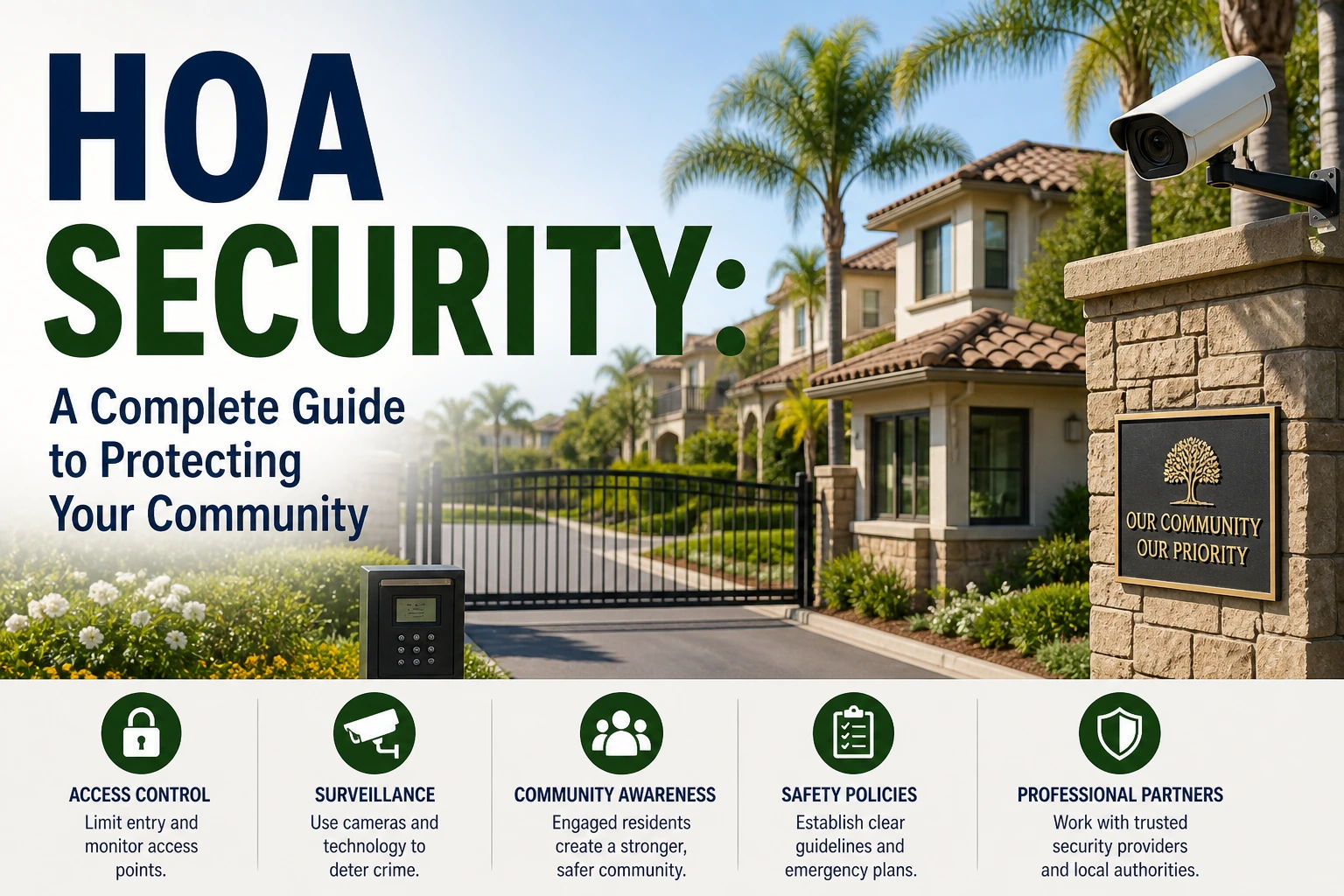
What is HOA security?
HOA security refers to the systems, policies, and practices a homeowners association uses to protect residents, common areas, and property from crime, unauthorized access, and safety threats. It encompasses physical infrastructure such as gates, cameras, and lighting; governance tools such as security policies and vendor contracts; and community engagement practices that turn residents into active participants in community safety.
Security is one of the primary reasons people choose to live in planned communities. The expectation is that a gated entrance, a camera system, and a well-lit parking lot add a meaningful layer of protection that a standard neighborhood does not provide. When that expectation is not met, the board hears about it quickly.
According to the National Association of Realtors, more than 30% of all homes in the United States are located in HOA-governed communities, with approximately 3,000 new associations forming each year. That scale means HOA security decisions affect tens of millions of residents. Getting those decisions right requires a structured approach, not ad hoc responses to individual incidents. For how security planning fits into the broader emergency preparedness framework, the HOA emergency preparedness guide is worth reading alongside this one.
This guide covers the full HOA security framework: how to identify vulnerabilities, which systems provide the most effective protection, how to involve residents, and how to build a written security policy that holds up over time.
Common HOA Security Vulnerabilities
Effective HOA security begins with an honest assessment of where the community is exposed. Common vulnerability categories include the following.
HOA Security Systems: The Core Infrastructure
Gate access systems and access control
HOA gate access systems are the first line of physical security for a community. Gated entries with key fobs, PIN codes, or license plate recognition restrict access to residents and authorized visitors. Visitor management systems, including call boxes that allow residents to grant remote entry, add a layer of oversight without requiring staffed gatehouse hours. Access control credentials should be reviewed and updated whenever a resident moves out and at least annually for all active credentials.
The design and technology of HOA gate systems has evolved significantly in recent years. Video-enabled entry systems that allow residents to visually verify visitors before granting access, combined with license plate recognition for resident vehicles, now represent the standard for new community gate installations. For communities replacing aging gate infrastructure, budgeting this replacement through the reserve study is the correct approach.
HOA security cameras and surveillance
HOA security camera systems are one of the most well-evidenced tools in community safety. A 40-year systematic review conducted by researchers from the City University of New York, Northeastern University, and Cambridge University found that CCTV camera deployment led to a 13% reduction in crime in surveilled areas. Source: cited in New York Times, 2022. Strategic placement is as important as coverage: cameras positioned at entrances, parking areas, mail and package delivery areas, pool access points, and common building entry doors provide the highest return per camera installed.
Data management matters as much as camera placement. The HOA security policy should define how long footage is retained, who has authorized access to it, and under what circumstances it is reviewed or provided to law enforcement. Residents expect surveillance to improve safety without compromising privacy within their homes.
HOA security lighting
Lighting is one of the most cost-effective HOA security investments available. Well-lit parking areas, pathways, entrances, and common building exteriors reduce the conditions that allow criminal activity to go unobserved. Motion-activated lighting adds deterrence value by drawing attention to movement in areas that are not continuously monitored. All exterior lighting should be inspected monthly and failed fixtures replaced promptly. The full maintenance schedule for HOA security lighting is in the HOA maintenance checklist.
HOA security systems: integrated approaches
Modern HOA security systems increasingly integrate gate access, camera surveillance, lighting control, and alarm monitoring into unified platforms managed from a single dashboard. These integrated HOA security systems reduce the operational burden of managing multiple separate vendors and provide more coherent data about security events across the community. When evaluating integrated systems, prioritize those with redundant communication paths so that a single point of failure, such as a power outage or internet disruption, does not disable the entire security infrastructure.
HOA security guard services
Professional HOA security guards add a human presence that technology alone cannot replicate. Research published in the National Center for Biotechnology Information examining security patrol increases across train stations found a 16% reduction in victim-reported crimes and a 49% increase in police-generated crime detections in patrolled areas. Source: NCBI PMC5718484. For communities with the budget for staffed security, the evidence supports its effectiveness. For those that cannot sustain full staffing, patrol contracts with a licensed security firm on a scheduled rotation deliver meaningful deterrence at lower cost.
HOA Security Camera Policy: What to Include
A written HOA security camera policy is increasingly expected by residents and, in some states, required by law. Without a policy, the association has no documented framework for managing footage, responding to records requests, or handling disputes about camera placement.
Building a Written HOA Security Policy
An HOA security policy is the governance document that defines how the association manages its security infrastructure, responds to incidents, and communicates with residents about security matters. Without a written policy, security decisions are made inconsistently, and the board has no documented framework to reference when a security incident occurs.
Resident Involvement in HOA Community Safety
The most sophisticated HOA security infrastructure is less effective without engaged residents. Residents who know their neighbors, notice unusual activity, and understand how to report concerns are one of the most reliable safety assets a community has.
Neighborhood watch programs, regular security updates in community communications, and clear guidance on how to report non-emergency security concerns all build the culture of mutual awareness that deters opportunistic crime. For the communication framework that supports resident engagement in security matters, the HOA communication guide covers the practical tools and approaches boards use to keep residents informed and involved.
Communication after incidents matters as much as prevention. When a security event occurs in the community, a timely and factual communication from the board that describes what happened, what the board is doing in response, and what residents can do to protect themselves builds trust and demonstrates that the board is on top of the issue.
HOA Security Budget Considerations
Security infrastructure is a capital investment, and major HOA security system components belong in the reserve study alongside other long-lived assets. Camera systems, gate mechanisms, access control hardware, and perimeter fencing all have defined useful lives and replacement costs that should be projected in the reserve plan. For how to include capital security assets in reserve planning, see the HOA reserve funds guide.
Operating security costs, including security patrol contracts, lighting electricity, and routine maintenance of security equipment, belong in the annual operating budget as recurring line items. Boards that treat all security costs as operating expenses end up underinvesting in capital replacement and facing large unplanned expenditures when aging systems need replacement.
HOA Security Best Practices
• Conduct a formal security vulnerability assessment before making system investment decisions.
• Develop and maintain a written HOA security policy covering access control, surveillance, lighting, and incident response.
• Prioritize HOA security systems upgrades: gate access systems and lighting deliver the strongest documented returns.
• Inspect all exterior lighting monthly and replace failed fixtures within 48 hours.
• Review and update access control credentials at least annually and immediately upon any resident move-out.
• Include major HOA security system components in the reserve study for capital replacement planning.
• Provide residents with clear guidance on how to report security concerns and what to expect in response.
• Review security contractor performance annually before renewing any patrol or monitoring contract.
• Communicate promptly and factually with residents following any significant security incident.
Centralize HOA Security Management with ManageCasa
ManageCasa gives HOA boards a centralized platform to manage vendor contracts, store security policies, track maintenance records, and communicate with residents. When security management is organized and documented, the board can respond to incidents faster and demonstrate a consistent record of diligence.
Explore HOA platform features at managecasa.com/hoa-management-software
Frequently Asked Questions
What does HOA security include?
HOA security includes all systems, policies, and practices the association uses to protect residents and common areas from crime and unauthorized access. Core components include HOA gate access systems and access control, security cameras and surveillance, perimeter fencing and lighting, security personnel or patrol services, and a written security policy governing how these systems are managed and how incidents are handled.
Are HOAs responsible for community security?
HOA boards have a responsibility to maintain common areas in a reasonably safe condition, which includes maintaining security infrastructure such as lighting, gates, and surveillance systems. The scope of that responsibility is defined by the governing documents and applicable state law. Boards that fail to address known security hazards or maintain security infrastructure in working condition may face liability exposure if a foreseeable incident occurs.
How effective are HOA security cameras?
HOA security cameras are well-supported by research as a crime deterrent. A 40-year systematic review by researchers from the City University of New York, Northeastern University, and Cambridge University found that CCTV deployment led to a 13% reduction in crime in surveilled areas. Effectiveness depends on strategic placement covering high-risk areas, adequate image quality, and a clear data governance policy defining how footage is managed and accessed.
What should an HOA security camera policy include?
An HOA security camera policy should specify where cameras are installed and what areas they are directed at, how long footage is retained before being overwritten, who has authorized access to recorded footage, under what circumstances footage is shared with law enforcement, privacy standards protecting residents, and a schedule for annual policy review. A sample HOA security camera policy framework is included in this guide.
What are the most effective HOA security systems?
The most effective HOA security systems in 2026 combine gate access systems with video-enabled entry, strategically placed surveillance cameras covering high-risk areas, motion-activated lighting, and integrated monitoring platforms that unify these components into a single managed system. Research consistently shows that lighting and access control deliver the most reliable deterrence returns, with camera systems adding significant value when strategically placed rather than installed for general coverage.

Content Writer
Dann is a real estate and property management content strategist specializing in HOA operations, financial management, and community governance. He works closely with industry professionals to produce accurate, practical guidance for property managers and HOA boards.