


QUICK ANSWER California landlord tenant law is the body of state statutes, primarily Civil Code Sections 1940 to 1954.06, that governs the rights and responsibilities of rental property owners and renters throughout California. It covers lease agreements, security deposits, habitability standards, rent increases, eviction procedures, entry rights, and required disclosures.
DISCLAIMER: This article is for informational purposes only and does not constitute legal advice. California landlord-tenant law is complex and changes frequently. Landlords and tenants with specific legal questions ordisputes should consult a qualified California attorney.
California has some of the most detailed rental laws in the country. For landlords, that means a long list of obligations around habitability, deposits, notice periods, and eviction procedures. For renters, it means a substantial set of legal protections that apply regardless of what a lease says. Whether you own a single rental unit in Sacramento or manage a small portfolio in Los Angeles, knowing what the law requires is not optional.
This guide covers the full scope of California landlord tenant law for 2026, with specific attention to security deposit rules, rent increase limits, eviction procedures, required disclosures, and tenant rights. It also highlights key differences between state law and local ordinances, because in California, cities and counties often layer additional protections on top of state minimums.
The Foundation: California Civil Code 1940 to 1954.06
The core of California landlord tenant law sits in Civil Code Sections 1940 through 1954.06. These statutes establish the baseline rules for all residential rental agreements in the state. A lease begins the moment there is either an oral agreement or a written document between the parties, and from that moment, both sides acquire legally enforceable rights and obligations.
One principle worth knowing upfront: the law cannot generally be waived by lease language. If a lease clause contradicts a state statute, the statute wins. That means landlords cannot write provisions into lease agreements that strip tenants of rights the legislature has granted, and tenants cannot waive protections that the law treats as non-negotiable.
Local ordinances also matter. Cities including Los Angeles, San Francisco, Oakland, San Diego, Berkeley, Santa Monica, and many others have passed rent control and tenant protection rules that go beyond state law. For rental owners operating in those jurisdictions, understanding both layers is essential.
Landlord Responsibilities Under California Law
California law places clear obligations on rental property owners. These are not suggestions. Failing to meet them can give tenants legal remedies ranging from rent withholding to lawsuits, and in some cases, a right to terminate the tenancy entirely.
Providing a Habitable Dwelling
Every California landlord has an implied warranty of habitability. This means the rental unit must meet basic health and safety standards throughout the tenancy, not just at move-in. Under Health and Safety Code Section 17920.3, a dwelling can be deemed substandard if it lacks:
• Effective weatherproofing, including unbroken windows and doors
• Plumbing that is in good working order, with hot and cold running water
• A working heating system capable of maintaining indoor temperatures of at least 70 degrees Fahrenheit
• Functioning electrical wiring and outlets
• Clean and sanitary common areas, free of debris, garbage, and vermin
• Safe structural conditions, including floors, walls, ceilings, and stairways
Landlords are required to make repairs within a reasonable time after a tenant reports a problem. For conditions that affect health or safety, courts have generally interpreted "reasonable" as 30 days or fewer, depending on the severity.
Required Disclosures Before Move-In
California landlords must provide tenants with several disclosures before the lease is signed. These include:
• Lead-based paint disclosure for units built before 1978, as required by federal law
• Bed bug disclosure with legally specified language under Civil Code Section 1954.603
• Known mold disclosure, including any documented presence of mold in the unit
• Flood zone disclosure if the property is in a known flood-prone area
• Drug contamination disclosure if the property was previously used for methamphetamine or fentanyl production and remediation is not yet complete
• Megan's Law notice as required by Civil Code Section 2079.10(a)
• Whether the Tenant Protection Act (AB 1482) or any local rent control ordinance applies to the unit
• How utilities are divided if tenants share common utility meters
Failing to provide required disclosures can expose a landlord to legal liability, including claims of fraud or misrepresentation.
Entry Rights and Notice Requirements
California landlords generally must give at least 24 hours written notice before entering a rental unit. This applies to repairs, inspections, showings, and most other landlord visits. The notice must state the reason for entry and a reasonable time window.
Emergencies are the primary exception. A landlord may enter without advance notice when there is a genuine emergency, such as a burst pipe or fire. Outside of emergency situations, entry without notice can be treated as harassment and may give tenants a legal basis for damages or even lease termination.
Entry must also occur at a reasonable time. Courts have generally interpreted this as between 8 a.m. and 6 p.m. on normal business days, though tenants can agree to different hours in writing.
Repair and Maintenance Obligations
Beyond habitability, landlords are responsible for maintaining all features and services that are part of the rental agreement. If an appliance, HVAC unit, or amenity is included in the lease, it needs to remain in working order throughout the tenancy.
When tenants make repair requests, landlords should document both the request and the response. Written records become critical if a dispute escalates to small claims court or a habitability complaint.
Tenant Rights Under California Law
California tenants have an extensive set of legal rights. Some of these are created by state statute, others by local ordinance, and a few by the U.S. Constitution and federal law. Here is what renters in California are legally entitled to.
The Right to Habitable Housing
Every tenant in California is legally entitled to live in housing that meets the state's habitability standards. If a landlord fails to maintain a habitable unit after being notified, tenants have several legal remedies available:
• Repair and deduct: Tenants may arrange and pay for a necessary repair themselves, then deduct the cost from rent. This remedy is available up to twice per year, with each repair capped at one month's rent (Civil Code Section 1942(a)).
• Rent withholding: In cases involving serious habitability failures, tenants may withhold rent until repairs are made. This step carries legal risk and should be taken carefully, ideally after written notice and with documentation.
• Reporting to inspectors: Tenants can contact local building or health departments to trigger a code compliance inspection.
• Legal action: Tenants may sue in small claims court or civil court for damages caused by uninhabitable conditions.
Protection Against Discrimination
The federal Fair Housing Act prohibits discrimination based on race, color, religion, sex, national origin, familial status, and disability. California extends these protections further under the Fair Employment and Housing Act (FEHA).
In California, it is illegal for a landlord to discriminate against a prospective or current tenant based on:
• Ancestry, immigration status, or citizenship
• Primary language spoken
• Mental or physical disability
• Gender identity or expression
• Marital or family status
• Sexual orientation
• Military or veteran status
• Source of income, including housing vouchers
A landlord who refuses to rent to, or harasses, a tenant on the basis of any protected characteristic can face significant civil liability under both state and federal law.
Quiet Enjoyment
California's covenant of quiet enjoyment gives tenants the right to use their rental unit without unreasonable interference from the landlord. This means a landlord cannot harass a tenant, enter without notice, or take actions intended to pressure a tenant into leaving. Landlord harassment is a legally recognized cause of action in California, and courts have awarded significant damages in cases where landlords engaged in conduct designed to disrupt a tenant's use of their home.
California Security Deposit Law
Security deposits are one of the most common sources of landlord-tenant disputes in California. The rules changed significantly with Senate Bill 567, which took effect in 2024.
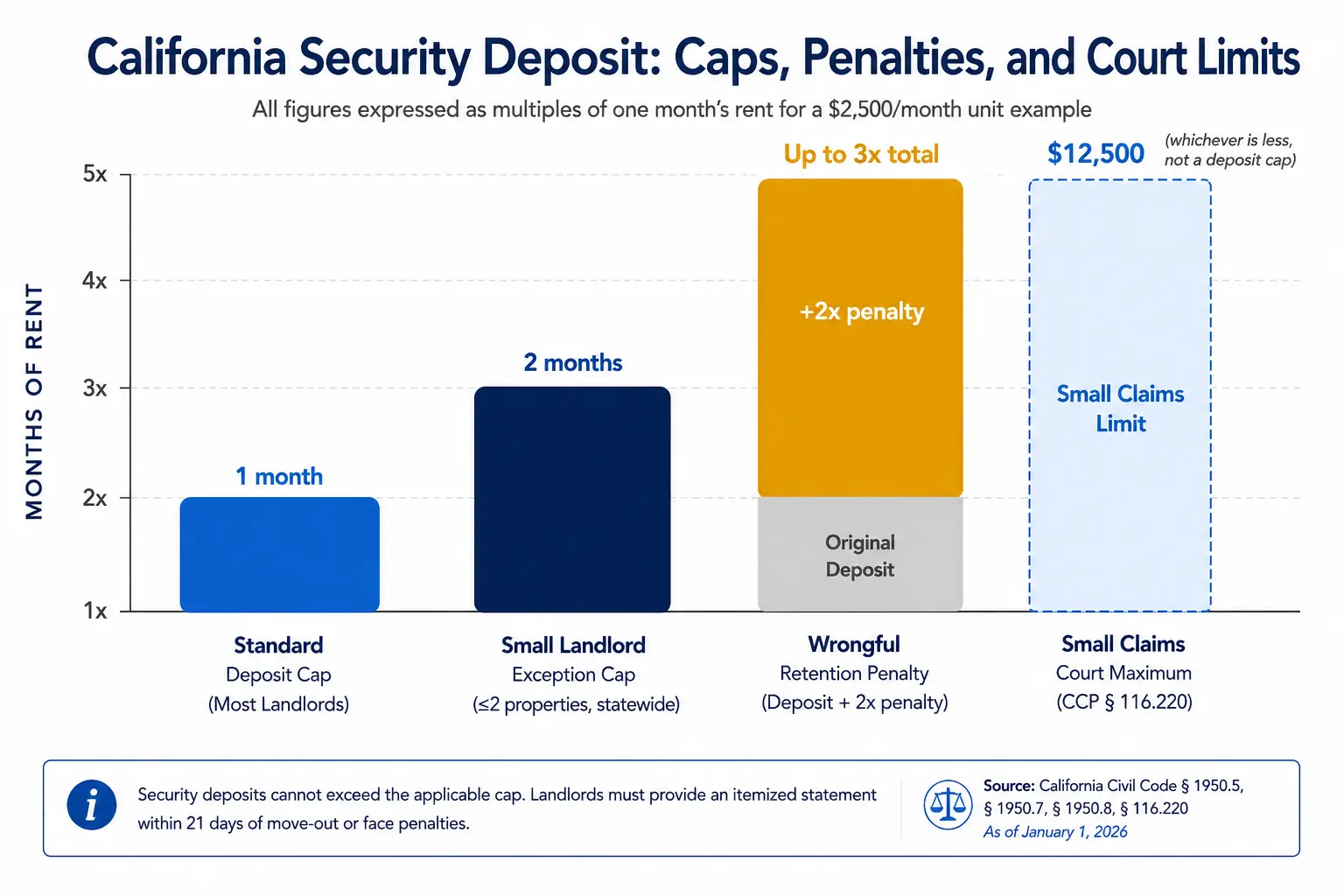
Landlords must attach receipts or documentation to the itemized deduction statement if costs exceed $125. Within the 21-day window, they must also provide an initial inspection report if they conduct a pre-move-out inspection, which tenants can request.
Rent Increases: AB 1482 and the Tenant Protection Act
The Tenant Protection Act of 2019 (AB 1482) caps how much most California landlords can raise rent in any 12-month period. The cap is the lower of:
• 5% plus the local Consumer Price Index (CPI) increase, or
• 10% total, whichever is lower
Only one rent increase is allowed per 12-month period per tenant. Landlords must provide written notice of any increase:
• 30 days' written notice if the increase is 10% or less
• 90 days' written notice if the increase exceeds 10% (though increases above the cap are not permitted under AB 1482)
Which Properties Are Exempt from AB 1482
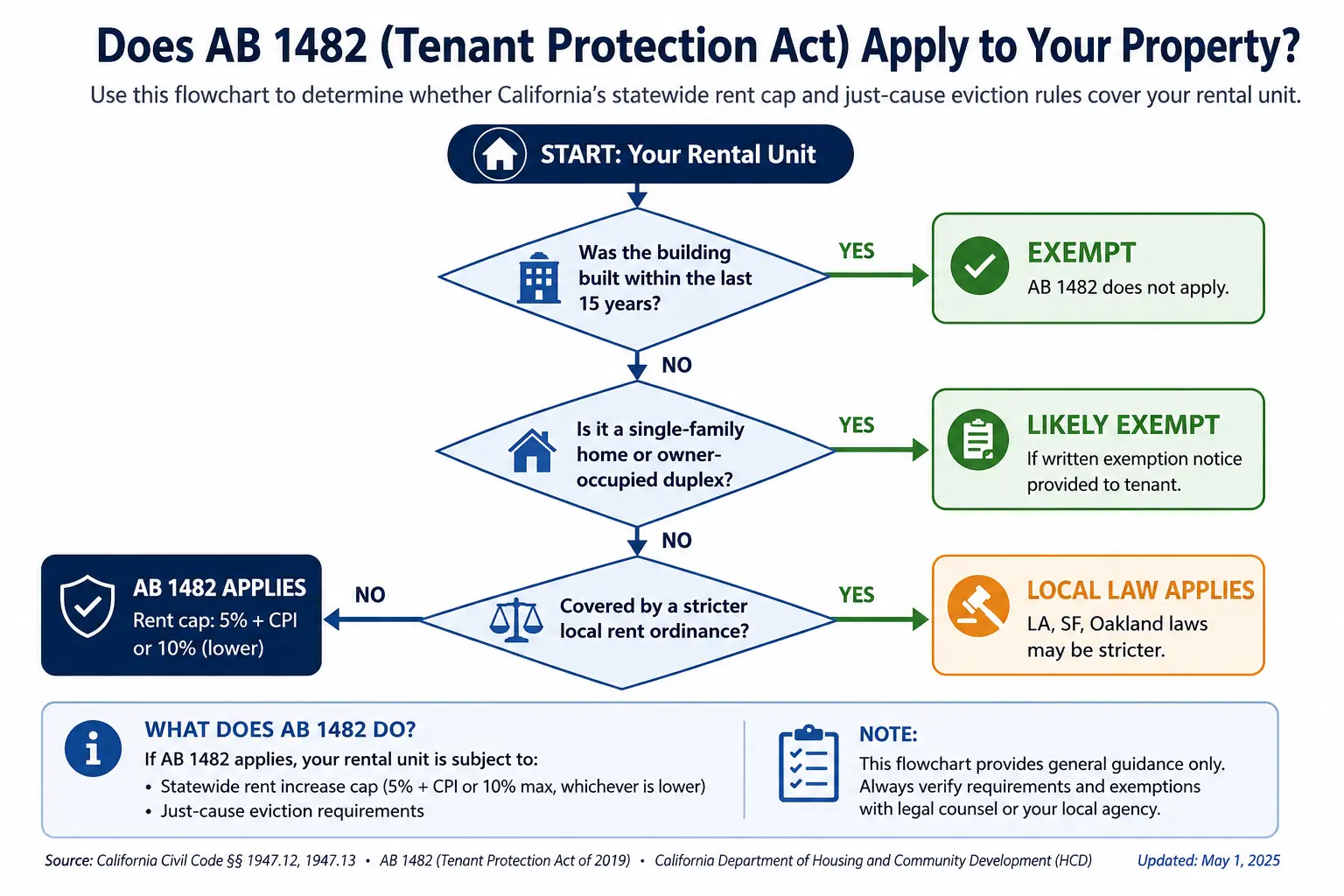
Not all California rentals fall under the Tenant Protection Act. The following are generally exempt:
• Single-family homes and condos where the owner has provided a written notice of exemption to the tenant, and where the tenant has a separate, independent ownership from the landlord
• Buildings constructed within the last 15 years (a rolling exemption)
• Owner-occupied duplexes
• Units already covered by a stricter local rent control ordinance
• Subsidized affordable housing with their own rent restrictions
Even when AB 1482 does not apply, local ordinances may impose their own limits. Los Angeles, San Francisco, Oakland, and other cities have rent stabilization ordinances that apply to older units and often come with stricter caps and just cause eviction requirements.
California Eviction Laws: Just Cause and the Eviction Process
Evicting a tenant in California requires following a legally prescribed process. Under AB 1482, most tenants who have lived in a unit for 12 months or more can only be evicted for specific, legally recognized reasons, known as just cause.
Just Cause Eviction Grounds
California law divides just cause eviction grounds into two categories: at-fault and no-fault.
At-fault grounds (the tenant has done something to justify eviction) include:
• Failure to pay rent
• Violation of a material lease term after written notice to cure
• Subletting without permission
• Committing or allowing nuisance or criminal activity on the premises
• Refusal to allow lawful entry
No-fault grounds (the landlord needs the unit for a legitimate reason unrelated to tenant conduct) include:
• Owner or qualifying family member move-in, with required occupancy for at least 12 months
• Withdrawal of the unit from the rental market under the Ellis Act
• Compliance with a government order to vacate
• Substantial renovation requiring vacancy (with specific restrictions under SB 567)
For no-fault evictions, California law generally requires the landlord to pay relocation assistance equal to one month's rent.
The Eviction Notice and Unlawful Detainer Process
The eviction process follows specific steps and timelines under California law:
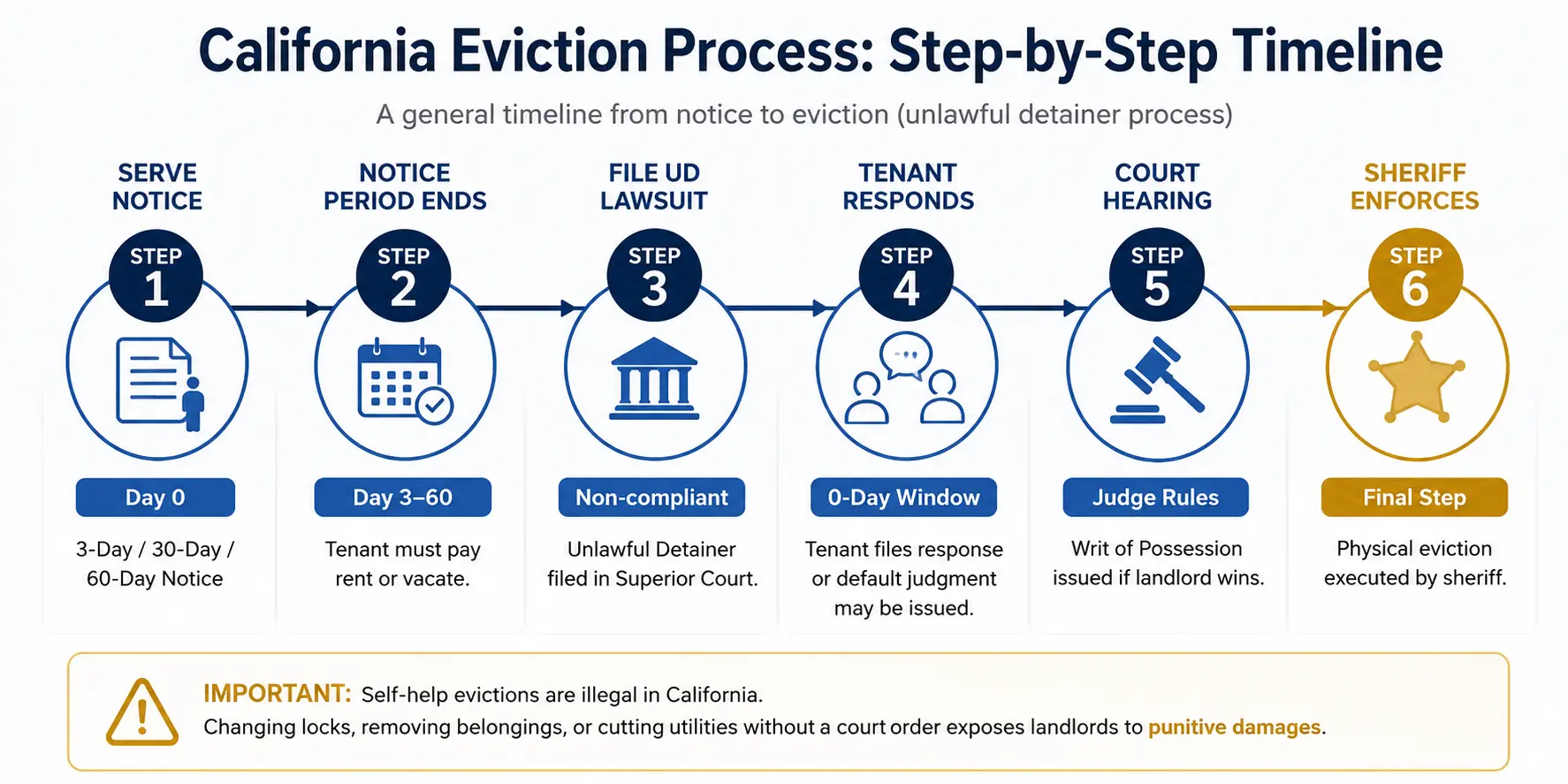
1. 3-Day Notice to Pay or Quit: Served when a tenant has not paid rent. The tenant has 3 days to pay in full or vacate.
2. 3-Day Notice to Cure or Quit: Served for a lease violation. The tenant has 3 days to fix the problem or vacate.
3. 30- or 60-Day Notice to Vacate: Used for no-fault terminations. 30 days applies to tenancies under one year; 60 days for tenancies of one year or more.
4. Unlawful Detainer Lawsuit: If the tenant does not comply with the notice, the landlord files an unlawful detainer (UD) lawsuit in superior court. Tenants have 10 days to file a response.
5. Court Hearing and Judgment: If the court rules in the landlord's favor, a writ of possession is issued. A sheriff executes the eviction.
Self-help evictions, meaning changing the locks, removing a tenant's belongings, or cutting off utilities to force a tenant out, are illegal in California. A landlord who engages in self-help eviction can be liable for actual damages, punitive damages, and attorney fees.
Lease Agreements and Disclosures
California does not require that all lease agreements be in writing, but any tenancy of more than one year must be in writing to be enforceable under the Statute of Frauds. In practice, written leases are strongly advisable for all tenancies, regardless of length.
Required Lease Disclosures in California
In addition to pre-move-in disclosures, California leases for most residential units should include:
• Whether the unit is subject to AB 1482 or a local rent control ordinance, with specific statutory language if required
• Utility billing arrangements, including how shared utilities are allocated
• Pet policies and any associated fees (note: pet fees are counted toward the deposit cap under SB 567 for most landlords)
• Parking arrangements, including whether parking is bundled with rent or offered separately
• Smoking policies for the unit and common areas
Starting in 2024, California also requires landlords to offer tenants the option to have positive rent payments reported to at least one nationwide credit bureau. Tenants can opt out of this, but landlords must offer it.
Lease Termination
Lease termination rights differ based on the type of tenancy. For month-to-month tenancies, either party can terminate with proper notice:
• 30 days' notice if the tenant has lived there fewer than 12 months
• 60 days' notice if the tenant has lived there 12 months or more (landlord only; tenant always gives 30 days)
For fixed-term leases, the lease expires at the end of the term unless both parties agree to renew. A landlord cannot refuse to accept a renewal without just cause under AB 1482, if the unit is covered.
Early termination by a tenant can trigger liability for remaining rent, though California landlords have a legal duty to mitigate damages by making reasonable efforts to re-rent the unit.
Local Ordinances: When Cities Go Further Than the State
California law sets a floor, not a ceiling. A growing number of cities and counties have passed their own ordinances that provide additional tenant protections beyond state minimums. Landlords operating in these jurisdictions must comply with both state law and local rules.
This table is a summary for orientation purposes. Before managing a rental in any California jurisdiction, confirm current local ordinances directly with the city or county housing department, as these rules change frequently.

What Changed in California Rental Law in 2026
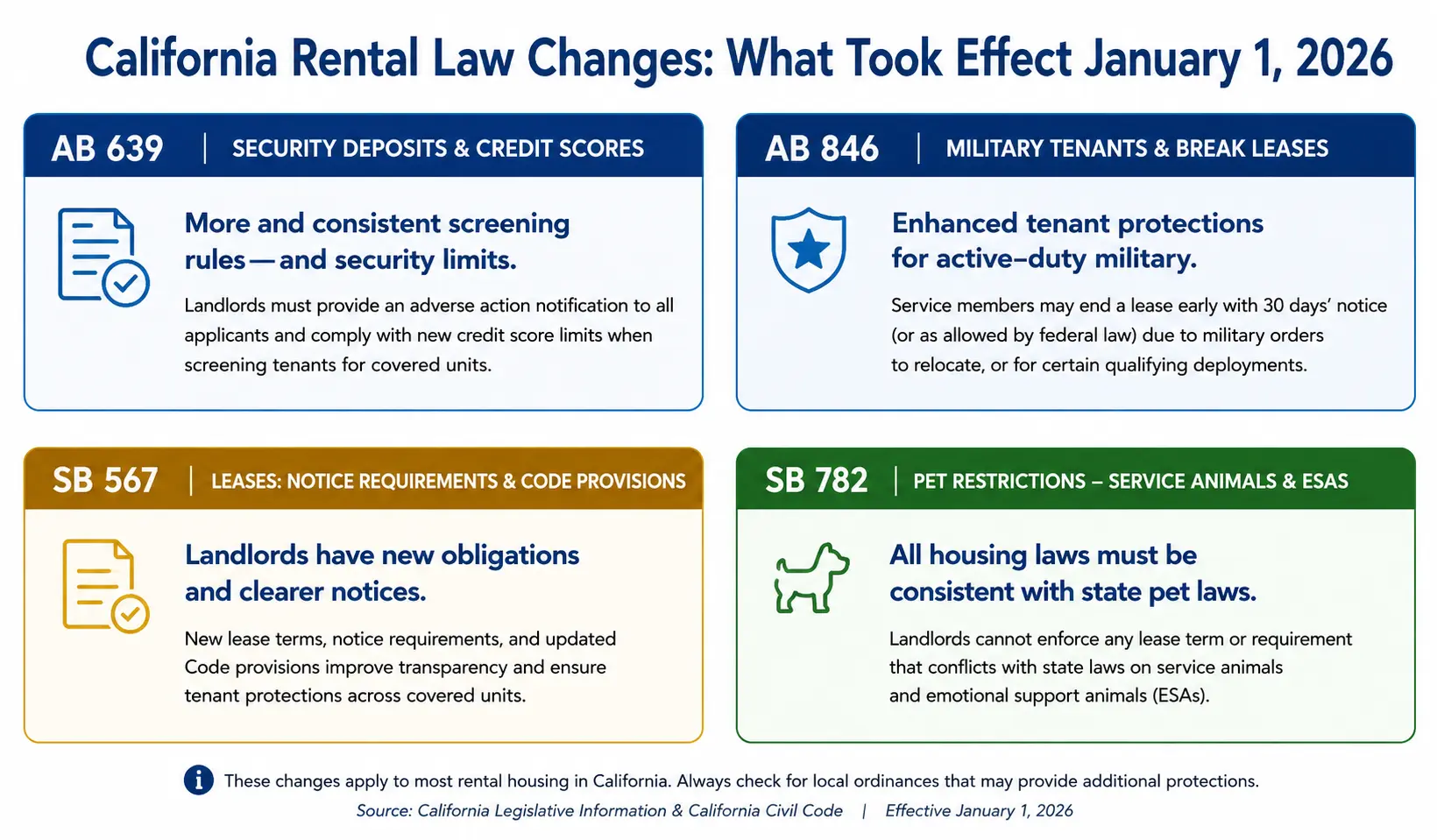
Several significant pieces of legislation took effect January 1, 2026, expanding landlord obligations across habitability, security deposits, fee transparency, and disaster response. Each bill is verified against the California Legislative Information database and sources from the California Apartment Association (CAA).
AB 628: Stoves and Refrigerators Now Required for Habitability
AB 628 amends Civil Code Section 1941.1 to add a working stove and a working refrigerator to the statutory list of features required for a rental unit to be considered legally tenantable. Before this law, appliances were not part of the state's habitability definition, and some landlords, particularly in Southern California, routinely rented units without them.
Key points for landlords under AB 628:
• The law applies to leases entered into, amended, or extended on or after January 1, 2026. Fixed-term leases in place before that date are not affected until renewal or amendment. Month-to-month tenancies are effectively covered from January 1, 2026, since they renew each month.
• Landlords must provide a stove or cooktop and a refrigerator, and keep both in good working order for the duration of the tenancy.
• If a provided stove or refrigerator is subject to a manufacturer or government recall, the landlord must repair or replace it within 30 days of receiving notice, even if the appliance is still functioning.
• Tenants may choose to provide their own refrigerator, but only if both parties agree in writing at the time the lease is signed. Landlords cannot require tenants to supply their own refrigerator as a condition of renting. Tenants who opt to supply their own refrigerator may later submit a written request for the landlord to provide one.
• Landlords cannot raise rent solely to offset the cost of AB 628 compliance.
• Certain housing types are exempt, including permanent supportive housing and units with shared kitchens, such as some boarding houses and student housing.
Non-compliance with AB 628 can expose landlords to habitability claims, repair-and-deduct remedies, rent withholding by tenants, and code enforcement actions under Civil Code Section 1941.1.
Primary source: California Legislative Information, AB 628 bill text: leginfo.legislature.ca.gov
AB 414: Electronic Security Deposit Returns Now Required in Some Cases
AB 414 amends Civil Code Section 1950.5 to modernize how security deposits are returned. The key change: if a landlord received rent or the security deposit from the tenant electronically, the remaining deposit must be returned electronically unless both parties agree in writing to a different method.
Key points for landlords under AB 414:
• The 21-calendar-day return deadline remains unchanged.
• If rent or the deposit was paid electronically, the landlord must notify the tenant in writing of their right to receive the deposit refund electronically.
• If both parties prefer a different method, such as a paper check, that arrangement must be documented in a written agreement. The agreement can be made at the start of the lease or at any point during the tenancy, not just after move-out, which is a change from prior law.
• For units with multiple adult tenants, the default is a single check made payable to all adult tenants unless a written agreement specifies otherwise.
• Itemized deduction statements may now be delivered by email if the tenant agrees in writing, at any point during the tenancy.
The law applies to any tenancy ending on or after January 1, 2026.
Primary source: California Legislative Information, AB 414 bill text: leginfo.legislature.ca.gov
SB 610: New Landlord Obligations After Natural Disasters
SB 610 directly addresses confusion that arose after the January 2025 Los Angeles wildfires, when disputes broke out over cleanup responsibilities, rent obligations, and tenant rights to return to damaged properties. The law establishes clear obligations for landlords when a rental property is affected by a declared state of emergency.
Under SB 610, landlords must:
• Halt all rent and fees during a mandatory government evacuation order. If a tenant has already paid rent for a period covered by the evacuation, the landlord must return that rent within 10 calendar days after the evacuation order is lifted, or the tenant may deduct the amount from the following month's rent.
• Remove disaster-related debris and remediate hazards, including smoke damage, ash, mold, water damage, and asbestos, before the unit can be considered habitable again. The law creates a legal presumption that a unit with disaster debris present is uninhabitable until a local public health agency determines otherwise.
• Notify tenants in writing once remediation is complete and the unit is safe for re-occupancy.
• Allow tenants the right to return to their unit at the same rental rate in effect before the disaster, unless the tenancy has been lawfully terminated.
• Return any prepaid rent to the tenant if the unit is destroyed or rendered uninhabitable and cannot be remediated.
• Allow tenants whose units are destroyed or permanently uninhabitable to terminate their lease without penalty.
SB 610 also extends eviction-related notice periods and deadlines when a state of emergency is active in the relevant county.
Primary source: California Legislative Information, SB 610 bill text: leginfo.legislature.ca.gov
AB 747: Mandatory Fee Transparency in Rental Advertising
AB 747 requires landlords to disclose all mandatory fees upfront when advertising a rental unit, providing a price quote, or charging recurring fees. The intent is to eliminate hidden charges that appear only after a prospective tenant has toured the property or begun an application. If a fee applies to every tenant as a condition of renting, it must be disclosed as part of the total rental price, not buried in the application process.
Common mandatory fees that must now be disclosed include trash and sewer surcharges passed to tenants, parking fees required as part of tenancy, utility connectivity charges, and administrative fees billed monthly. Optional fees, such as pet rent or a storage unit that tenants can decline, may still be listed separately.
Primary source: California Legislative Information, AB 747 bill text: leginfo.legislature.ca.gov
Other Protections Now Fully in Force (2024 and Forward)
Several additional protections enacted in prior legislative sessions are now fully operative:
• Security deposit cap of one month's rent for most landlords (SB 567 / AB 12, effective July 1, 2024)
• Positive rent reporting: landlords must offer tenants the option to have on-time payments reported to a credit bureau (AB 2747, effective April 2025 for larger properties)
• Lock change protections: landlords must change locks at their own expense upon written request from a tenant who is a victim of domestic violence or abuse
• Tenant screening fee cap adjusted annually by CPI, currently set at $62.02
• Third-party tenant screening services must meet cybersecurity standards protecting tenant data (AB 1414)
• Unbundled parking: tenants in qualifying newer multifamily buildings may decline to pay for bundled parking
Tenant Responsibilities
Rights flow in both directions. California law also establishes what tenants are obligated to do during a tenancy:
• Pay rent in full and on time as specified in the lease
• Keep the unit clean and sanitary
• Avoid damaging the property beyond normal wear and tear
• Use the unit only for its intended residential purposes
• Allow the landlord to enter for legitimate purposes with proper notice
• Report maintenance issues to the landlord in writing
• Comply with all terms of the lease agreement
• Respect other tenants and neighbors
Tenants who cause damage, fail to pay rent, or materially breach lease terms give landlords grounds to pursue eviction under just cause rules.
Primary Legal Sources
The following are the authoritative government and statutory sources for California landlord tenant law. These are the primary references for any legal or compliance question:
California Civil Code Sections 1940 to 1954.06: leginfo.legislature.ca.gov
California Department of Consumer Affairs, Landlord/Tenant Guide: dca.ca.gov/legal/landlordbook
AB 1482 Tenant Protection Act (full text): leginfo.legislature.ca.gov
California Courts Self-Help: Landlord-Tenant: courts.ca.gov/selfhelp-eviction.htm
Related Resources from ManageCasa
If you manage rental properties in California, these guides cover adjacent topics that affect your obligations and operations:
How to Screen Tenants: 6 Essential Steps to Protect Your Investment
Rental Agreements and Lease Terms: What Every Rental Owner Should Know
7 Essential Tenant Rights and Rental Owner Obligations: managecasa.com
22 Tips for First-Time Rental Property Owners: managecasa.com
MANAGE YOUR CALIFORNIA RENTALS: ManageCasa's rental platform handles lease management, rent collection, maintenance tracking, and tenant communications in one place. Explore what it can do for your rental portfolio at
managecasa.com/rental-management-software
Frequently Asked Questions
What is the maximum security deposit a landlord can charge in California in 2026?
Most California landlords can charge a maximum security deposit equal to one month’s rent. Certain small property owners may still qualify to collect up to two months’ rent.
How much notice does a California landlord need to give before entering a rental unit?
California landlords must generally provide at least 24 hours written notice before entering a rental unit, except during emergencies requiring immediate access.
By how much can a landlord increase rent in California?
Under AB 1482, many California landlords may raise rent by up to 5% plus local CPI annually, with a total cap of 10% within a 12-month period.
What is just cause eviction and when does it apply in California?
Just cause eviction requires landlords to provide a legally valid reason to remove tenants who have occupied a unit for 12 months or longer under California law.
What happens if a California landlord does not return the security deposit within 21 days?
Landlords who fail to return security deposits within 21 days may owe penalties, damages, and additional compensation for improperly withheld funds under California law.

Expert in Property Management and SaaS
Peter Koch is an expert in property management and SaaS, focused on building top digital tools for property managers and growing technology-driven startups. He specializes in enhancing property management operations through smart software solutions that streamline accounting, automate workflows, and improve community communication. Peter writes about HOA management technology, proptech innovation, and scalable SaaS strategies designed to help modern property professionals operate more efficiently.