




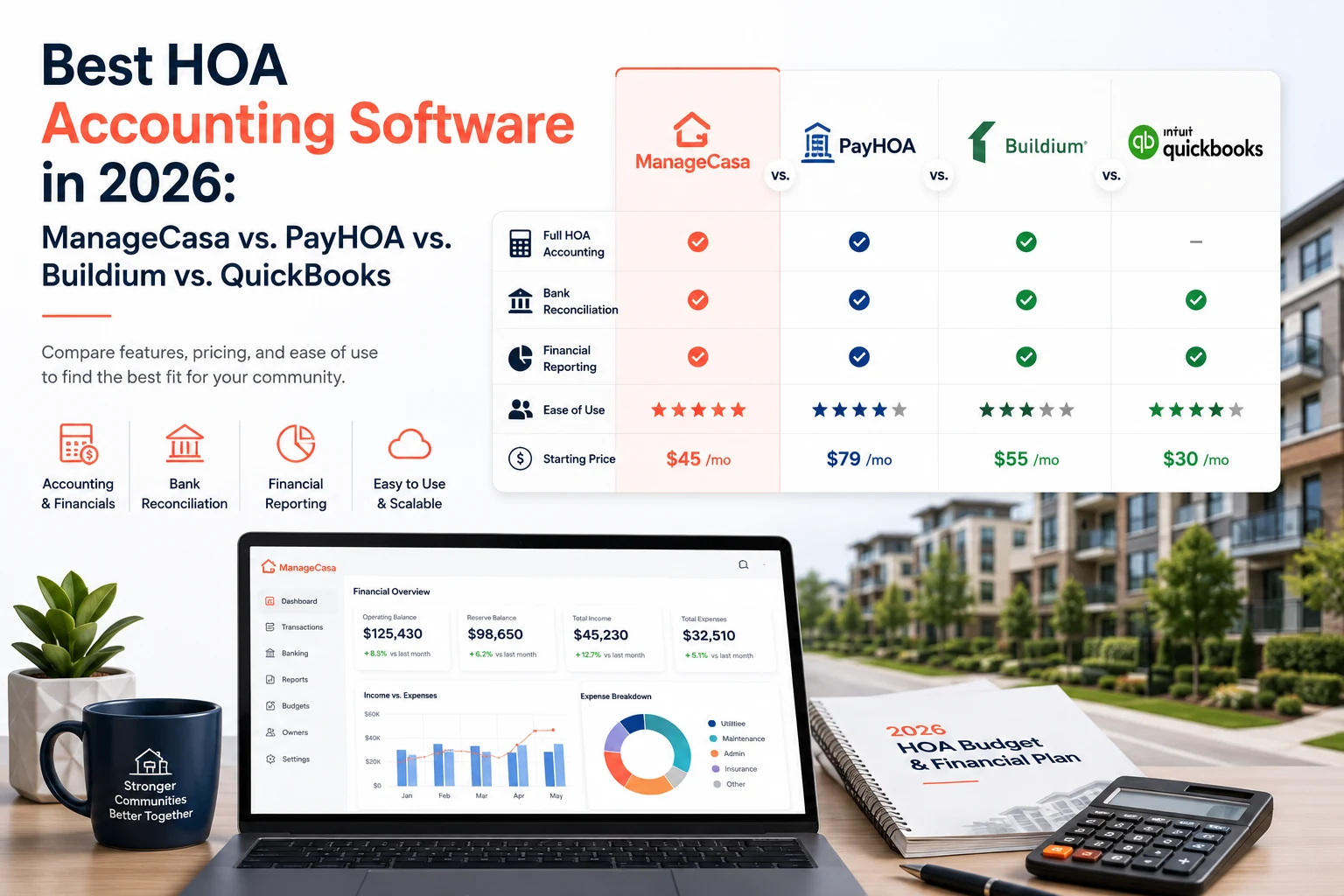
The best HOA accounting software depends on community size and who manages the books. Self-managed boards under 100 units typically do well with PayHOA or ManageCasa for built-in dues collection and reserve tracking. Professional management companies handling multiple associations often choose Buildium. Generic tools like QuickBooks Online work but require manual setup for HOA-specific workflows.
Every HOA treasurer eventually reaches a point where spreadsheets or generic accounting software are no longer enough. Tracking assessments, separating operating and reserve funds, reconciling bank accounts, preparing board reports, and answering homeowner questions can quickly become time-consuming and prone to errors. Many volunteer board members spend hours each month on manual bookkeeping instead of managing their community. The right HOA accounting software automates these tasks, improves financial transparency, helps maintain accurate records, and simplifies day-to-day operations.
This comparison looks at four platforms that come up most often in that decision: ManageCasa, PayHOA, Buildium, and QuickBooks Online. Each takes a different approach to dues billing, reserve fund tracking, and reporting, and each fits a different size and type of association. The pricing and feature details below were checked directly against each vendor's own pricing page, with verification dates noted.
How We Evaluated These Platforms
Four factors mattered most for this comparison:
- HOA-specific accounting depth: whether reserve funds are separated from operating funds automatically, whether reporting follows GAAP-style statements, and whether dues billing is built in rather than bolted on.
- True monthly cost at a realistic community size, not just the headline starting price, since transaction fees and per-unit charges can change the total significantly.
- Setup effort for the people actually using the software, since a volunteer board member and a professional property manager need very different onboarding experiences.
- Integration and portal features, including whether homeowners can view balances and pay online without calling the office.
Best HOA Accounting Software at a Glance
ManageCasa
ManageCasa is built specifically for HOAs and condo associations rather than adapted from rental property software. Pricing starts at $45 per month for the Base plan, $80 per month for Growth, and $130 per month for Premium, all billed yearly, with a $0.50 per unit overage above 500 units. A community website is a separately billed add-on.
The accounting module includes dues and assessment billing, reserve fund tracking kept separate from operating funds, bank reconciliation, and financial reporting boards can hand directly to a CPA. Homeowners get a self-service portal to check balances and pay online, which reduces the volume of calls a treasurer has to field.
Learn more on the ManageCasa's HOA platform page or compare plans on the pricing page.
PayHOA
PayHOA is designed to be an accessible, all-in-one platform that scales from small, self-managed communities to large portfolios handled by professional management companies. Annual billing starts at $49 per month for up to 25 units and scales up through unit-count tiers to $275 per month minimum for 401 to 500 units, then $0.55 per unit above that. Monthly billing starts at $54 per month. Every plan includes the same feature set, so there is no upsell pressure to reach a higher tier. The platform also offers a 30-day free trial, allowing boards to test the full feature set before committing.
The accounting side covers both cash and accrual reporting, bank reconciliation, invoicing, and financial reports. The gap most boards run into is reserve fund management: PayHOA supports custom chart-of-accounts categories for reserves, but it does not include a dedicated reserve study module, a percent-funded dashboard, or automatic fund separation enforcement. Boards that want that level of reserve automation typically need to layer on a separate tool or choose a platform where it is built in.
Buildium
Buildium is the most established name on this list and the one most professional management companies already know. Pricing runs in three flat tiers: Essential at $62 per month, Growth at $192 per month, and Premium at $400 per month, with no per-unit charge on the base subscription. Transaction fees apply on top, including incoming EFT fees that range from $2.35 per transaction on Essential down to $0.60 on Premium.
Where Buildium stands out is fund accounting depth. It supports full trust accounting with GAAP-recognized reporting and proper separation between operating and reserve funds, along with accounts payable, accounts receivable, and 1099 preparation. That depth is aimed at management companies running the books for multiple associations at once, not a single volunteer board looking for something simple.
QuickBooks Online
QuickBooks Online is not built for HOAs, but plenty of associations use it anyway because it is familiar to accountants and treasurers. Current pricing runs from $38 per month for Simple Start, $75 for Essentials, $115 for Plus, up to $275 per month for Advanced, verified directly on Intuit's pricing page. Note that Intuit has an increase scheduled for August 1, 2026 affecting the Essentials, Plus, and Advanced tiers; Simple Start pricing is not changing.
What QuickBooks does not include out of the box is anything HOA-specific: no dues billing, no homeowner portal, no violation tracking, and no automatic reserve fund separation. Boards have to build a chart of accounts that mimics HOA fund accounting manually, and per-unit ownership tracking has to be recreated with classes or locations. Some HOA platforms, including HOALife, offer a direct QuickBooks Online integration for boards that want to keep the accounting system while adding HOA-specific tools around it.
Other Notable HOA Software Options
While the platforms above are common choices, the HOA software market includes several other major players, particularly for larger communities or professional management companies:
- AppFolio: A comprehensive platform aimed at professional property managers who handle a mix of residential, commercial, and community association properties. It's known for its robust accounting features and all-in-one approach but is generally overkill for self-managed HOAs.
- Yardi: Similar to AppFolio, Yardi offers enterprise-level solutions for large-scale property management. Its community association management products are designed for portfolios with hundreds or thousands of units and offer deep customization.
- Vantaca: A newer player focused specifically on the needs of association management companies. It emphasizes workflow automation and banking integrations to streamline operations for managers handling multiple communities.
Should Your HOA Use QuickBooks Instead of Dedicated Software?
For a very small, simple association, mainly one where the treasurer is already comfortable in QuickBooks and the community has no more than a couple dozen units, QuickBooks Online alone can work. It handles basic bookkeeping fine.
The tradeoff shows up as the community grows or as dues collection, violation tracking, and homeowner communication start eating up volunteer hours. That is usually the point where a platform built for HOAs pays for itself in time saved, even before accounting for the reserve fund tracking and homeowner portal features QuickBooks does not offer natively.
How to Choose the Right Accounting Software for Your HOA
When evaluating different platforms, use this checklist to ensure you're covering the most critical features for sound financial management:
- Fund Accounting: Does the software properly segregate operating funds from reserve funds? This is non-negotiable for compliance and transparency.
- Dues & Assessments: Can you automate recurring dues billing, send reminders, and easily levy special assessments?
- Accounts Receivable/Payable: Look for features like A/R aging reports to track delinquencies and a streamlined process for managing vendor bills.
- Financial Reporting: The system should generate standard HOA reports like a Balance Sheet, Income Statement (P&L), and Budget vs. Actuals that are easy for board members to understand.
- Homeowner Portal: A self-service portal where residents can view their balance, make payments online, and access documents significantly reduces administrative work.
- Bank Reconciliation: Check for direct bank feed integration, which automates the reconciliation process and reduces manual errors.
- Budgeting Tools: Does the platform provide tools to help you build and track your annual budget?
- Scalability: Consider whether the software can grow with your community or portfolio, looking at its pricing tiers and feature sets for larger unit counts.
Don't Forget About Data Migration
Switching accounting systems can be a major project. Before you choose a platform, ask about the onboarding process. Can you import existing data—like your homeowner roster, chart of accounts, and opening balances—from a spreadsheet? Does the vendor offer support or a dedicated onboarding specialist to help you get set up correctly? A smooth migration process is just as important as the software's features.
Ready to Simplify Your HOA's Accounting?
ManageCasa gives HOA boards dues billing, reserve fund tracking, bank reconciliation, and homeowner portals in one platform, built for community associations rather than adapted from general business accounting.
See how it compares on the ManageCasa's HOA platform page, check current plans on the pricing page, or visit ManageCasa.com to learn more.
Related HOA Guides
• HOA Accounting and Financial Management Guide
• Recovering Delinquent HOA Dues
Frequently Asked Questions
Is QuickBooks good enough for HOA accounting?
QuickBooks Online can handle basic HOA bookkeeping, but it lacks dues billing, homeowner portals, and reserve fund tracking built for community associations. Most HOAs pair it with a management add-on or switch to purpose-built software as the community grows.
What is the difference between cash and accrual accounting for HOAs?
Cash accounting records income and expenses when money changes hands, while accrual accounting records them when they are earned or owed. Accrual accounting gives HOA boards a more accurate financial picture and is generally recommended for community associations.
Do self-managed HOAs need dedicated accounting software?
Self-managed HOAs benefit most from dedicated software once dues collection, reserve tracking, or homeowner communication become too time consuming for spreadsheets or generic tools. Communities under roughly twenty five units can sometimes manage with QuickBooks alone.
How much does HOA accounting software cost per month?
Costs vary widely, but many platforms are priced on a per-unit, per-month basis, often falling in the range of $0.50 to $2.00 per unit per month. Flat-fee plans for smaller, self-managed communities can range from $40 to $150 per month, while comprehensive platforms for professional managers can cost several hundred dollars per month.
Does HOA accounting software need to track reserve funds separately?
Yes. Reserve funds should be tracked separately from operating funds so boards and homeowners can see how much is set aside for major repairs. Not every platform enforces this separation automatically, so boards should confirm it during evaluation.

Content Writer
Patrick Bohan is a content strategist focused on property management technology, HOA operations, and real estate. A Cornell graduate, he began his career at UBS covering housing markets, homeownership policy, and financial regulation — experience that now informs his research-driven approach to proptech content. Today he bridges the gap between software teams and the practitioners who use them, producing practical resources on community associations, rental operations, and accounting workflows for property managers.